France Erupts as Public Workers Strike Over Pay and Student Protests Turn Violent
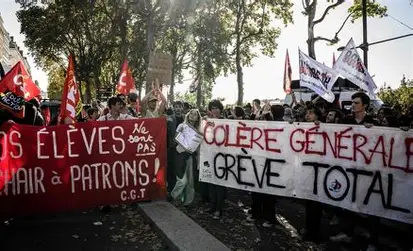
A France public workers strike brought tens of thousands of people onto the streets on Tuesday, as teachers, firefighters and healthcare staff marched in cities across the country to demand better pay. At the same time, separate student protests at schools turned chaotic, ending in clashes with police and hundreds of arrests.
The twin waves of unrest have added fresh pressure on President Emmanuel Macron’s government at a sensitive moment, just days before it presents its draft budget and months ahead of the next presidential election.
How Big Was the Strike?
The size of the turnout depends on who is counting. Unions said roughly 300,000 people joined the one-day walkout nationwide. Police estimated that about 30,000 people marched in Paris alone.
Beyond wages, workers also called for improved working conditions and voiced anger over the government’s plans to cut spending.
Official figures suggested participation was uneven across sectors:
- Just over 11 percent of teachers and other school staff went on strike, according to the Education Ministry
- Fewer than one in ten other civil servants took part
- Participation in hospitals was lower still
Losing a day’s wages likely kept many people from joining. The civil aviation authority had also warned travelers that some airports could face flight disruptions.
Why Workers Are Angry
At the center of the dispute is a proposed pay freeze. According to unions, the government wants to hold base salaries for state employees flat in 2027 in order to save around 2 billion euros.
If it goes ahead, it would be:
- The fourth salary freeze in a row
- The eighth since Macron took office
Unions argue that these repeated freezes have eaten away a double-digit percentage of workers’ purchasing power. They are now pushing for a 6 percent pay rise.
Teachers have particular reason to feel frustrated. On average, French teachers earn less than their colleagues in many other European countries.
Firefighters were also well represented at the marches. Many say the massive wildfires that swept parts of the country this summer revealed how stretched their resources have become.
The government has already rolled out support measures to help households deal with soaring energy prices, which have been pushed up by the US and Israeli war on Iran. So far, those efforts have done little to ease public frustration with Macron and his administration.
Unions Sound the Alarm
Sophie Binet, who leads the General Confederation of Labor, one of France’s largest unions, described the day of protest as a red alert for the government.
She warned that the anger would not simply fade away and urged ministers to rethink the budget. Binet gave the government 48 hours to drop the planned cuts before her union decides whether to launch further strikes.
Student Protests Turn Violent
While public workers marched, students were staging their own demonstrations at schools across the country.
Their complaints focused on everyday conditions in the classroom, including:
- Timetables
- Overcrowded classes
- Teacher shortages
- Classrooms that became unbearably hot during this year’s heatwaves
The protests started in the Ile-de-France region around Paris before spreading to other cities. In total, demonstrations took place at more than 400 schools. About 40 were fully blockaded, while attempts were made to block another 44.
In some places, the situation escalated. Students set rubbish bins on fire and threw objects at police, who responded with batons and tear gas.
The toll from the clashes included:
- 10 students and school staff injured
- 48 members of law enforcement hurt
- At least 440 people detained
Interior Minister Laurent Nunez said the final figures were still being counted but that around two thirds of those detained had been placed in police custody. He stressed that violence can never be justified under any circumstances.
Education Minister Edouard Geffray also condemned the clashes, calling the violence shocking and confirming that legal action had been launched. He argued that anyone excusing the violence or encouraging more blockades was putting both students and public employees at risk.
Voices From the Schools
Not everyone saw the protests as reckless. In Seine-Saint-Denis, a low-income suburb of Paris, local mayor Bally Bagayoko of the hard-left France Unbowed party joined hundreds of students outside the Lycee Paul-Eluard. He led them in singing the national anthem and described their protest as entirely legitimate, arguing that poorer neighborhoods receive fewer resources than wealthier ones.
In Paris, students at the Arago school, some with their faces covered, perched on dumpsters to block the entrance under a sign reading “Macron explosion.” At the Helene-Boucher school, a banner called for fewer police and more funding.
Mael Breton, a final-year student there, said young people feel heavily policed, both in school protests and in wider social movements. He argued this was especially troubling given the lack of money for his school and for the education system as a whole.
The Political Fallout
Prime Minister Sebastien Lecornu criticized the school protests as irresponsible on Monday. However, he also admitted that the problems facing high schools are real and need to be listened to and fixed.
Hard-left presidential hopeful Jean-Luc Melenchon seized on the moment. Speaking to protesters in Paris, he accused the government of gradually tearing down public services and called on his supporters to rally against the upcoming budget.
The unrest is unfolding with the presidential election about seven months away. A recent poll suggested that Melenchon and Marine Le Pen, leader of the far-right National Rally, would reach the second round of voting, with Le Pen currently in the stronger position to win.
What Comes Next
All eyes now turn to the draft budget, due in two days. Unions are waiting to see whether the government backs away from the pay freeze, while students continue to press for better conditions in their schools.
If ministers hold firm, further strikes and protests look likely. With public anger running high and an election on the horizon, the coming weeks could prove decisive for Macron’s government and for the political direction France takes next.
Author