The Azov Corps strikes Russian forces with renewed intensity four years after one of the most painful defeats of the war, and this time, the unit is determined to make Moscow pay for its occupation of Mariupol. Once forced to surrender the ruins of their home city, Azov’s fighters have rebuilt into a far larger and more sophisticated force, and they’re now turning their drones on the very port they were driven from.
A Symbol Reborn From Defeat
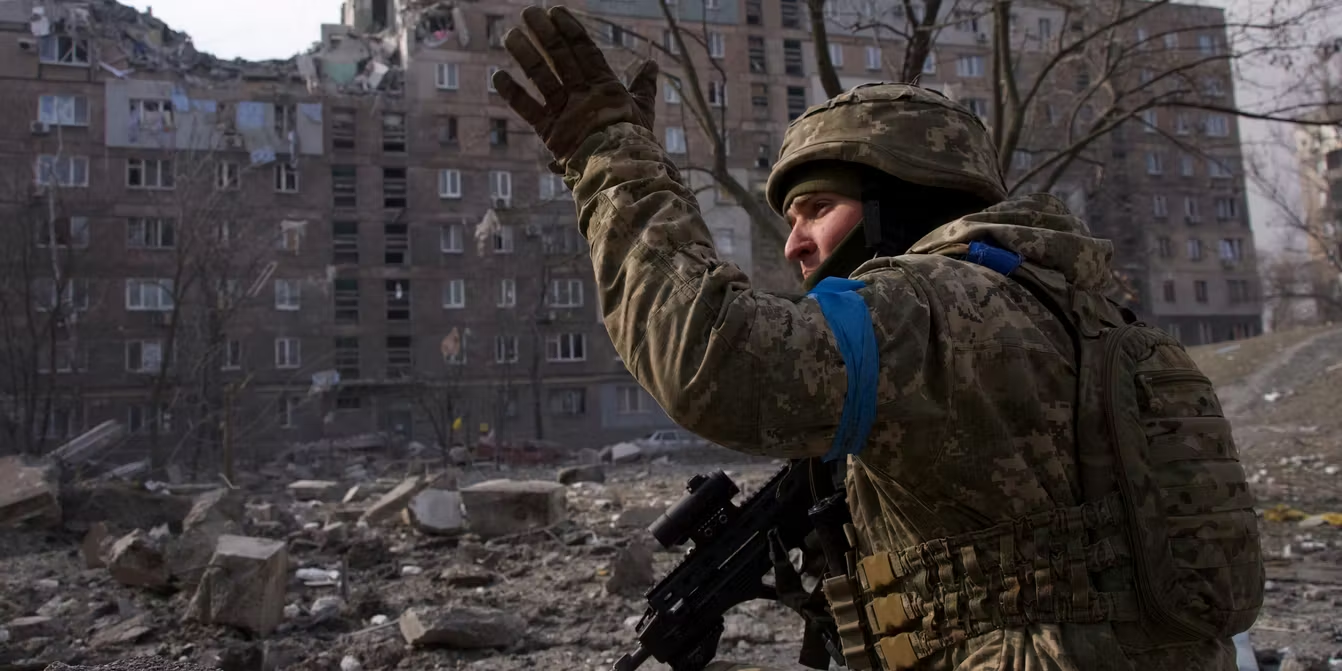
The story of Azov’s resurgence begins with tragedy. In May 2022, after a brutal three-month siege, the regiment surrendered the last sliver of Mariupol to Russian troops. Hundreds of fighters were killed or taken prisoner.
Yet that defeat didn’t break the unit, it transformed it. Azov became a powerful emblem of Ukrainian endurance, and its near-mythic reputation helped fuel its return as a stronger, better-equipped fighting force.
Today, the corps has its sights set firmly back on its home city along the Azov Sea.
Drones Over Mariupol’s Port
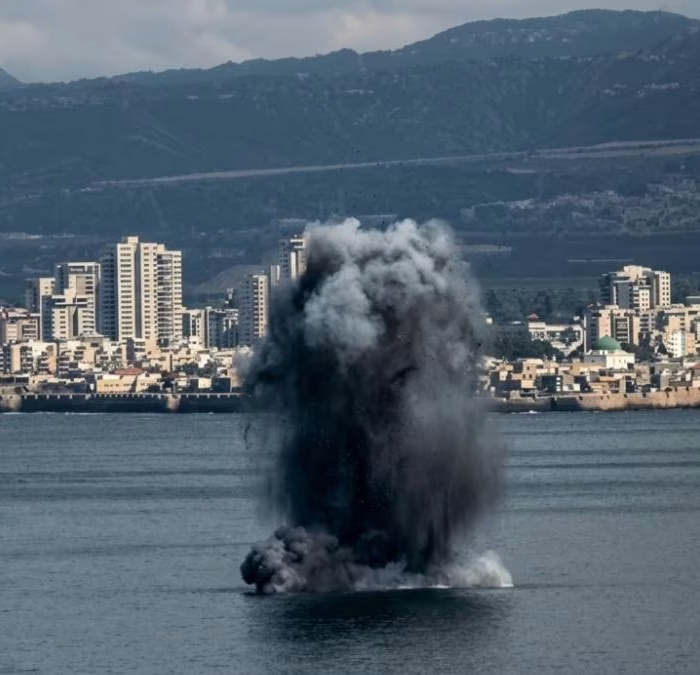
The clearest sign of Azov’s revival came last week, when drones belonging to First Corps Azov swept over Mariupol’s strategic seaport.
According to Ukraine’s military, the operation targeted:
- Electrical substations
- Ship repair facilities
- A sanctioned vessel docked at the port
The strike plunged the port into a blackout, and Reuters was able to verify the location shown in parts of a video posted by the corps. Notably, the attack landed just miles from the shattered Azovstal steel works, the site of Azov’s desperate last stand in 2022.
Part of a Bigger Strategy
This wasn’t an isolated act of revenge. The Mariupol port strike fits squarely within Ukraine’s broader campaign to dismantle Russian military logistics far behind the front lines.
The goal is simple but ambitious: grind down Moscow’s war machine by disrupting the supply lines that keep it running. Carried out alongside Ukraine’s drone forces and the SBU security service, the operation reflected a deliberate, systematic effort rather than a one-off attack.
Col. Arsen Dmytryk, First Corps Azov’s chief of staff, made clear that many more such operations are coming, designed to showcase the unit’s technology, planning, and capabilities.
A “Long Game” for Mariupol
Dmytryk, who was himself captured by Russia before later being freed, didn’t pretend that liberating Mariupol would be quick. The city sits roughly 120 kilometers behind front lines that have barely moved.
He described retaking it as a “long game,” vowing that Azov would spend as long as necessary planning and preparing. Even if it took two decades, he insisted, the unit would be ready when the moment arrived. For him, the return of Mariupol is not a question of if, but when.
Cutting Russia’s Critical Supplies
At the heart of Azov’s mission is a focused objective: choking off the flow of enemy cargo, especially fuel, moving through key hubs like Mariupol and Donetsk.
A corps drone officer explained why these supply routes are so vulnerable. Fuel tankers and supply trucks travel along vast, open roads with little cover, making them nearly impossible to hide or defend.
The targeted routes include:
- The M14, linking Mariupol with the Russian city of Rostov
- The H20, running north from Mariupol toward Donetsk
- A ring road encircling Donetsk
By repeatedly hitting these arteries, Azov aims to strangle the logistics that sustain Russian operations near the front.
Squeezing the Crimea “Land Bridge”
Azov’s efforts are part of a wider Ukrainian push against Russian logistics across the occupied “land bridge” connecting Russia to Crimea. These strikes have already triggered fuel shortages on the peninsula.
Ukraine’s top drone commander, Robert Brovdi, recently pledged to “isolate Crimea in the near future” by intensifying attacks on the key P-280 highway. The pressure on Russian supply networks appears to be mounting steadily.
Slow Pressure, Real Impact
Military analysts caution that Azov’s strikes are not instantly decisive, but they are far from meaningless.
According to Franz-Stefan Gady of the Center for a New American Security, the attacks are “cumulative rather than decisive.” They force Russian forces to:
- Disperse their vehicles
- Take longer detours
- Rely more heavily on risky night driving
Over time, Gady noted, this steadily erodes the offensive momentum Russia can generate on the battlefield.
This comes at a moment when Russia’s overall advance has slowed to a crawl, even as its forces close in on the city of Kostiantynivka. Some experts, like Rob Lee of the Foreign Policy Research Institute, suggest Ukraine’s mid-range strikes could eventually create conditions for Kyiv, and possibly Azov, to go on the offensive.
Cutting-Edge Technology
A major factor behind Azov’s effectiveness is its embrace of advanced drone technology. One of its primary weapons is the AI-assisted Hornet drone, produced by a U.S. defense-tech firm founded by former Google CEO Eric Schmidt.
Azov operators didn’t just use the drone, they improved it. By installing Starlink internet terminals, they extended the Hornet’s original 100-kilometer range, a modification that highlighted the unit’s technical ingenuity. Analysts credit Azov with driving many of the Hornet’s key enhancements.
Fighting to Bring Comrades Home
Beyond territory and logistics, Azov’s campaign carries a deeply personal motivation: freeing its captured fighters.
By pressuring Russian forces around Mariupol, the corps hopes to accelerate an end to the fighting that could secure the release of more than 700 of its members still held in Russian prisons. An all-for-all prisoner swap has become a central demand in Kyiv’s vision of any peace deal.
The unit’s heroic standing in Ukrainian society is reflected in frequent “Free Azov” rallies held across the country. For corps commander Denys Prokopenko, freeing his comrades remains a matter of personal honor.
From Volunteer Battalion to Elite Force
Today’s Azov bears little resemblance to its earlier incarnations. Once a scrappy volunteer battalion that helped push pro-Russian separatists out of Mariupol in 2014, and later a fragmented regiment in 2022, it has since evolved dramatically.
Now formally part of the National Guard, Azov is widely regarded as one of Ukraine’s premier fighting forces and among its most advanced in drone warfare. Over the past year, it expanded into a full corps comprising six brigades, a drone regiment, and a special-purposes unit, totaling tens of thousands of troops.
The Bottom Line
The way the Azov Corps strikes Russian forces today tells a remarkable story of resilience and reinvention. What Russia once sought to destroy has instead grown into a formidable, technologically advanced fighting force with its eyes fixed firmly on Mariupol.
As Dmytryk put it, Russian captors once vowed to destroy Azov again and again, yet somehow their efforts at “destruction” keep scaling the unit up instead. For Azov, the road back to Mariupol may be long, but their drones are already flying over its skies, a signal that, for them, the return is only a matter of time.
Author