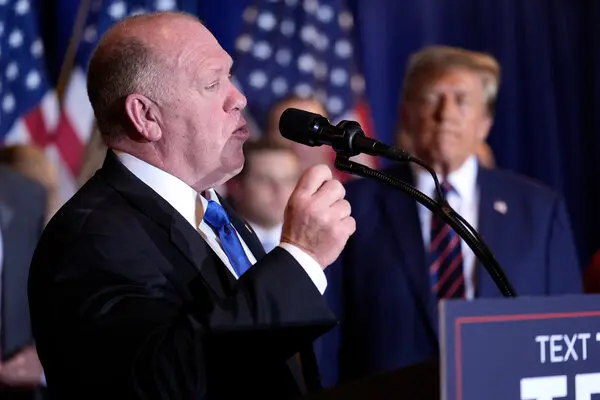
The debate over Tom Homan ICE criticism escalated Monday when the border czar told reporters he cannot buy groceries without a security detail, blaming what he called hateful rhetoric from Democrats and administration opponents.
Speaking outside the White House, Homan was visibly frustrated as he described the personal toll of overseeing the administration’s immigration enforcement.
What Homan Said
His central complaint was that critics have stripped ICE agents of their humanity, particularly by drawing comparisons to Nazis.
“Guys, ICE agents are moms and dads, too,” Homan told reporters. “They don’t hang your heart on a hook every day to do this job.”
He argued the criticism does not stop with the agents themselves, saying it extends to their spouses and children, and that nobody understands that better than he does.
Then came the line that drew the most attention.
“I can’t even go get a quarter of milk at a grocery store without a security detail. Why?” he asked, before answering himself: because he is enforcing the country’s laws.
He called the situation pathetic and disgusting, then walked away from the press gathering without taking further questions.
The Context He Left Out
Homan’s remarks landed against a backdrop he did not address directly.
He has overseen immigration enforcement since late January, when two United States citizens were killed by federal agents. That incident, and the operations that followed, have driven much of the public anger he was describing.
The gap between his framing and that context is essentially the entire dispute. Homan presented the hostility as unprovoked rhetoric aimed at ordinary public servants. His critics point to specific outcomes and argue the anger has a cause.
The Online Reaction
Response on social media was swift and largely unsympathetic.
The widely followed Wu Tang is for the Children account on X called him an unhinged lunatic. Another user simply labeled him a snowflake.
Others engaged the substance rather than the tone. One response argued that no previous official in Homan’s position had expressed similar grievances, attributing that to deportations and enforcement being carried out ethically and legally in the past. The same user told him to stop whining and said nobody feels sympathy for him or for agents deployed on the streets with what the poster described as minimal training.
Two Arguments That Don’t Meet
What makes this exchange unproductive is that the two sides are answering different questions.
Homan is making a claim about people. ICE agents have families, go home at night, and did not sign up to be treated as villains in public. Their children hear the rhetoric. That argument, on its own terms, is not unreasonable.
His critics are making a claim about policy. They contend that the enforcement approach itself, including the deaths of American citizens, is what generated the hostility, and that officials who direct such operations cannot then position themselves as victims of the reaction.
Neither argument refutes the other. They simply operate on separate tracks.
Why Security Details Matter Here
The detail about grocery shopping is doing significant rhetorical work, and it is worth examining.
Senior federal officials in contentious roles routinely receive protection. That is not new, and it is not evidence in itself that public criticism has crossed into genuine danger.
At the same time, threats against immigration officials have been documented, and agencies do not assign details casually. Whether Homan’s specific situation reflects real risk or standard precaution for someone in his position is not something his remarks clarified.
The Larger Pattern
This exchange fits a familiar shape in American political argument.
An official implementing a divisive policy describes the personal cost of doing so. Opponents respond that the cost is self-inflicted and considerably smaller than the cost borne by people affected by the policy. Both sides come away confirmed in their existing view.
What tends to get lost is any conversation about the underlying enforcement decisions, which is presumably where the actual disagreement lives.
Where This Goes
Homan gave no indication he intends to modify his approach, and his framing suggests he sees the backlash as evidence he is doing the job correctly rather than a reason to reconsider it.
His critics show no sign of softening either, particularly with the January deaths still driving much of the opposition.
The result is a stalemate that plays out in press scrums and social media threads while the enforcement operations continue on their own track, largely untouched by either.
Author