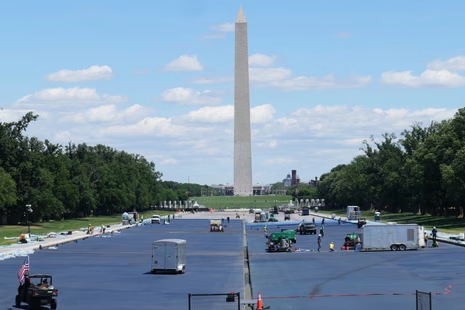
The Lincoln Memorial reflecting pool is filling with water once again after a controversial repainting project kept it closed for weeks — and to many of the visitors gathered along its edge, the much-hyped transformation is surprisingly hard to spot. The big question on everyone’s mind seems to be a simple one: what actually changed?
The reopening caps a saga marked by political fanfare, legal challenges, and lingering questions about cost — all over a coat of paint on one of Washington’s most iconic landmarks.
A Grand Promise, a Subtle Result
President Trump set high expectations earlier in the week. Speaking to reporters in the Oval Office on Wednesday, he predicted the pool would be completed by 4 o’clock, with water flowing in and the whole thing turning out beautiful.
The next day, Interior Secretary Doug Burgum shared a video showing water bubbling up through a grate on the freshly darkened pool floor. Trump had ordered the surface darkened to a shade he calls “American flag blue,” complaining that for the past century the pool had been just gray — the color of concrete and stone.
By Friday morning, the enormous 2,028-foot-long shallow pool had collected only a stripe of water down its center, just wide enough to reflect the Washington Monument standing across from it. The refilling continued under bright sun, with one worker standing mid-pool, pants rolled above his knees, wielding a hose.
Visitors Struggle to See the Change
As temperatures climbed toward 90 degrees, tourists, cyclists, and joggers paused at the top of the nearby steps to snap photos and watch the process unfold. Many welcomed the return of the water — and the ducks that play in it — but admitted they couldn’t immediately detect any difference in color.
Luisa Córdoba, a D.C. resident and dedicated runner who has been checking on the pool daily since work began, captured the prevailing sentiment. She noted that the more water filled in, the more it resembled its old appearance. Her main relief was that it no longer showed the alarming bright blue seen in the early days, concluding that if it stayed as it was, it would be fine.
Early renderings and the first preliminary coats of paint back in late April had stoked fears the historic landmark might end up looking like a swimming pool. But Friday’s onlookers largely didn’t see that outcome.
The reactions ranged from amused to skeptical:
- Terry Barzanti, a Maryland resident, joked that since he’s colorblind, it didn’t look blue to him — at least not yet.
- Edgar Sadsad, his coworker, laughed that he isn’t colorblind and it still didn’t look blue, describing it instead as more grey.
- Other passersby said it looked closer to black, suggesting the difference might become clearer once the pool fully refilled.
Despite the muted color change, Sadsad and Barzanti were among those who praised the project, saying the pool already looked cleaner and more appealing.
Why Trump Targeted the Pool
The president has complained for months about the pool’s condition. He claims he made it a priority after an unnamed friend visiting from Germany called it “filthy” and “not representative of the country.”
The pool, which first opened in 1923, last underwent major renovations between 2010 and 2012. Even so, it has continued to suffer from broken pipes and water leaks requiring costly refills, according to the Department of the Interior.
Trump has said the project sealed crevices in the stone to prevent leaks and removed 12 truckloads of garbage from the pool, though it remains unclear whether the broken pipes were actually addressed. He confidently predicted the work would last 50 to 100 years before anything more needed to be done.
A Timeline and Budget That Slipped
The reality of the project diverged sharply from Trump’s initial promises on both schedule and cost.
In late April, Trump estimated the work would wrap up in a week or two. The Department of the Interior, however, told NPR it would take closer to a month — and that proved nearer the mark.
The legal landscape added further complications. In mid-May, the nonprofit Cultural Landscape Foundation sued the administration to halt the work, arguing it had bypassed federally required historic preservation reviews. A judge heard arguments later that month but had not yet ruled by the time the administration informed the court on Wednesday that the work was finished.
The financial picture raised even sharper questions. Trump put the price tag at $2 million, which he claimed — without specifics — was significantly less than he’d been quoted before. But Interior Department records obtained by The New York Times show the administration plans to pay $13.1 million to Atlantic Industrial Coatings, the Virginia firm Trump selected for the job.
Where Is the Money Coming From?
The funding source remains murky, and not everyone is pleased about it. Samantha Sorokin of Arlington, Virginia, taking her parents on a tour, lamented that it was sad to see where tax dollars were going, noting the pool seemed fine to her before.
A large sign on the construction fence, printed on National Park Service letterhead, told visitors that the improvements were being completed using “your fee dollars.” That detail carries added weight given recent reporting: The Washington Post revealed this week that the administration is diverting at least $90 million from national park entry fees to fund its July 4th fireworks display and other D.C. beautification efforts.
When NPR asked about the cost and funding, the Department of the Interior said it has many funding sources available for deferred maintenance. An unnamed spokesperson took a swipe at the previous administration, contrasting Trump’s approach — which the spokesperson said includes endowment funds and revenue from park pass sales — with how Barack Obama spent recession recovery aid. For context, that earlier two-year renovation ending in 2012 was funded by $34 million from an Obama-era economic stimulus package.
Part of a Bigger Beautification Drive
The reflecting pool is just one piece of Trump’s sweeping campaign to spruce up Washington. His ambitions range from massive undertakings to smaller touches, including:
- A proposed triumphal arch, which received preliminary approval from a second federal agency this week
- New statues installed around the city
- Restored park fountains
Trump declared Wednesday that the city’s many monuments and fountains were just about completed. The White House has touted specific accomplishments, including 500 instances of graffiti removed, 134 rat-resistant trash cans installed, and 250 truckloads of debris cleared from ponds.
Much of this work is being carried out by National Guard troops deployed to D.C., whose numbers are set to double ahead of the nation’s 250th birthday celebrations around July 4th — the deadline driving many of these projects.
Mixed Feelings Among Locals
Opinions on whether the anniversary justifies such efforts are divided. Maria Sorokin, visiting her daughter from Pennsylvania, voiced doubt about the reflecting pool resurfacing. She acknowledged the special anniversary warranted some sprucing up but wasn’t convinced this particular project was necessary, offering the timeless caution: if it’s not broken, don’t fix it.
Others embraced the cleanup wholeheartedly. Barzanti, who walks down for lunch breaks, argued that since people come from all over the world to see the nation’s capital, the city should show it off and take care of it.
The Fountains Win Hearts
While the reflecting pool drew lukewarm reactions, some of Trump’s other water projects have been received far more warmly. Several locals, including Córdoba, expressed delight at seeing the fountains at Meridian Hill Park — about 1.5 miles north of the White House — flowing for the first time in seven years.
Maryellen Thornton, who lives near that park, described the fountain restoration as amazing for the community, comparing the picnic-packed grass to “nirvana.” It was part of what drew her and her husband, Brad Thornton, to come see the reflecting pool too. She marveled at how wonderful it was to have these water features restored across the district, saying it brings happiness to everyone.
Brad echoed that enthusiasm, looking forward to water returning to the fountain outside Union Station as well. For him, the appeal transcends politics. He said a little spraying water goes a long way, and that it shouldn’t be about politics at all — just about enjoying the green space a city needs.
The Takeaway
As water slowly creeps across the darkened floor of the Lincoln Memorial reflecting pool, the project stands as a small but telling snapshot of a larger moment in Washington. It’s a story of grand presidential promises meeting subtle real-world results, of ballooning costs and murky funding, and of a public that can’t quite agree on whether any of it was needed.
For now, the verdict from the pool’s edge is decidedly mixed — a shrug more than a cheer. Whether the new “American flag blue” ultimately reveals itself as the water rises, or simply blends back into the familiar gray of memory, remains very much in the eye of the beholder.
Author