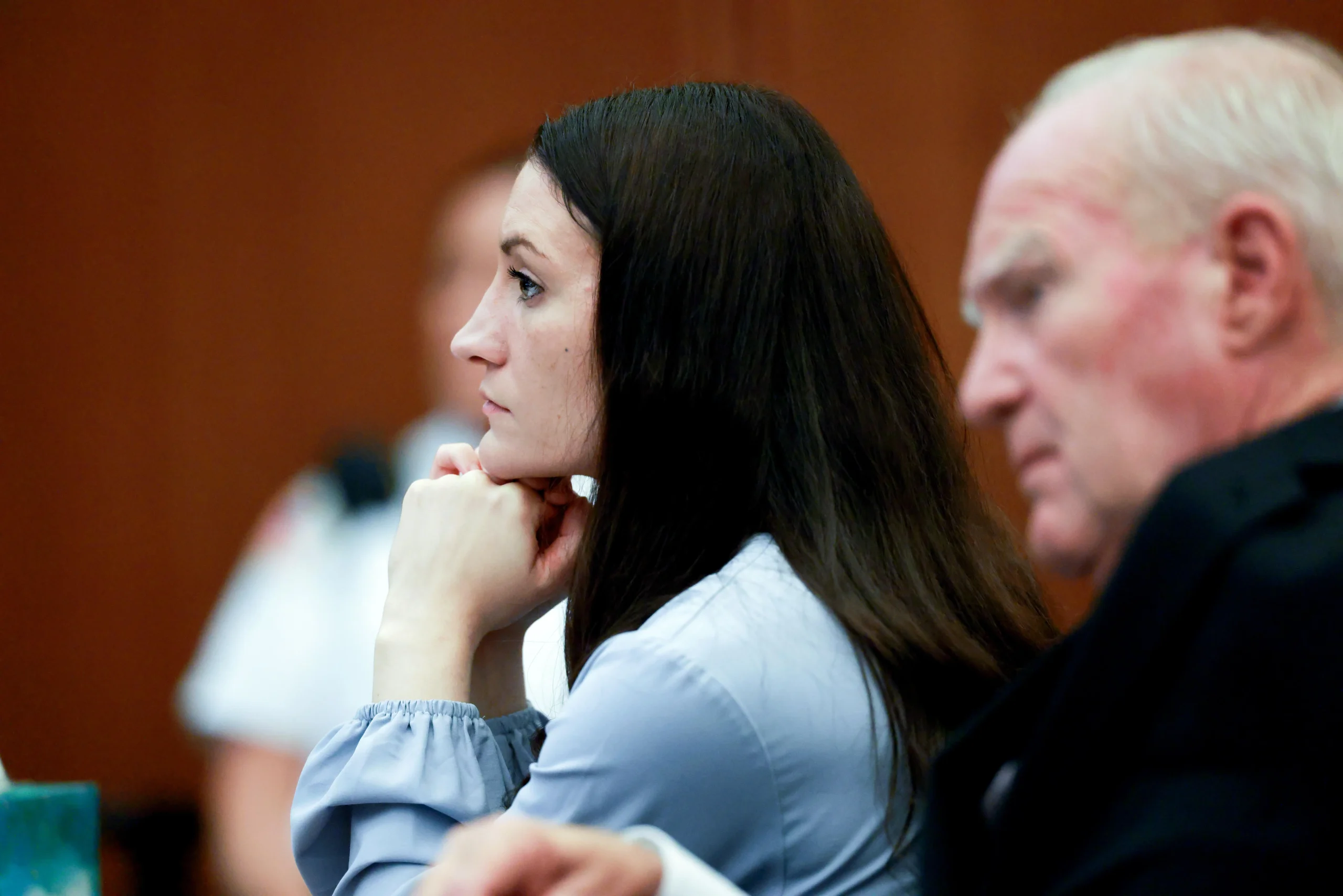
The Lindsay Clancy trial reached one of its most difficult stretches Wednesday, as medical examiners took the stand to describe the autopsies performed on two of her children and the defendant broke down repeatedly in court. The judge called several recesses to allow her to compose herself.
The day also produced a contested piece of testimony about how prosecutors believe a key element of the defense narrative came to exist.
What the Case Alleges
Prosecutors say that on January 24, 2023, Clancy, now 36, sent her then-husband Patrick out of the house on errands and then strangled the couple’s three children.
The children were Cora, aged five, Dawson, aged three, and Callan, eight months old.
After the killings, Clancy went out a second-story window of the family home. She survived the fall but was left paralyzed from the waist down.
The defense does not contest that she caused the deaths. Its position is that she was in the grip of severe mental illness at the time, specifically bipolar disorder and postpartum psychosis, and therefore should not be held criminally responsible under Massachusetts law.
That single question, criminal responsibility rather than physical causation, is what the entire trial turns on.
The Trooper’s Testimony About a Prosecution Theory
One of the more consequential moments came from a Massachusetts State Police trooper, who told the court about information conveyed to him by the lead investigator in the case.
According to that testimony, prosecutors have advanced a theory that a doctor instructed Clancy to tell her husband she had been hearing voices.
The implication is significant. If jurors accept that framing, the reported auditory hallucinations, one of the most striking symptoms cited in support of the psychosis defense, could be recast as something she was coached to say rather than something she independently experienced.
The defense is expected to challenge that interpretation, and the testimony arrived secondhand rather than from the physician involved. How much weight it ultimately carries will depend on what corroborating evidence follows.
An Emotional Session in the Courtroom
The autopsy testimony was, predictably, the hardest portion of the day.
As two medical examiners walked through their findings on two of the children, Clancy wept openly. The judge interrupted proceedings on multiple occasions to allow her time.
Autopsy testimony in a case like this serves a narrow legal function. It establishes cause and manner of death with clinical precision. But it does so in front of a jury, a courtroom of observers, and family members, using language that strips away any softening.
Judges managing these sessions generally try to balance the prosecution’s right to present its evidence fully against the risk that visible distress from a defendant becomes prejudicial in either direction, sympathetic or performative depending on who is watching.
Who Else Testified
Wednesday’s witness list was varied, reflecting a prosecution assembling multiple strands at once.
Alongside the trooper and the two medical examiners, the jury heard from a therapist, a Duxbury police officer, and a manager from a sheriff’s office.
That mix suggests the prosecution is covering three distinct areas simultaneously: the physical and forensic evidence, the mental health treatment history that the defense relies on, and the response and custody chain that followed.
Therapist testimony is particularly sensitive in a case built around a mental illness defense. Both sides tend to mine clinical records intensively, because contemporaneous notes made before any legal stakes existed often carry more credibility with juries than expert opinions formed afterward.
Where the Trial Stands
The prosecution is approaching the end of its case in chief. The judge has noted that proceedings are running on schedule or slightly ahead of it.
Once the state rests, the defense will begin presenting its own evidence, which in a criminal responsibility case typically centers on expert psychiatric testimony and detailed reconstruction of the defendant’s mental state in the weeks and days beforehand.
The Legal Standard at Issue
Massachusetts uses a lack of criminal responsibility standard rather than the phrase insanity defense, though the concepts overlap in public discussion.
Broadly, the defense must establish that as a result of mental disease or defect, the defendant lacked substantial capacity either to appreciate the wrongfulness of her conduct or to conform her conduct to the requirements of law.
Two points about that standard are often misunderstood.
First, having a diagnosed mental illness is not sufficient on its own. The illness must have impaired capacity in one of the specific ways described.
Second, evidence of planning or awareness, such as arranging for someone to be out of the house, is frequently used by prosecutors to argue that capacity was intact. Defense experts commonly respond that psychosis does not eliminate the ability to sequence actions, and that organized behavior can coexist with a profoundly distorted grasp of reality.
Both arguments are likely to feature heavily in this trial.
Why the Case Draws Such Attention
Beyond the horror of the facts, the case has become a focal point in a wider public conversation about maternal mental health.
Postpartum psychosis is rare but genuinely severe, and it is distinct from postpartum depression. It can involve hallucinations, delusions, and rapid fluctuations in mental state, and clinicians generally treat it as a psychiatric emergency.
Advocates have used the case to press for better screening and faster access to care. Others caution against allowing a diagnosis to become an explanation for every outcome, and emphasize that three children died.
The jury is not being asked to resolve that societal debate. It is being asked a narrower question about one person’s mental state on one day.
What Comes Next
Testimony continues as the prosecution finishes presenting its evidence. The defense case will follow, and the psychiatric expert testimony on both sides is likely to be the decisive stretch of the trial.
This coverage involves child deaths and severe mental illness, which many people find hard to read about. If any of it resonates personally, I’m glad to help you find appropriate support.
Author
-
Lucienne Albrecht is Luxe Chronicle’s wealth and lifestyle editor, celebrated for her elegant perspective on finance, legacy, and global luxury culture. With a flair for blending sophistication with insight, she brings a distinctly feminine voice to the world of high society and wealth.