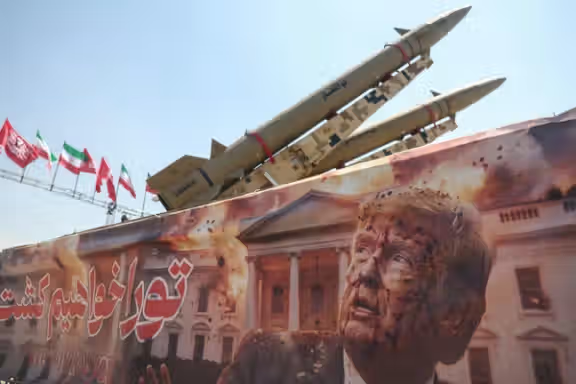
Iran’s economic crisis has reached a point where the country’s president is describing it publicly and without much cushioning. In a Friday interview with state media, Masoud Pezeshkian listed the pressures stacking up on ordinary Iranians and made a remark that has drawn attention well beyond Tehran: that missiles and bombs, whatever the country possesses, are of no use.
The comment landed while American forces tighten a naval blockade on Iranian trade and simultaneously work to reopen the Strait of Hormuz to everyone else.
What Pezeshkian Said
His tone mixed candour with defiance. He acknowledged that the country faces many problems, citing inflation, broader economic difficulties and unemployment, while insisting that the public remains behind the government.
He attributed Iran’s endurance to national unity rather than to any improvement in conditions.
The line about weaponry appeared to be aimed inward, at hardliners who reject talks with Washington and prefer continued confrontation. Coming from a sitting president during wartime, it was an unusually direct concession that military capability is not translating into leverage.
The Numbers Behind the Admission
The economic picture supports his framing.
- Inflation has climbed past 80 percent
- Prices for some food staples have doubled
- The IMF projected in April that the economy would contract 6.1 percent this year, the sharpest decline in decades
- A labour ministry official estimated more than one million jobs lost by late May
- Pezeshkian himself put the drop in overall trade at between 25 and 35 percent, with imports falling considerably more than exports
Trade intelligence firm Kpler recorded an even starker figure on the export side, reporting that August crude loadings collapsed by more than 80 percent compared with the same month last year.
Addressing sceptics at home, Pezeshkian said he did not know how to respond to those claiming sanctions have no effect, adding only that such a claim does not square with the facts.
Fuel Shortages in an Oil-Producing State
One of the sharper ironies of the blockade is what it has done to Iran’s fuel supply. The country exports crude but depends on imported refined products, and the blockade has choked both directions.
Pezeshkian confirmed that imports, including gasoline, are not arriving. The result has been shortages and lengthy queues at filling stations, worsened by heavy subsidies that encourage consumption well above what supply can sustain.
He described attempts to reduce demand and raise prices, but signalled clear limits to how far the government can push. He said the state should not inflict suffering on people whose daily lives revolve around fuel, and warned that the public is already at the edge. Additional pressure, in his words, risks pushing people over it.
That is an unusually explicit acknowledgment of political fragility, and it explains why price reform has stalled.
The Blockade in Practice
Central Command described the scale of enforcement on Friday. Since the blockade was reimposed, US forces have:
- Redirected 82 commercial vessels
- Disabled three
- Boarded two
The effect has been to isolate Iranian ports while leaving other traffic largely untouched.
Hormuz Is Reopening Without Iran
The second half of the American strategy has been to strip Iran of its ability to close the waterway at all.
Central Command announced last week that forces had finished clearing sea mines from the strait’s international shipping lanes. On Sunday, US forces struck Iranian rocket launchers that were being readied to deploy fresh mines.
Traffic has responded. Estimates differ, but the direction is consistent:
- Goldman Sachs puts total regional crude and product exports at 15 to 16 million barrels a day
- Kpler assesses Persian Gulf flows at roughly 70 percent of pre-war levels
- US officials told Axios that about 10 million barrels a day now move through the Omani corridor under American protection
A two-week bombing campaign last month degraded Iranian radar and maritime surveillance, according to reporting on the effort. That has allowed tankers to transit at night with transponders switched off, running shuttle trips and transferring cargo to other vessels that carry it on to buyers.
Iran continues to attack shipping, but the attacks have not been sufficient to halt the flow.
Was July a Miscalculation?
Gregory Brew, who covers Iran and oil at the Eurasia Group, offered a blunt assessment on Friday. He argued Iran overplayed its position in July by resuming attacks on shipping along the strait’s southern route.
The consequences, as he described them, were that the understanding governing traffic collapsed, the blockade returned, and the United States is now succeeding, at least partially, in reopening the strait without needing a new agreement.
He allowed that circumstances could shift back in Iran’s favour, but said the July decision currently looks like an error.
Where This Leaves Tehran
The strategic problem facing Iran is straightforward and difficult to escape. Its main source of pressure was the ability to threaten global energy flows through Hormuz. As that threat erodes, its leverage erodes with it, while the economic damage from the blockade continues accumulating at home.
Pezeshkian’s remarks reflect a leadership weighing two unappealing options: hold the current course as inflation and shortages deepen, or move toward negotiation from a visibly weaker position than a year ago.
Neither path is comfortable, which is likely why a president chose to say out loud that the country’s arsenal is not solving the problem in front of it.
Author