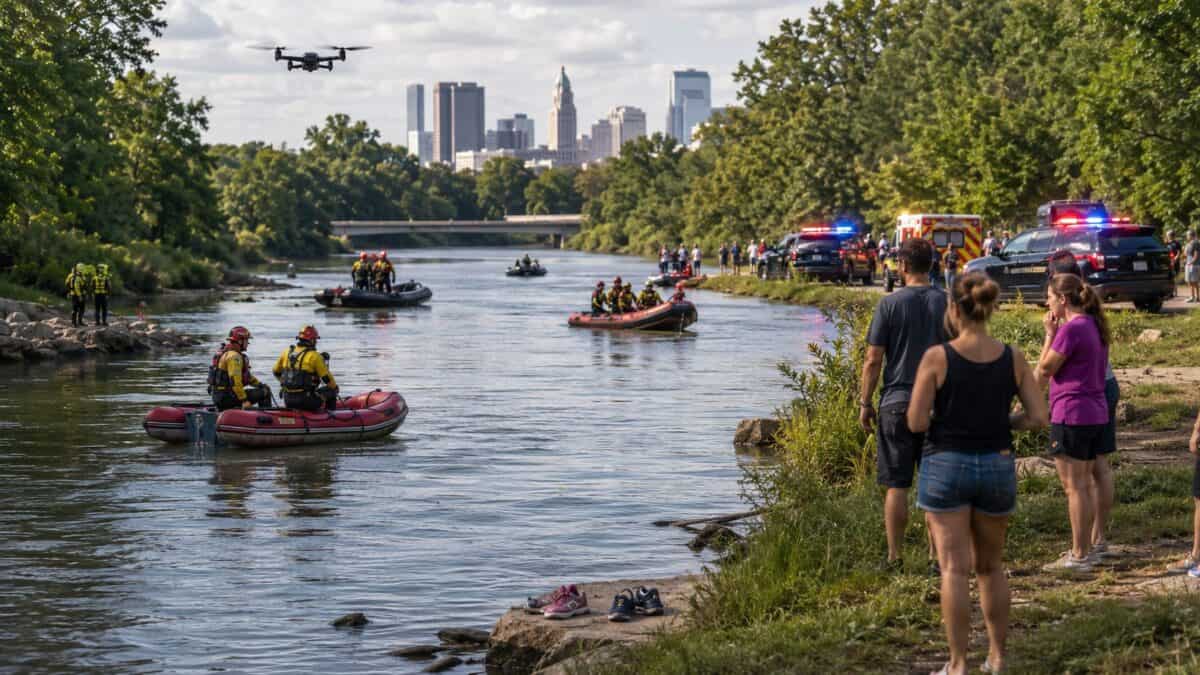
A Scioto River drowning in suburban Ohio has claimed five lives after a group of people entered the water trying to save someone who was struggling to swim, authorities said Monday.
All five who went in to help died. The person they were trying to reach was among them.
How the Alarm Was Raised
The rescue effort did not begin with a call from the scene. It began with a child running down a road.
Delaware County Sheriff Jeffrey Balzer told reporters Monday that a passing motorist spotted a frightened child who had been with the group and was running along a nearby roadway. The driver called 911.
Two children under the age of 10, including the one who ran for help, have since been placed in the care of family services.
What Happened at the River
The group had gathered Sunday along the Scioto River in Powell, a suburb north of Columbus.
One person entered the water to swim.
“And that’s when the tragedy started to occur,” Balzer said.
As that swimmer began struggling, others went in after them. Then they began struggling too.
The Recovery
Rescue crews searching the water Sunday located two women. Both were pronounced dead at a hospital.
The search continued into Monday, when the bodies of three men were recovered from the river, according to Tracy Whited, a spokesperson for the Delaware County Sheriff’s Department.
Authorities have not publicly identified the victims or described their relationships to one another.
Why Rescue Attempts Turn Deadly
The pattern that unfolded on the Scioto is tragically well documented, and water safety experts have a name for it: multiple-victim drowning, or the drowning chain.
The mechanics are brutal in their simplicity:
- A swimmer gets into trouble, often from current, cold water shock or fatigue
- Someone nearby enters the water without a flotation device
- A panicking person in the water instinctively grabs and climbs on their rescuer
- The rescuer is pushed under and now needs rescue themselves
- Additional bystanders enter and the cycle repeats
Rivers compound the danger. Unlike pools, they carry current, uneven depth, submerged debris and sudden drop-offs that are invisible from shore. Water that appears calm on the surface can be moving substantially beneath it.
What makes these events so painful is that the people who die are almost always acting on the best instinct a person has. Watching someone drown and doing nothing is not something most people are capable of.
What Safety Officials Recommend
The guidance from lifeguard and water rescue organizations is consistent and counterintuitive: do not enter the water.
The standard advice is to reach, throw, or row rather than go. That means extending a branch, a pole or an oar, throwing anything that floats, or using a boat if one is available. Calling 911 immediately, as the motorist did here, remains the single most useful action a bystander can take.
None of this is easy to remember in the moment. It is offered less as criticism of anyone than as information worth having before it is needed.
A Difficult Stretch
The Ohio deaths came two days after five members of a single family were killed in southern Utah, when a flash flood tore through canyons during a hiking trip.
Two separate incidents, two different states, five lives lost in each. Both involved water moving faster and more powerfully than anyone anticipated.
What Remains
For the families connected to the Scioto River group, the immediate reality includes two young children now in the care of family services, one of whom did the only thing available to a child in that situation and ran for help.
That child’s actions brought emergency crews to the river. It was not enough to change the outcome, but it was everything a person that age could have done.
Authorities have not indicated whether any further investigation is planned. In most cases like this, there is nothing to investigate. There is only a stretch of river that looked safe enough on a summer Sunday, and a group of people who did what people do when someone is drowning.
Author