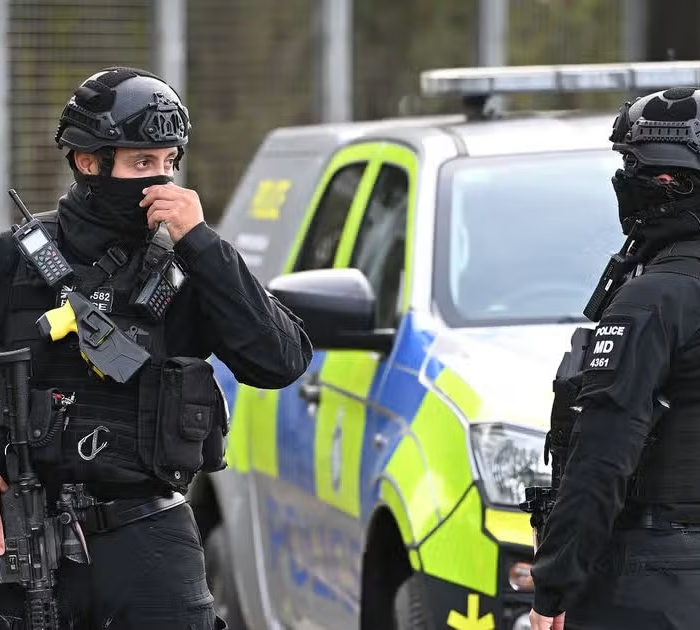
The latest round of Los Angeles sex-trafficking arrests has delivered a significant blow to a criminal operation that authorities say preyed on dozens of vulnerable young girls and women. On Wednesday, California officials announced that ten people had been taken into custody as part of an ongoing effort to root out trafficking along the notorious Figueroa corridor, a stretch of the city long plagued by such crimes.
A Coordinated Strike Against Exploitation
According to a news release from prosecutors, the ten individuals stand accused of facilitating a sprawling trafficking scheme that targeted roughly 51 underage girls and women. The operation, they say, was tied to a south Los Angeles street gang known as the Hoovers.
Investigators allege that members and associates of the gang operated as pimps, luring victims into sex work over a period stretching from February 2021 through June 2026. Many of those targeted were especially defenseless, including runaways and children in the foster system. The recruiters, prosecutors claim, relied on two chilling tactics:
- False promises of a better, more stable life
- Outright violence and intimidation
That combination of deception and brutality allowed the operation to trap victims who often had few places to turn for help.
Disturbing Allegations Against the Accused
Some of the accusations detailed by authorities are especially harrowing, painting a picture of cruelty aimed at controlling and silencing victims.
One defendant, 23-year-old Cameron Lockett, allegedly assaulted a victim so savagely in November 2024 that he bit off a portion of her cheek. After the attack, authorities say, he took her to a hospital for treatment but then pressured her to lie to police about how she had been injured, an apparent effort to conceal his role.
In another case, 26-year-old Caleed Mouton is accused of arranging an abortion for an underage trafficking victim in July 2025, then ordering her to return to sex work that very same day. The callousness of that alleged demand underscores the kind of exploitation prosecutors say defined the operation.
The scheme also reportedly depended on people willing to provide it cover. Mukeshkumar Ahir, the 45-year-old manager of the Stadium Inn & Spas, faces charges for allegedly profiting from the enterprise. Authorities say he reserved rooms for the illegal activity and pocketed more than $64,000 in the process, effectively turning his motel into a hub for the trafficking.
Officials Vow to Reclaim the Corridor
Law enforcement leaders framed the arrests as part of a broader mission to restore safety and dignity to the community.
Bill Essayli, first assistant U.S. attorney, expressed hope that the operation would help break the cycle of crime and abuse in one of the city’s most infamous trafficking zones. His words reflected a desire not just to punish offenders but to disrupt the conditions that allow trafficking to persist.
Los Angeles Police Chief Jim McDonnell echoed that sentiment forcefully. He said authorities were dismantling the criminal networks that profit from human trafficking, rescuing those who had been victimized, and working to reclaim the Figueroa corridor for a community he said has always deserved far better.
If convicted, the defendants face severe consequences, with potential sentences ranging from 15 years to life in prison.
A Corridor With a Troubled History
The Figueroa corridor is no stranger to law enforcement attention. Running roughly four miles from north to south, the area has repeatedly drawn scrutiny because of persistent sex-trafficking activity that has proven difficult to stamp out.
This week’s arrests are only the most recent chapter. Last year, authorities charged 11 other individuals connected to the Hoover gang with sex-trafficking crimes. Among them was 25-year-old Amaya Armstead, described by officials as the group’s de facto leader. That case is still working its way through the courts, with a trial scheduled to begin next March.
The recurring nature of these operations highlights just how entrenched the problem has become and how much effort it takes to make lasting progress.
The Challenges Behind the Crackdown
Beyond the arrests themselves, the situation reveals deeper obstacles that have complicated efforts to combat trafficking in the area. Several factors have reportedly weakened law enforcement’s ability to respond over the years.
Budget cuts in 2021 significantly reduced the resources the Los Angeles Police Department could devote to fighting human trafficking. With fewer tools and less funding, officers found it harder to mount the kind of sustained pressure needed to dismantle these operations.
Legal changes added another layer of difficulty. According to reporting, the repeal of a law that had allowed police to arrest people loitering for the purpose of sex work made it harder for officers to intervene and reach trafficked minors. Supporters of that repeal, including state senator and congressional candidate Scott Wiener, argued that the original law enabled discriminatory treatment of people of color and transgender communities.
That tension illustrates the complexity of the issue. Efforts to prevent discrimination and protect marginalized groups can, in some cases, intersect with the practical challenges of stopping exploitation, leaving officials to navigate difficult trade-offs.
Why These Arrests Matter
The significance of this operation extends well beyond the ten individuals now in custody. Each case represents an attempt to protect some of the most vulnerable members of society, young people who were manipulated, coerced, or forced into unimaginable circumstances.
For the surrounding community, the arrests offer a measure of hope that a long-suffering neighborhood might finally see meaningful change. The Figueroa corridor has carried the weight of this reputation for years, and every successful intervention chips away at the networks that have exploited it.
At the same time, the case serves as a sobering reminder of how persistent and adaptable trafficking operations can be. Dismantling one network does not guarantee the end of the problem, especially in an area with such a deeply rooted history.
Looking Ahead
As the legal process unfolds, prosecutors will work to hold the accused accountable while continuing broader efforts to secure the corridor. The upcoming trial of the previously charged Hoover gang members next March will likely keep attention fixed on the region and its ongoing struggles.
For now, authorities are treating these arrests as a step forward, one that they hope will rescue victims, deter future offenders, and slowly reclaim a community that has endured too much for too long. The road ahead remains challenging, but each operation signals a refusal to let these crimes go unchallenged.
This article discusses sex trafficking and abuse involving minors, which some readers may find distressing. If this topic affects you personally, reaching out to a trusted person or a local support service may help.
Author