The Custard Apple Revolution: How a Drought-Resistant Fruit Is Transforming Indian Farming
Custard apple farming is quietly reshaping the fortunes of growers across India, turning a once-overlooked wild fruit into a profitable, climate-friendly crop with global appeal. Behind this transformation are determined farmers and dedicated scientists who saw potential where others saw only a thirsty, struggling agricultural sector.
From AI Engineer to Custard Apple Farmer
Ashoka Shivareddy grew up in a farming family in Kolar, a district in southern India known for its harsh, drought-stricken landscape. Generations of his relatives tried to coax crops from soil that received barely 60 to 70 centimetres of rainfall a year. The family drilled borewells reaching depths of 1,300 feet, sinking their savings into the endless chase for groundwater.
By 2005, the financial strain forced them to walk away from farming entirely. They moved to Bengaluru and opened a vegetable shop, and Shivareddy went on to build a career as an AI software engineer. Yet the pull of the land never quite left him.
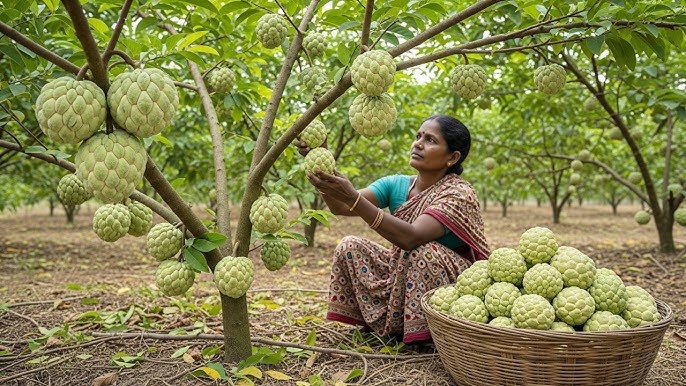
In 2018, he returned to his roots with a new mission. This time, however, he wanted to approach farming with the same analytical mindset he brought to his tech work. He needed a crop tough enough to thrive without constant irrigation, resistant to pests, and capable of growing on rainfall alone. The custard apple, a knobbly green fruit roughly the size of a large avocado with creamy, sweet flesh, fit the brief perfectly.
Why the Custard Apple Works
Locally, custard apple trees had always grown wild across Shivareddy’s region. Villagers would gather the fruit and sell it in nearby markets, which signaled clear commercial potential. He planted trees closer together than usual to boost yield per acre and carefully chose three different varieties, each offering its own strengths.
The strategy paid off. His harvest jumped from around 20 tonnes one year to roughly 25 tonnes the next, and domestic and international demand has been climbing steadily.
Challenges of Growing Custard Apple
Despite its resilience, custard apple farming comes with real hurdles. Traditional varieties such as Balangar offer wonderful flavour but spoil within three or four days of harvest, leaving farmers little time to sell. They are also packed with seeds and produce limited edible pulp, which puts off many buyers.
Dr Sakthivel T, principal scientist at the Indian Institute of Horticulture Research in Bangalore, explains that classic varieties suffer from poor pulp recovery, high seed counts, and short shelf life. To address this, his team developed a hybrid known as Arka Sahan. This newer variety stays fresh for up to a week at room temperature, contains fewer seeds, and offers far more pulp.
The numbers tell a striking story. Wild custard apples typically yield about 30 percent usable pulp, while hybrids like Arka Sahan reach 70 percent. That improvement essentially doubles the harvest’s value without requiring additional land.
Researchers are now tackling another issue: custard apple pulp tends to brown quickly once extracted. Scientists at IIHR are experimenting with new processing techniques to help the pulp retain its creamy colour, opening the door to wider use in ice creams, milkshakes, and other processed foods.
Maharashtra Leads the Way
The central Indian state of Maharashtra produces nearly a third of the country’s custard apples, making it the unrivalled leader in cultivation. One of its most influential farmers is Navnath Malhari Kaspate, who has spent decades experimenting with seeds collected from across the country.
His patient cross-pollination work eventually produced the NMK-01 variety, named after his initials. Released in 2014, it has become one of the most prized custard apples in India. Kaspate now cultivates the fruit across nearly 50 acres, harvesting around 10 tonnes per acre. More importantly, the variety’s improved shelf life unlocked export markets that were previously out of reach, including the Gulf nations and parts of Europe.
He continues to push the boundaries, currently working on a version with better appearance and stronger resistance to disease. As he puts it, developing a new variety can take 12 to 15 years of relentless experimentation.
Exporting a Delicate Fruit
Manoj Kumar Barai is among the entrepreneurs taking NMK-01 to international markets such as the United States, UAE, Saudi Arabia, and Europe. He prefers this variety because of its thicker skin, sweeter taste, longer shelf life, and superior pulp content.
Yet shipping such a sensitive fruit halfway across the world is no easy task. Every step must be carefully timed, from picking and packing to airport transfers and customs clearance. Heat is the biggest enemy. In Maharashtra, where temperatures can climb above 40 degrees Celsius, even brief exposure during transport can ruin the fruit.
To manage this, the harvest is pre-cooled for around five hours before being loaded into refrigerated vans. Road journeys are often scheduled overnight, and specially designed corrugated boxes help maintain low temperatures during transit.
The Rise of Custard Apple Pulp
A growing share of exports now travels in the form of pulp or powder, which Barai describes as a revolution for the industry. Although the pulp must be kept frozen at -18 degrees Celsius, this method allows larger volumes to be shipped affordably without spoilage. Overseas ice cream brands, bakeries, and even speciality “pulp-shot” cafes are increasingly using it.
Back in Kolar, Shivareddy is planning his own pulp processing facility to use fruit that cannot be sold whole. Still, he notes that custard apple farming sits in an unusual place. Demand is climbing fast, yet because the crop is naturally hardy and needs little water, many farmers have not embraced high-tech tools.
For now, this humble, custard-flavoured fruit is proving that resilience and innovation can coexist beautifully on the same farm.
Author