Thirteen Warehouses in Two Weeks: Ukraine’s Campaign Against Russia’s Amazon
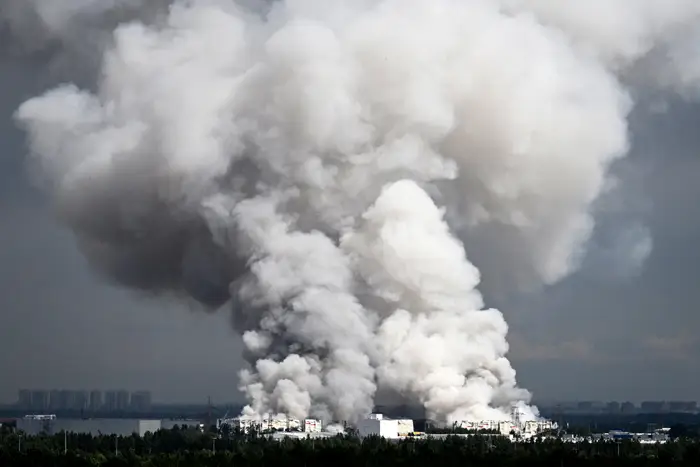
Two more Wildberries warehouses burned overnight into Thursday, hit by Ukrainian drones in the Penza region and in Sarapul, in the republic of Udmurtia. The company and regional officials confirmed both fires.
They are the latest in a campaign that began on July 18 and has now touched somewhere between a dozen and thirteen facilities belonging to Russia’s largest online retailer — a company routinely described as the country’s answer to Amazon.
What Happened Overnight
In the Penza region, Governor Oleg Melnichenko said one person was injured and around 200 people were evacuated. Reports described fire spreading across tens of thousands of square metres at a facility that functions as a main sorting node for the Volga region and represents only the first phase of a complex designed to be roughly twice the size.
At Sarapul, more than a thousand kilometres from Ukrainian territory, Wildberries said staff had been evacuated in advance after an air raid alert and that no casualties were reported. Olga Abramova, who heads Udmurtia, confirmed emergency services were responding. Authorities closed a section of highway near the site.
The company said deliveries were being rerouted through other facilities.
Several Russian outlets reported a third strike at a Wildberries site in the Perm region, and an independent publication geolocated a fire there from eyewitness photographs. The company said its sorting centre in Perm was operating normally. The regional governor said Perm had come under heavy drone attack overnight.
Ukraine’s Unmanned Systems Forces commander, Robert Brovdi, confirmed the attacks. Russia’s Defence Ministry said air defences downed 258 Ukrainian drones overnight across Russian regions, occupied Crimea and the Azov and Black seas.
Russia’s Investigative Committee said it opened terrorism investigations following the strikes.
Why This Target
Ukraine describes its long-range strikes inside Russia as “long-range sanctions” — a campaign intended to erode Moscow’s capacity to sustain a war now in its fifth year and to pressure it toward ending the conflict. The same programme has repeatedly targeted refineries, contributing to a domestic fuel crisis.
The specific justification for hitting a retailer is that its facilities store components for drones and other dual-use goods, and that the company helps supply the Russian military.
Wildberries denies the allegations.
That dispute cannot be independently resolved from outside. What is verifiable is the scale: the company operates more than 200 warehouses and logistics centres across Russia, and estimates suggest the campaign has destroyed roughly 10 percent of its storage capacity.
The Human Cost
The strikes have not been bloodless. Reporting on the campaign as a whole indicates at least eight or nine deaths and more than 80 injuries, with most casualties occurring in the earliest strikes and falling on night-shift warehouse staff. Eyewitnesses described evacuations from the first targeted sites as chaotic.
The pattern has shifted since. In the most recent incidents, workers were moved out in advance of the drones arriving, which accounts for the low casualty figures at Sarapul and Penza.
That change is itself a consequence of the campaign — warehouses now treat an air raid alert as a signal to clear the building.
The Economic Damage
The financial effects fall well beyond the company. Wildberries functions as the primary marketplace for tens of thousands of Russian small businesses, many of which hold their entire inventory in its warehouses.
A Moscow-based analytics firm estimated merchandise losses at roughly 170 billion roubles by late July — and that figure predates the most recent strikes.
Sellers have reported severe outcomes. Some have told independent outlets they had no insurance and expect no compensation, describing losses running into millions of roubles.
Wildberries says it has begun making compensation payments. Government sources told Reuters this week that authorities are exploring ways to support the company and businesses connected to it.
Regional governments are acting as well. Alexander Drozdenko, governor of the Leningrad region surrounding St Petersburg, said roughly 1,500 sellers had goods destroyed or damaged in a strike on a warehouse there last week. He announced a regional task force and low-interest loans to help affected businesses restock quickly.
The Broader Strategy
The campaign’s logic appears to extend past the buildings themselves.
Warehouses can be rebuilt, and inventory replaced. What is harder to replace is the willingness of people to work in them. Russia’s labour market is exceptionally tight — official unemployment has fallen to record lows as mobilisation and emigration have drained the workforce, with the state projecting a shortfall of millions of workers by the end of the decade.
In that environment, a warehouse job that carries a genuine risk of not surviving a shift competes badly against alternatives. Staff who evacuated a burning facility before dawn can find safer employment quickly.
Insurance and logistics costs are also affected in ways that persist after the fires are out.
The Contested Question
There is a serious legal argument embedded in this campaign, and it is worth stating plainly rather than resolving.
Under the laws of armed conflict, objects used to make an effective contribution to military action can become legitimate targets. If Wildberries facilities do store drone components and military-relevant dual-use goods, as Ukraine asserts, the strikes fall within a defensible category — the same reasoning applied to industrial targets in past conflicts.
If they do not, or if military-relevant stock is a small fraction of what is stored alongside ordinary consumer goods, then the campaign primarily damages civilian commerce and the people who work in it. The deaths of night-shift staff sit inside that question.
Neither Ukraine’s evidence nor the company’s denial has been independently tested. Russian officials have framed the attacks as terrorism; Ukraine frames them as economic pressure against an aggressor whose forces strike Ukrainian cities daily.
Where It Leaves Things
Ukraine’s own cities remain under sustained missile and drone attack, including strikes this week that killed civilians in several regions.
The Wildberries campaign continues, and the company’s dispersed network — hundreds of sites spread across an enormous country — is effectively impossible to defend comprehensively with expensive air defence against inexpensive drones.
That asymmetry is the point. It is also why this particular front of the war is unlikely to close soon.
Author
-
Lucienne Albrecht is Luxe Chronicle’s wealth and lifestyle editor, celebrated for her elegant perspective on finance, legacy, and global luxury culture. With a flair for blending sophistication with insight, she brings a distinctly feminine voice to the world of high society and wealth.