President Trump has signaled that he may be willing to sell F-35 jets to Turkey and allow the country to rejoin the fighter jet program, a move that could mark a major shift in U.S. policy and reshape the balance of power across the Middle East. He made the remarks at the start of his meeting with Turkish President Erdoğan in Ankara on Tuesday.
Why the Signal Matters
Bringing Turkey back into the F-35 program would represent a significant reversal of the current American stance. The potential shift carries weighty regional implications, particularly for Israel, which fears such a deal could tilt the balance of power in the region and undercut long-standing U.S. commitments to preserve Israel’s military advantage.
If the sale moves forward, the consequences would be historic in several respects:
- Turkey would become the first country in the region to take part in the F-35 development and production program.
- It would also become only the second country in the region, after Israel, to actually operate F-35 jets.
Notably, Trump had previously indicated he would sell F-35s to Saudi Arabia without including it in the development program. Yet so far, no such deal has been finalized and no jets have been delivered, underscoring how these high-profile commitments can remain unfulfilled.
What Trump Said
Trump framed the potential sale as a natural reward for a loyal partner. When asked whether he intended to sell the jets to Turkey, he suggested that many people, including those in the room, saw no reason not to move forward. He praised Turkey as being, in many ways, more loyal than other countries the U.S. would typically count on, and said the sale was something his administration would seriously consider.
He went further in his praise, calling Turkey a great ally. Trump even claimed that Turkey could have entered the recent war with Iran, possibly on the Iranian side, but chose not to. He noted that Iran had fired several missiles that struck Turkish territory during that conflict.
Erdoğan, for his part, reminded those present that the F-35s had been promised to Turkey in the past. He expressed optimism that the issue would move in a positive direction as a result of his summit with Trump.
How Turkey Lost Its Place in the Program
Turkey’s exclusion from the F-35 program dates back to 2019, when it was expelled after purchasing Russia’s S-400 air defense system. U.S. officials warned at the time that the Russian-made system could compromise the security of the advanced fighter jet, making it incompatible with Turkey’s continued participation.
That decision has remained a sticking point ever since, and the S-400 issue continues to complicate any path back into the program.
A Review Already Underway
Despite the obstacles, the administration appears to be actively exploring options. Vice President Vance said last week that the Pentagon is conducting a review to determine how the U.S. might sell F-35s to Turkey even while it still possesses the Russian-made missile defense system.
Vance explained that certain legal requirements must be met before any sale could proceed. He noted that there are specific conditions the administration has to certify in order to comply with American law, and that the president had directed his team to carry out that process.
Israel’s Objections
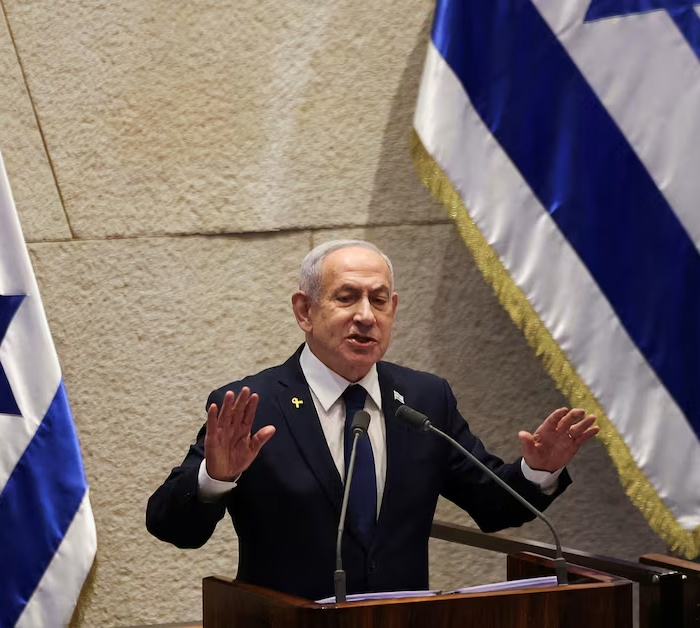
The prospect of arming Turkey with advanced jets has clearly rattled Israel. Israeli Prime Minister Benjamin Netanyahu reportedly complained to Trump last Friday about Erdoğan’s increasingly hostile rhetoric toward Israel.
Beyond the rhetoric, Netanyahu made a direct appeal. He asked Trump to hold back from selling weapons systems that would help modernize Turkey’s air force, singling out the F-35 jets in particular as a red line for Israeli security concerns.
Pushback From Congress
Opposition is not limited to Israel. A group of 18 lawmakers, led by Representative Dina Titus, sent a letter to House Majority Leader Steve Scalise and House Minority Leader Hakeem Jeffries urging them to block any potential F-35 sale to Turkey.
Their central argument centers on Turkey’s continued possession of the Russian-made S-400 systems. As long as the Turkish military holds onto that equipment, the lawmakers contend, any sale would violate U.S. law and existing sanctions.
The Bigger Picture
The debate over selling F-35 jets to Turkey sits at the intersection of diplomacy, defense policy, and regional rivalry. For Trump, the move represents a way to reward an ally he considers steadfast. For Turkey, it fulfills a long-standing promise and a strategic ambition.
But for Israel, key members of Congress, and critics wary of Turkey’s ties to Russian military hardware, the potential deal raises serious legal and security alarms. With a Pentagon review still in progress and political opposition mounting on multiple fronts, the outcome remains far from settled, and the coming weeks may reveal just how far Trump is prepared to go.
Author