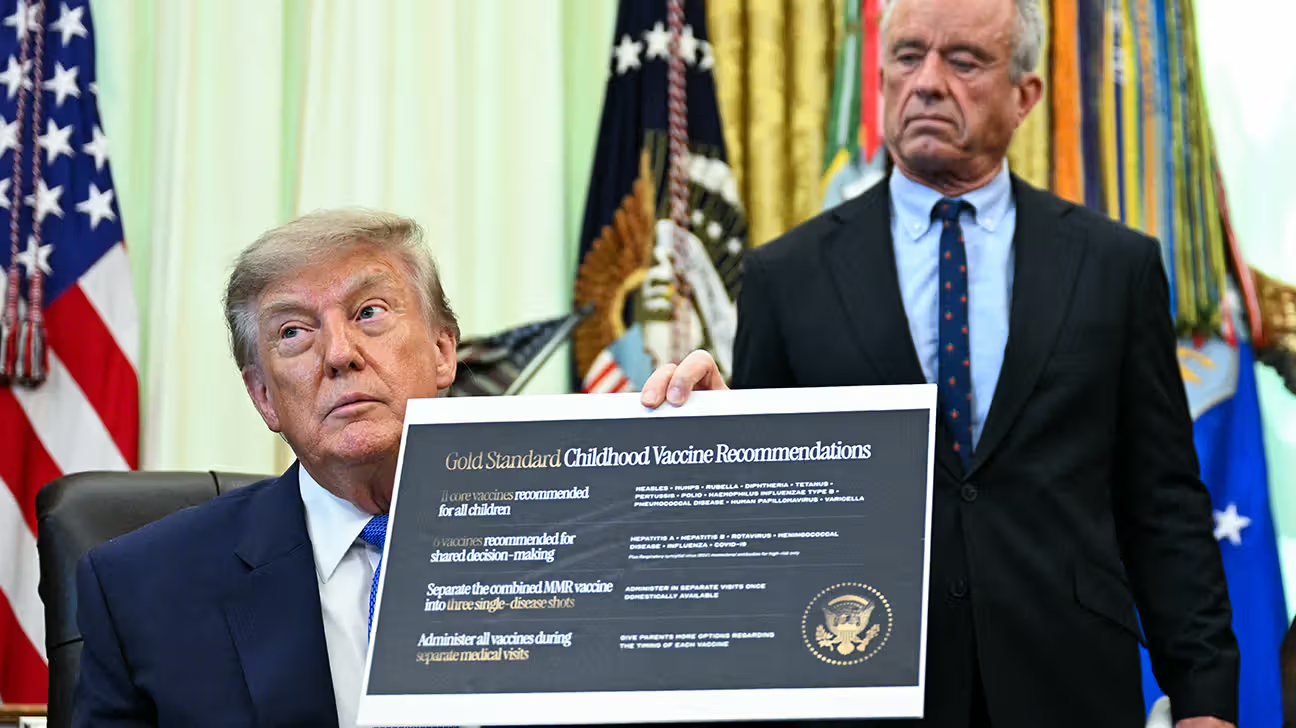
The childhood vaccine schedule used across the United States would shrink substantially under an executive order signed by President Donald Trump, which also calls for the combined measles, mumps and rubella shot to be administered as separate injections.
Medical organisations responded quickly and critically, arguing the changes could lower immunisation rates and expose children to preventable disease.
What the Order Proposes
Two central changes sit at the heart of the directive.
The first would reduce the number of recommended childhood vaccines from 18, the figure recommended by the American Academy of Pediatrics, down to 11.
The immunisations retained under the order cover measles, mumps, rubella, diphtheria, tetanus, pertussis, polio, Haemophilus influenzae type B, pneumococcal disease, human papillomavirus, and varicella.
The second change concerns delivery. Trump said the goal is not simply administering fewer vaccines but spreading them across a series of separate doctor visits rather than combining them.
An important limitation applies. The order functions as guidance rather than a mandate, because vaccination requirements for school attendance are established by individual states, not the federal government.
The Claims Behind the Policy
Trump framed the order around a comparison to earlier decades, saying children once received only a small fraction of today’s vaccines, that people were healthier then, and that current rates of autism did not exist.
He also suggested the MMR vaccine could be quite lethal when given as a single dose, likening the volume to pouring a bottle of soda into a child’s body.
For context on that comparison, a single MMR dose measures 0.5 millilitres according to FDA documentation.
When a reporter asked what evidence supported the lethality claim, Trump replied that some people say it is that way.
What the Evidence Actually Shows
Federal health guidance contradicts several of the assertions underlying the order.
The CDC states that no published scientific evidence demonstrates any benefit to splitting the combination MMR vaccine into three separate injections.
On safety, the agency acknowledges a very small risk of febrile seizures in young children and advises that those with severe allergic reactions or weakened immune systems consult healthcare providers first. It also states that most people experience no serious problems from the vaccine, and that receiving it is considerably safer than contracting measles, mumps or rubella.
On autism, multiple studies have found no connection. A large Danish study published in 2019 examined 657,461 children and concluded the data did not support the vaccine causing or triggering autism.
The Practical Objections
Physicians raised concerns that have less to do with ideology than with logistics.
Dr William Schaffner of Vanderbilt University School of Medicine told the BBC that additional visits would be harder for both parents and providers to track, and would add expense without delivering any scientific benefit.
The broader concerns experts raise include:
- Children remain unprotected during gaps between separated doses
- More appointments create more opportunities for missed visits
- Costs increase for families and healthcare systems
- Splitting the shot means more injections total, not fewer
Dr Andrew Racine, president of the American Academy of Pediatrics, called the order dangerous and said it was not grounded in gold-standard science. He warned that delaying or skipping shots carries real risk, particularly with measles spreading and children returning to school.
The AAP notes that vaccine timing is designed around when immune systems respond best and when children are most vulnerable to specific diseases, and says there is no medical justification for delaying or skipping recommended immunisations.
Republican Criticism
Opposition came from within the president’s own party.
Senator Bill Cassidy, a physician who cast the deciding Senate vote to confirm Robert F. Kennedy Jr. as health secretary, called the order wrong. Writing on X, he said the president lacks the expertise to make these changes, and stated plainly that vaccines are overwhelmingly safe, effective, and do not cause autism.
The Health Secretary’s Position
Kennedy has pursued changes to vaccine regulation since taking office in 2025.
During a tense CNN interview last week, he said he had never questioned the efficacy of the MMR vaccine, and framed the proposed changes as expanding parental choice rather than restricting access.
Administration officials have said the order means American children would receive far fewer than the 72 shots associated with the previous schedule, a figure that counts annual flu and Covid-19 doses.
The Aluminium Provision
A less discussed portion of the order calls for developing alternatives to aluminium in vaccines and testing whether those alternatives prove safer or more effective.
Aluminium salts occur naturally in soil, water and food, and small quantities have been used in vaccines for decades to strengthen immune response. That function allows smaller quantities of vaccine and fewer doses overall.
The AAP says research has identified no significant health risks from the tiny amounts present in vaccines.
Current Guidance Remains Unchanged
The CDC continues to recommend two doses of the combined MMR vaccine, the first between 12 and 15 months of age and the second between four and six years.
Because states control school immunisation requirements, existing schedules remain in effect unless individual state governments act.
The Underlying Concern
The worry running through every expert response is straightforward. If parents delay or skip immunisations based on a link between vaccines and autism that research has repeatedly failed to find, coverage falls, and diseases that were once effectively controlled return.
Measles is the clearest example. It spreads with extraordinary efficiency and requires very high community immunity to stay suppressed. Small drops in coverage can produce outbreaks quickly.
That is why the timing drew particular criticism. The order arrives during an active measles resurgence, at the start of a school year, proposing changes that would add appointments to an already demanding schedule.
Author
-
Lucienne Albrecht is Luxe Chronicle’s wealth and lifestyle editor, celebrated for her elegant perspective on finance, legacy, and global luxury culture. With a flair for blending sophistication with insight, she brings a distinctly feminine voice to the world of high society and wealth.