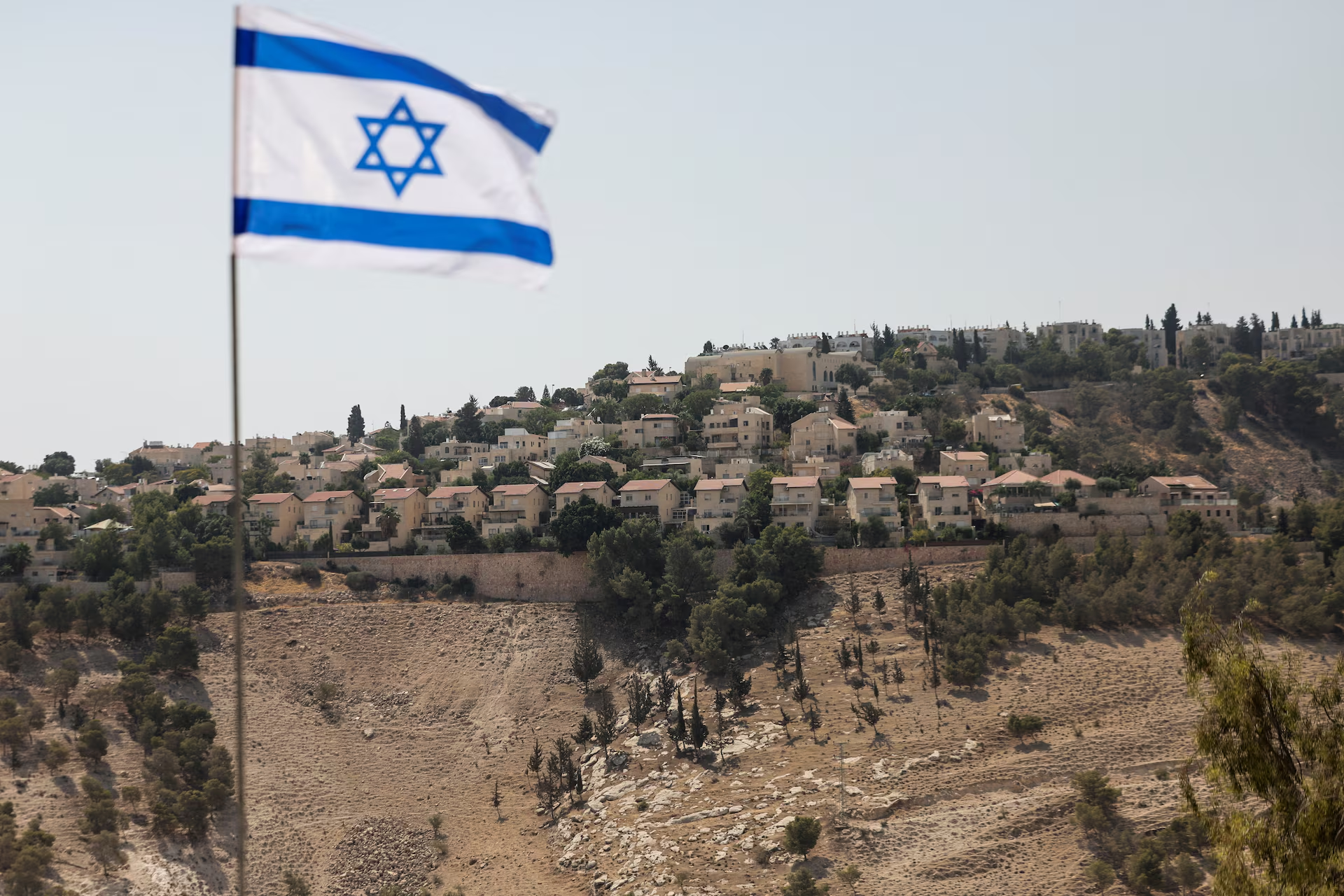
The UN list Israeli settlement companies just got significantly longer, with the United Nations human rights office confirming it has added 61 new businesses to its ongoing database of companies tied to activity in the occupied West Bank and occupied East Jerusalem. The update brings the total count to 214 companies spread across 11 different countries, cementing this as one of the more closely watched corporate accountability efforts connected to the Israeli-Palestinian conflict.
What the New Report Actually Says
An 18-page document released Friday lays out the reasoning behind each company’s inclusion on the list. According to the report, investigators assessed a total of 126 businesses during this latest review cycle before settling on which ones met the threshold for inclusion. Interestingly, the update wasn’t purely additive, five companies that had appeared on last year’s list of 158 businesses were actually removed this time around, suggesting the database isn’t static and gets revisited rather than simply expanded indefinitely.
Geographically, the list skews heavily toward Israeli firms, which make up the bulk of entries. That said, the remaining companies operate out of a fairly diverse spread of nations, including China, France, Germany, Luxembourg, Mexico, the Netherlands, South Africa, Spain, the United States, and the United Kingdom. This international spread underscores how deeply global commerce has become entangled with settlement-related activity, it’s not just a regional issue confined to companies operating solely within Israel’s borders.
How Companies Actually Land on This List
So what actually qualifies a business for inclusion? The report outlines ten specific categories of prohibited activity, and a company needs to be linked to at least one of them to make the cut. These categories cover a fairly broad range of involvement, everything from directly facilitating the construction and expansion of settlements, to supplying surveillance and identification equipment used in the occupied territories, to offering banking services or providing basic utilities and services to settlement operations.
The bar for inclusion isn’t criminal-level proof, and the report is upfront about that distinction. Rather than requiring guilt beyond a reasonable doubt, the standard here is whether there are reasonable grounds to believe a company engaged in one of the prohibited activities. That’s a notably lower threshold than what a courtroom would demand, but the UN notes it aligns with standards typically used by other UN fact-finding bodies. Essentially, this database operates more like a documentation and transparency tool than a legal verdict, it’s flagging patterns of involvement rather than issuing judgments.
Once the UN’s review team concludes that a company likely meets one of these criteria, the organization reaches out directly to that business. Companies then get a 60-day window to respond, offering clarification, additional context, or updates on whether their situation has changed since the assessment began. Out of everyone contacted following this most recent round, only 14 companies actually responded to the UN’s outreach. It remains unclear exactly how many of the 126 reviewed companies were reached out to in the first place, which leaves some ambiguity around how much dialogue actually took place before the list was finalized.
Notable Names Joining the List
Among the fresh additions this year, Spanish logistics company Salvat Logistica now appears in the database, alongside Alony Hetz, an Israeli real estate investment holding firm. These newcomers join a roster that already includes some fairly recognizable global brands, travel platforms Expedia and Trip Advisor, short-term rental giant Airbnb, and telecommunications company Motorola were all already listed from previous assessments. Their continued presence, alongside the new entrants, illustrates how this isn’t limited to niche or obscure companies, some genuinely mainstream, consumer-facing businesses are represented here.
The Broader Legal Context
None of this exists in isolation from the wider legal conversation around Israeli settlements. These settlements have long been considered illegal under international law, and scrutiny around them has intensified considerably since Israel’s war in Gaza began roughly three years ago. A pivotal moment came in July 2024, when the International Court of Justice weighed in with an advisory opinion declaring Israel’s settlement policies unlawful. The court went further too, stating that Israel should halt any new settlement construction in the occupied West Bank and East Jerusalem, and that the country is obligated to withdraw from occupied Palestinian territory as quickly as possible.
It’s worth noting that this ICJ ruling, while carrying substantial political weight and moral authority, was advisory in nature rather than legally binding. That distinction matters practically, there’s no direct enforcement mechanism forcing compliance, but the ruling has nonetheless shaped how governments, human rights organizations, and now this UN database approach the settlement question.
Why This Matters Going Forward
Taken together, the growing size of this corporate list and the ICJ’s earlier legal findings paint a picture of increasing international pressure on the web of businesses connected to settlement activity. Whether this translates into meaningful changes in corporate behavior, divestment, or policy shifts remains to be seen. But the steady expansion of the database, now at 214 companies and counting, suggests that scrutiny in this area isn’t fading anytime soon. If anything, the pattern of annual reviews, additions, and even occasional removals indicates this has become a recurring fixture in how the UN tracks corporate involvement in one of the world’s most closely watched territorial disputes.
Author