The Britain social media ban under-16s has moved from debate to firm policy, with Prime Minister Keir Starmer announcing that children under the age of 16 will be barred from a wide range of popular apps. The sweeping decision aims to shield young people from harmful content and the toll of excessive screen time, positioning the UK at the forefront of a growing global push for online child safety.
A Firm Stance From the Prime Minister
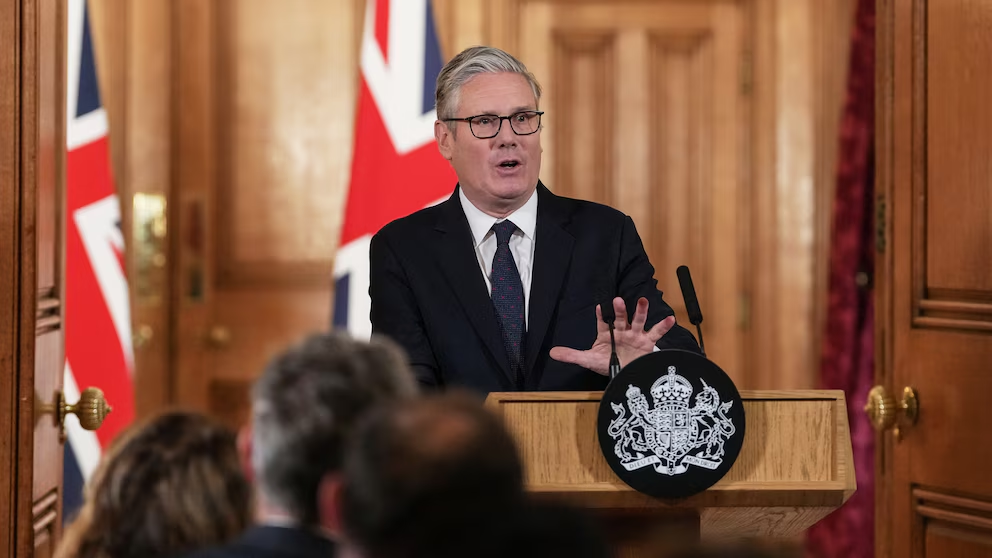
Speaking at a news conference on Monday, Starmer made clear he is prepared to confront any resistance from technology companies. He also acknowledged a practical reality, admitting that some teenagers will inevitably try to find ways around the restrictions.
Even so, the prime minister insisted he would not waver. He stated plainly that he is not willing to compromise on the safety and happiness of the nation’s children. As a father of two teenagers himself, Starmer spoke from personal experience, noting that parents everywhere can see for themselves how social media is affecting their kids’ wellbeing.
He described hearing directly from families who are desperate for change and pledged that the government would deliver for them.
Which Apps Are Affected
The ban, expected to take effect early next year, will apply to several of the world’s most widely used platforms. According to the government, the restrictions will cover:
- Snapchat
- TikTok
- YouTube
- X
Importantly, certain services are exempt from the rules. YouTube Kids will remain accessible, as will messaging apps such as WhatsApp and Signal. Starmer was careful to emphasize that enforcement will be aimed squarely at tech companies rather than at children themselves.
Following Australia’s Lead, and Going Further
The UK plans to model its approach on Australia, which last year became the first country to prohibit under-16s from holding social media accounts. Under the framework, platforms that fail to take reasonable steps to keep younger children off their services could face multimillion-dollar fines.
Starmer signaled that Britain intends to push beyond Australia’s measures. He outlined plans to prevent strangers from contacting children on gaming and livestreaming platforms, addressing a significant safety concern for many parents.
Authorities are also weighing additional protections, including:
- Overnight curfews for younger users.
- Breaks built into infinite scrolling for those under 18.
The government has said more details about these measures are expected next month.
Part of a Global Movement
Britain’s decision places it within a broader international trend toward tighter online safeguards for minors. Several countries have already introduced legislation or announced age-based restrictions, including Australia, Canada, Brazil, and Indonesia.
Meanwhile, others such as France, Spain, Denmark, Thailand, and South Korea are studying or developing similar frameworks. The momentum suggests that age-based social media restrictions may soon become far more common around the world.
Strong Public Support
The announcement followed a public comment period that drew an enormous response. The government received 116,000 submissions from parents, the technology industry, and children themselves. Remarkably, that turnout was second only to the consultation on same-sex marriage back in 2012.
The feedback left little room for doubt. More than 90 percent of respondents expressed support for an under-16 ban, giving the government a clear mandate to act.
Mixed Reactions to the Plan
Despite the strong public backing, the announcement drew a range of responses from advocates, charities, and critics alike.
Esther Ghey, whose 16-year-old daughter Brianna was killed in 2023 by two teenagers who had accessed harmful online content, said the ban could potentially save many children’s lives. However, she stressed that it must be paired with additional measures to be truly effective.
The NSPCC, a prominent children’s charity, welcomed the government’s ambition but urged officials to ensure platforms implement robust age checks and enforce the policy properly.
Not everyone is convinced. Critics, including the Open Rights Group, raised concerns about age verification companies and how users’ private data would be protected. A spokesperson for YouTube cautioned that a blanket restriction could push children away from curated, supervised environments and toward anonymous, less-safe alternatives.
Starmer Defends the Vision
Acknowledging these challenges, Starmer remained optimistic about the outcome. He said that success would look like a dramatic drop in the number of children using social media, alongside a broader cultural shift, a growing sense that young people can grow up differently.
The announcement also carries political weight. Elected just under two years ago, Starmer faces pressure from within his own party over concerns about his leadership and could confront a leadership challenge in the coming days or weeks. With this measure, he appears to be pursuing a consequential policy that could define part of his legacy.
Tensions With the United States
The ban risks straining relations with the United States, which has voiced opposition to the move. According to a statement from the U.S. Embassy in London, Washington has warned that such regulations should remain narrow and avoid infringing on free speech protections.
The embassy also expressed concern that the rules could place heavier burdens on American technology companies. Starmer said he expected to discuss the matter with U.S. President Donald Trump and other leaders at a Group of Seven summit in France beginning Monday.
He downplayed the likelihood of serious conflict, arguing that world leaders have generally recognized their responsibility to protect children. While he acknowledged there will always be debate over the precise limits and rules, he did not view the disagreement as a major obstacle.
Skepticism From Experts
Some experts remain doubtful about how effective the ban will ultimately be. Jon Crowcroft, a communications systems professor at the University of Cambridge, described supporters of social media bans as well-intentioned but likely misguided.
He warned that the policy could inadvertently cut children off from sites they genuinely need. Crowcroft also raised a technical concern, noting that there is a real risk of driving some users toward worse platforms, and that policing individual devices is nearly impossible. In his view, regulating the platforms themselves would be far more practical, if only regulators would commit to it.
Final Thoughts
The Britain social media ban under-16s represents one of the most ambitious efforts yet to reshape how young people engage with the online world. While it enjoys overwhelming public support and aligns with a wider global movement, it also faces real questions about enforcement, privacy, and unintended consequences. As the policy takes shape in the months ahead, the UK’s experience may well become a closely watched test case for governments everywhere grappling with the same difficult balance between protection and access.
Author