Upper West Side Stabbing Attacks Prompt Hate Crime Investigation
A pair of Upper West Side stabbing incidents Thursday afternoon left two men hospitalized and set off an urgent police response in one of Manhattan’s most heavily Jewish neighborhoods. According to the NYPD, citing accounts from the victim and witnesses, the attacker shouted “allahu akbar” during one of the assaults.
NYPD Commissioner Jessica Tisch confirmed that the two stabbings occurred separately within a span of a few blocks. One victim was Jewish; the other was Asian and, according to a neighborhood watch coordinator, not Jewish. Early reports had incorrectly described both men as Jewish.
What Investigators Know So Far
Police identified the suspect as Raul Morales, 51, and took him into custody a short time after the second attack.
Tisch said detectives are assessing whether the incidents qualify as hate crimes. She also noted that mental health may have played a role, a caveat that has shaped much of the official language surrounding the case.
The timeline and geography police have released:
- The first call came in at 1:31 p.m.
- The initial stabbing happened at 84th Street and Central Park West
- The second occurred at 86th Street and Amsterdam Avenue
- Both victims, aged 57 and 50, were stabbed in the torso
- Both were taken to Mount Sinai Medical Center in stable condition
The Manhattan Shomrim neighborhood watch group reported that the weapon used was a screwdriver.
The second attack took place roughly half a block from a Jewish community center, in an area with a substantial Jewish population.
A Community Watch Group Helped Locate the Suspect
An operations coordinator with Manhattan Shomrim described a rapid mobilization. The group fielded about five calls in the immediate aftermath and sent members to the scene, where Hatzolah emergency responders and police were already working.
Shomrim volunteers fanned out across the area, gathering statements from witnesses. Through that canvassing, they learned the attacker had fled into nearby public housing and relayed the information to police. Officers arrested the suspect several blocks north of the second stabbing site.
The coordinator credited the department’s response, describing the NYPD as fast and determined in tracking the man down.
The Victim’s Condition
Rabbi Allen Schwartz spoke with the Jewish victim after the attack and said the man had been pierced on the right side of his chest. The victim recalled hearing screams before everything went dark.
He is expected to recover. Schwartz said he would be home before Shabbat.
The man has asked not to be named publicly. His reason is personal rather than legal: his elderly mother lives in Israel and was asleep when the attack occurred, and he wanted to break the news to her himself.
The Timing Carried Additional Weight
The attacks fell on Tisha B’Av, the most mournful day on the Jewish calendar, observed through fasting and prayer.
New York Assemblymember Micah Lasher, who is Jewish and represents the district, went to the scene. He said one of the victims had been wearing a kippah.
City Council Speaker Julie Menin stated that the incident appeared antisemitic in nature. She described the fear within the Jewish community as genuine and argued that safety in one’s own neighborhood should not depend on faith or identity.
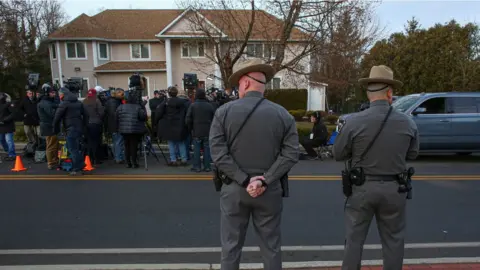
At the scene, police tape sealed off both locations. Officers were stationed nearby and a helicopter circled overhead. Stickers on nearby flagpoles carried a Hebrew phrase declaring that the people of Israel live, alongside an image of Hersh Goldberg-Polin, the hostage who died in Gaza.
Hate Crime Numbers Provide Context
The attack did not occur in isolation. NYPD data shows Jews are targeted in hate crimes at a rate far exceeding any other group in the city.
Between January and the end of June, the department confirmed 178 antisemitic hate crimes. That figure represents 55 percent of all hate crimes recorded citywide during that period — despite Jews making up roughly 10 percent of New York’s population.
The day before the Upper West Side attacks, a man shouting antisemitic slurs shoved a 64-year-old Jewish man in Brooklyn. That victim required hospital treatment for his injuries.
Political Fallout Reaches the Mayor’s Office
The stabbings have intensified scrutiny of Mayor Zohran Mamdani, who has faced repeated criticism from Jewish organizations arguing that his anti-Zionist rhetoric contributes to a climate of hostility.
That criticism sharpened this week. A video Mamdani posted Wednesday, containing accusations against Israeli forces in Gaza, drew widespread condemnation from Jewish New Yorkers.
Mamdani addressed the stabbings in a statement, relaying that the NYPD’s early investigation points toward mental health as a possible factor and that the incidents are being evaluated as potential hate crimes. He called the attacks hateful and despicable, saying they have no place in the city.
Jewish Organizations Respond
For several groups, the mayor’s statement was insufficient.
The UJA-Federation of New York said it was horrified but not surprised by the attacks, arguing that words carry consequences — particularly words spoken by the mayor of New York City.
State Assemblymember Nily Rozic, an Israeli-American representing part of the city, framed the issue around a specific slogan. Anyone unwilling to fully condemn calls to globalize the intifada, she argued, should expect that rhetoric to become normalized. In her view, such language inflames, emboldens, and ultimately produces violence against Jewish communities.
The Council of Orthodox Jewish Organizations of the Upper West Side went further still, stating that this act of violence in their quiet neighborhood would be remembered against the backdrop of the mayor’s rhetoric and his vilification of Israel and its leadership. The group insisted the pattern must end for Jewish New Yorkers to feel secure.
An Unresolved Question
The central tension in this case is now explicit. Police have raised mental health as a possible factor while simultaneously investigating the attacks as potential hate crimes — two framings that many in the community see as being used to soften each other.
For residents of the Upper West Side, that debate is somewhat beside the point. Two men were stabbed in daylight, blocks apart, on a day of mourning, near a community center. The investigation will assign a legal category eventually. The neighborhood has already drawn its own conclusions.
Author
-
Lucienne Albrecht is Luxe Chronicle’s wealth and lifestyle editor, celebrated for her elegant perspective on finance, legacy, and global luxury culture. With a flair for blending sophistication with insight, she brings a distinctly feminine voice to the world of high society and wealth.