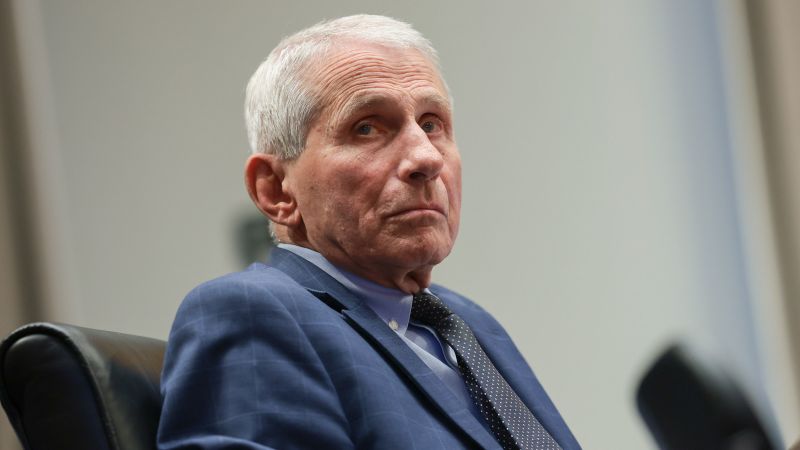
A Fauci contempt of Congress resolution cleared the Senate Homeland Security and Governmental Affairs Committee on an 8-5 party-line vote Thursday, escalating a confrontation that has been building for years and sending the matter to federal prosecutors who now must decide whether to act.
The vote followed a heated hearing last week in which Dr. Anthony Fauci declined to answer senators’ questions more than 100 times, invoking his Fifth Amendment right each time.
Why He Refused to Answer
Fauci explained his reasoning in his opening statement rather than leaving it to interpretation.
He argued that Senator Rand Paul had made his intentions unmistakable through an obvious obsession with securing his prosecution, repeated slanderous public comments, and the recent release of his unredacted personal diary in what Fauci characterized as an attempt to embarrass and intimidate him.
His conclusion was that the hearing existed for one purpose: to extract some statement, any statement, that could support Paul’s public pledges to see him end up behind bars.
Paul’s Legal Argument
The committee chairman framed the vote as a question about the limits of a pardon rather than a dispute over constitutional rights.
Paul said the committee was deciding whether a witness who has received a sweeping federal pardon can be ordered to answer questions and then defy that order without consequence. The reference is to the preemptive pardon President Joe Biden issued to Fauci and others shortly before leaving office, which Biden described as protection against politically motivated prosecution.
Paul said he ordered Fauci to answer and warned him about contempt, and that continued refusal amounted to obstruction of a congressional investigation.
Republicans advanced a second argument as well, contending that Fauci waived his Fifth Amendment protection by delivering opening testimony addressing subject matter relevant to the inquiry.
A Legal Expert Is Skeptical
Abbe Smith, a law professor at Georgetown, questioned both prongs of the Republican position.
On the pardon argument, she noted that resolving it would require a settled legal understanding of whether such a pardon is limitless, and that preemptive pardons are unusual enough that their protective scope remains genuinely unclear. She added that she would have advised Fauci to invoke the Fifth had she been representing him.
She found the waiver argument somewhat more interesting but ultimately unpersuasive. Fauci used his opening statement to reference his public service, his belief in accountability and his history of testifying, while explaining that this proceeding crossed a line. In her view, that does not constitute waiver, because he was not answering specific allegations and then cutting off further questioning.
Where the Referral Goes
Paul moved quickly after the vote, telling reporters the committee would hand-deliver the referral the same day to the attorney general and to the U.S. attorney for the District of Columbia.
The committee had another option available. It could have asked Senate Majority Leader John Thune to schedule a full chamber vote. That route was almost certainly a dead end, since the measure would need 60 votes in a narrowly divided Senate.
If Jeanine Pirro, the U.S. attorney in D.C., elects to pursue the case, her office would still need a grand jury in the district to return an indictment. Her track record on securing indictments there has been uneven.
Democrats Warn About Precedent
Senator Gary Peters of Michigan, the committee’s ranking Democrat, argued the vote creates a lasting problem well beyond this case.
He said punishing a witness for asserting a constitutionally protected right will lead future witnesses to conclude that appearing before Congress carries risk regardless of whether they comply with a subpoena. Those witnesses, he warned, will cite this specific vote as justification for refusing to appear at all.
Democrats attempted to table the resolution five separate times during the meeting. Each motion failed along party lines.
The Investigation Is Expanding
Senator Ron Johnson of Wisconsin made clear the contempt vote is not the endpoint.
Johnson said his investigation has only begun and revealed that the subcommittee he leads has obtained Fauci’s iPhone, the device he used while serving at the Department of Health and Human Services during the pandemic.
He also extended a new offer. If Fauci prefers not to face questioning in public, Johnson said, he can sit for a transcribed interview behind closed doors, adding that it would be one of several interviews the subcommittee conducts.
The Response From Fauci’s Camp
Fauci’s attorney, David Schertler, dismissed the proceeding entirely.
He called the vote a crude political stunt designed to punish his client for exercising constitutional rights, and described the resolution as a continuation of what he termed Paul’s personal vendetta against a man who spent 50 years in public health and saved countless lives. He accused Paul of abusing his position by attempting to weaponize the Justice Department.
Years in the Making
The confrontation did not begin last week. Paul has pursued Fauci through multiple hearings, repeatedly accusing him of dishonesty, which Fauci has consistently denied.
On Tuesday, Paul went further, alleging Fauci committed felonies by lying to Congress and destroying records. Asked in an interview whether Fauci should go to prison, Paul called it a good question, then stated his belief that Fauci lied to Congress, that people who do so should be charged and jailed if convicted, and that record destruction constitutes a separate felony.
The broader campaign has drawn energy from anti-lockdown sentiment and the unresolved argument over the pandemic’s origins.
What Determines the Outcome
Three factors will decide whether this produces anything beyond headlines.
Whether the Justice Department takes up a referral involving conduct arguably covered by a presidential pardon. Whether a D.C. grand jury would indict on these facts. And whether courts would accept either the pardon-nullifies-the-Fifth theory or the waiver-by-opening-statement theory, both of which remain untested.
The referral has been delivered. Everything after that belongs to prosecutors.
Author