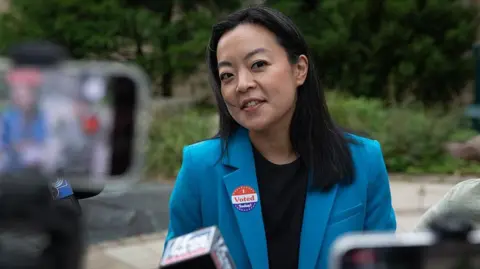
Francesca Hong came within a whisker of becoming the Democratic nominee for governor of Wisconsin, and then she didn’t. To one school of commentary, that near-miss counts as a lucky escape for her party rather than a tragedy. What follows lays out that argument, which has been advanced by critics who watched the primary closely.
The case is not that Hong lacked energy or conviction. She had plenty of both. It is that in a state Donald Trump carried in 2024, a candidate’s ability to speak to voters who are not already convinced matters more than the enthusiasm of those who are.
A Primary That Fell Apart in Slow Motion
Two weeks before the vote, Hong was the clear front-runner. That position had less to do with her strength than with the collapse of everyone around her.
Lieutenant Governor Sara Rodriguez suspended her campaign in mid-July over financial irregularities. By the end of the month, former Lieutenant Governor Mandela Barnes exited as well, with one poll at the time showing Hong leading by 22 points. Meanwhile Milwaukee County Executive David Crowley, who had already withdrawn once for lack of momentum, decided to climb back in.
The Democratic establishment ended up pinning its hopes on that relaunch. Improbably, it worked. Crowley edged past Hong at the finish.
The Baggage That Never Got Unpacked
Hong’s critics inside her own party were nervous for reasons beyond ideology, though ideology was part of it. She is affiliated with the Democratic Socialists of America, a group whose platform includes public ownership of major corporations, far looser immigration rules, and prison abolition. She has said she does not endorse every plank of it.
The bigger problem was her social media history, which she had never cleaned up. It contained a catalogue of pandemic-era pronouncements that landed badly outside progressive circles, including a description of Thanksgiving as a colonizer holiday and a superspreader event. Further digging turned up dismissive comments about Christmas, Valentine’s Day, and Halloween.
Old posts alone rarely sink a campaign. Plenty of politicians have survived worse by simply admitting that the early 2020s made everyone a little strange, and moving on. What hurt Hong was that she could not find the exit.
Given a chance to close the subject in a CNN interview with Kaitlan Collins, she explained that the holiday is painful for many communities. Days later she clarified that she actually loves Thanksgiving and is just generally grumpy about holidays. Each attempt kept the story alive another news cycle.
A Rally That Told the Story
The warning signs were visible in person. At a suburban Milwaukee event, Hong had genuine assets on display: a compelling biography as a restaurant worker, single mother, and community organizer, plus Korean immigrant parents seated proudly at the front, visibly delighted to watch their daughter run.
But her delivery was hesitant and nervous. At her own rally she was overshadowed by left-wing streamer Hasan Piker, who read brief remarks about socialism off his phone and then drew a crush of fans to the barrier for selfies while the candidate drifted around the edges.
The crowd itself was a study in narrowcasting. Introductions addressed ladies, gentlemen, and friends beyond the binary. There was a craft table with paper and crayons at the back. Volunteer-made pins carried profane anti-ICE slogans and stoner jokes. The campaign’s most circulated moment was a blunt, expletive-laced line about Ronald Reagan delivered while flipping burgers.
That mix can work in deep-blue urban districts. In a state decided by tens of thousands of votes, it looks like a ceiling rather than a launchpad.
Compare and Contrast
The critique here is not that left-wing candidates cannot win competitive races. Abdul El-Sayed, running for Senate in Michigan, carries his own vulnerabilities and has also appeared with Piker. But he presents as fluent, combative, and disciplined. He moves easily between a campaign ad with his white step-grandparents, rural organizing against data centers, and televised arguments over foreign policy.
Crucially, he has a message that fits on a bumper sticker: money out of politics, money in your pocket, Medicare for All. He is not going to spend a general election litigating which holidays he dislikes.
Politicians need what might be called main-character energy. El-Sayed has it. Hong, by this reading, did not.
The Endorsements That Never Came
One of the most telling details is who stayed away. Alexandria Ocasio-Cortez and Bernie Sanders both backed El-Sayed. Neither endorsed Hong. Elizabeth Warren offered only that she did not know her.
That restraint arguably reflects well on the progressive wing’s political instincts. It has enjoyed a strong primary season with surprise wins in New York and Colorado, yet its most prominent figures declined to spend credibility on a shaky candidate in a purple state. Ocasio-Cortez similarly withheld support from Graham Platner, whose Maine Senate bid collapsed amid misconduct allegations. Quality control, in this view, is the whole game.
Outgoing Governor Tony Evers, who had promised neutrality, broke it to back Crowley when he re-entered. The intervention proved decisive.
Why Republicans Wanted the Other Outcome
The Republican nominee, Tom Tiffany, faced no serious primary competition. He belongs to the hard-right Freedom Caucus, voted against certifying Joe Biden’s 2020 victory, and carries Trump’s enthusiastic endorsement — an asset in a primary and a liability in a general election.
Tiffany plainly preferred to face Hong, whom he could have caricatured as a radical hostile to immigration enforcement and to Thanksgiving alike. Tellingly, a Republican-linked super PAC spent 2.2 million dollars on ads calling her too liberal, a counterintuitive attempt to boost her among Democratic primary voters. Her own campaign barely advertised on television.
A large opposition research file went into the recycling bin the night the results came in.
The Larger Stakes
Wisconsin sits near the center of the electoral map. Biden won it by roughly 21,000 votes in 2020; Trump reclaimed it by about 30,000. The governor’s office matters enormously if a future presidential result is contested, and the 2020 phone call to Georgia officials is not an abstract worry.
The argument, then, is straightforward: for a decade, cultural over-reach on the left has helped make authoritarian behavior look comparatively tolerable to swing voters. Nominating someone better positioned to compete for those voters reduces that risk.
Supporters of Hong would counter that establishment gatekeeping suppressed a genuine grassroots movement, and that her near-win demonstrated real appetite for economic populism. That reading deserves a hearing too. The general election will supply better evidence than either side currently has.
Author
-
Lucienne Albrecht is Luxe Chronicle’s wealth and lifestyle editor, celebrated for her elegant perspective on finance, legacy, and global luxury culture. With a flair for blending sophistication with insight, she brings a distinctly feminine voice to the world of high society and wealth.