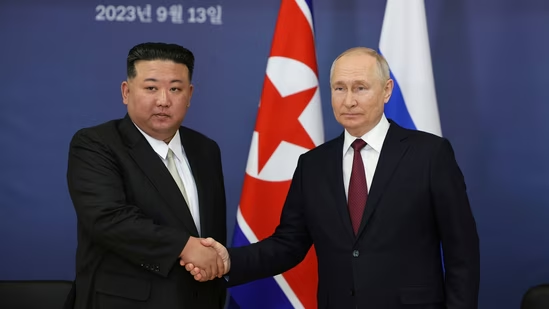
North Korea Russia ties received another public affirmation this weekend as Kim Jong Un exchanged messages with Vladimir Putin marking the anniversary of Korea’s liberation from Japanese colonial rule.
The exchange, reported by state news agency KCNA on Sunday, arrived alongside a starkly different set of signals from Seoul, where South Korea’s president used the same occasion to appeal for dialogue that Pyongyang shows no interest in accepting.
The Messages Exchanged
Kim was responding to congratulations sent by Putin marking Saturday’s 81st anniversary of Japan’s surrender in the Second World War.
The Russian leader framed the relationship in historical terms, describing a bond formed when Soviet soldiers fought against Japan, and pledging that cooperation between the two countries would continue across all sectors.
Kim’s reply struck a similar note, expressing hope for a relationship that he characterised as carrying forward a shared history of struggle for justice alongside valued traditions of friendship.
The language is ceremonial, but the timing and prominence are not accidental. Both governments benefit from presenting their alignment as rooted in historical solidarity rather than in recent transactional necessity.
What Changed the Relationship
The warmth is a relatively recent development, and its cause is not in dispute.
Pyongyang and Moscow have moved substantially closer since North Korea began supplying troops and weapons to support Russia’s war against Ukraine. That commitment represents the most significant North Korean involvement in an overseas conflict since the 1950s.
For Russia, the arrangement addresses manpower and munitions shortages. For North Korea, it offers access to resources, technology and diplomatic cover from a permanent member of the UN Security Council.
That exchange has done more to reshape the relationship than any amount of anniversary messaging.
A Ship in Wonsan
The symbolism extended beyond words. The Russian vessel Pallada arrived at Wonsan port on Saturday for a goodwill visit connected to the liberation anniversary.
According to KCNA, the ship was received by North Korean provincial officials alongside staff from the Russian embassy.
Port calls of this type serve a purpose beyond ceremony. They normalise military and quasi-military contact, and they provide visible evidence of a relationship for domestic audiences in both countries.
Seoul’s Very Different Message
South Korean President Lee Jae Myung marked the same anniversary with an appeal for engagement.
Speaking at Seoul’s Liberation Day ceremony on Saturday, Lee called for talks with the North aimed at peaceful coexistence. He argued that the two Koreas require mechanisms to prevent conflict from breaking out, and that the existing armistice should eventually be replaced by what he termed a peace regime.
He pressed for dialogue to formally conclude the Korean War of 1950 to 1953, which ended with a ceasefire but never a peace treaty. He also suggested such discussions could examine ways to constrain Pyongyang’s nuclear programme.
The response has been silence at best. Pyongyang has rejected Lee’s overtures outright and has continued to denounce joint military exercises conducted by the United States and South Korea as provocations.
Why the Overtures Fail
The structural problem is that North Korea currently has less need for what Seoul offers than at any point in recent decades.
Historically, engagement with the South carried the prospect of economic assistance, sanctions relief and international legitimacy. The relationship with Russia now supplies alternatives to at least some of that, reducing the incentive to negotiate on terms Seoul could accept.
There is also the nuclear question, which remains fundamentally unbridgeable. Lee’s suggestion that talks could address curbing the programme collides with Pyongyang’s position that its arsenal is not a subject for negotiation.
A Reminder of Unfinished Business
The weekend also produced a separate irritant involving Japan.
On Thursday, Putin visited an island off Hokkaido that Japan claims and that Moscow seized in the days immediately following Japan’s 1945 surrender. Tokyo condemned the visit.
That dispute over the Kuril Islands has blocked a formal Russia-Japan peace treaty for eight decades. Its resurfacing during the same week as liberation commemorations is a reminder that the settlement of the Second World War in East Asia remains genuinely incomplete.
The Broader Picture
What emerges from the weekend is a region organising itself along increasingly rigid lines.
Moscow and Pyongyang are deepening a partnership built on wartime necessity and mutual isolation. Seoul is attempting engagement without a receptive counterpart. Tokyo is objecting to territorial facts established in 1945 that no diplomatic process has resolved.
Anniversary messages are easy to dismiss as protocol. In this case they mark real alignments, and those alignments look more durable now than they did two years ago.
Author
-
Lucienne Albrecht is Luxe Chronicle’s wealth and lifestyle editor, celebrated for her elegant perspective on finance, legacy, and global luxury culture. With a flair for blending sophistication with insight, she brings a distinctly feminine voice to the world of high society and wealth.