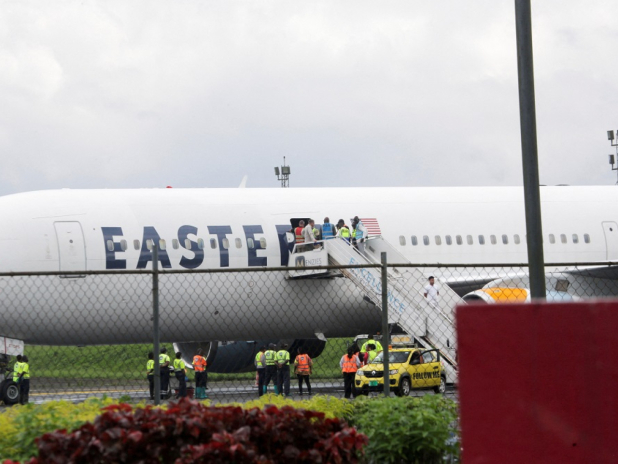
The first third-country deportation flight under a new agreement with Liberia landed Thursday at Roberts International Airport outside Monrovia, carrying 20 people who are not Liberian nationals.
The arrangement allows for as many as 1,200 such transfers, making it among the largest efforts the administration has undertaken to deport people to countries other than their own.
Who Is Being Sent
Liberian Information Minister Jerolinmek Piah indicated that deportees will include African nationals along with people from North America, South America and the Caribbean.
Liberian Justice Minister Natu Oswald Tweh has said those who arrive may seek asylum in Liberia if they choose to.
That offer raises immediate practical questions. Asylum systems require infrastructure, legal representation and processing capacity, and a country accepting hundreds of people with no prior connection to it faces obvious strain.
Official Silence
Neither American agency involved provided details.
The State Department declined to answer questions about the Liberia arrangement, stating instead that implementing the administration’s immigration policies remains a top priority and describing an unwavering commitment to ending illegal and mass immigration while strengthening border security.
The Homeland Security Department declined to confirm Thursday’s deportations, citing operational security, and referred further questions back to the State Department.
That circular response is characteristic of how these arrangements are handled.
A Pattern of Opacity
Third-country agreements typically operate with minimal public disclosure.
The consequences fall on individuals. People have been deported to nations they have never visited, or to places where they face genuine safety risks, leaving them with few options beyond returning to the countries they originally fled.
The scale is substantial. According to Third Country Deportation Watch, a joint effort by Refugees International and Human Rights First that compiles information through public records requests, news reports and other sources, the administration has reached agreements with at least 35 countries. Fourteen of those are in Africa, including Liberia.
More than 23,000 people have been deported to 26 countries under these arrangements.
What the Agreement Actually Says
The State Department previously announced that Liberia had agreed to accept non-Liberian deportees.
A six-page agreement reached in September 2025 and posted on the department’s website contains no specification of how many people would be transferred or which nationalities would be included.
That absence of detail in the published document is itself notable. Numbers and categories that shape the lives of hundreds of people appear to exist, if at all, outside the public record.
The Abrego Garcia Connection
One name recurs in reporting about the Liberia arrangement.
In October, Liberia offered to accept Kilmar Abrego Garcia, a Salvadoran national who was mistakenly deported to prison in his home country.
Blocked from returning him to El Salvador, the administration has pledged to send him to a third country, with Liberia among the options.
Abrego Garcia has said he would accept deportation to Costa Rica, which has stated it will take him. The government has declined to pursue that option.
He is currently contesting deportation to Liberia through a federal lawsuit in Maryland.
The situation captures the strangeness of the framework. A man has identified a country willing to receive him, and the government has instead pursued a destination he is fighting in court.
Why These Arrangements Exist
The legal logic is straightforward even when the outcomes are not.
Deportation requires a country willing to accept the person. When someone’s home country refuses to take them back, or when returning them would violate legal protections against sending people into danger, removal stalls.
Third-country agreements resolve that impasse by finding somewhere else willing to accept them, typically in exchange for diplomatic or financial consideration that is rarely disclosed.
The Questions Critics Raise
Human rights organizations have focused on several concerns:
- Whether individuals receive meaningful opportunity to contest transfer to an unfamiliar country
- Whether receiving nations have capacity to process asylum claims or provide basic support
- What happens to people who arrive with no language, family or economic connection
- Whether the arrangements effectively return people to danger by leaving them no alternative but to travel onward to the countries they fled
- What receiving countries are given in exchange, and whether those terms are public
Supporters counter that immigration law must be enforceable, that removal orders lose meaning if they cannot be executed, and that sovereign nations are entitled to negotiate arrangements of this kind.
What Happens Next
The 20 people who landed Thursday now face decisions in a country most had no prior connection to. Whether they pursue asylum in Liberia, attempt to move elsewhere or find some other path is unknown.
The agreement permits 1,200 transfers. Thursday accounted for less than two percent of that ceiling, which means the third-country deportation program in Liberia is only beginning.
Author