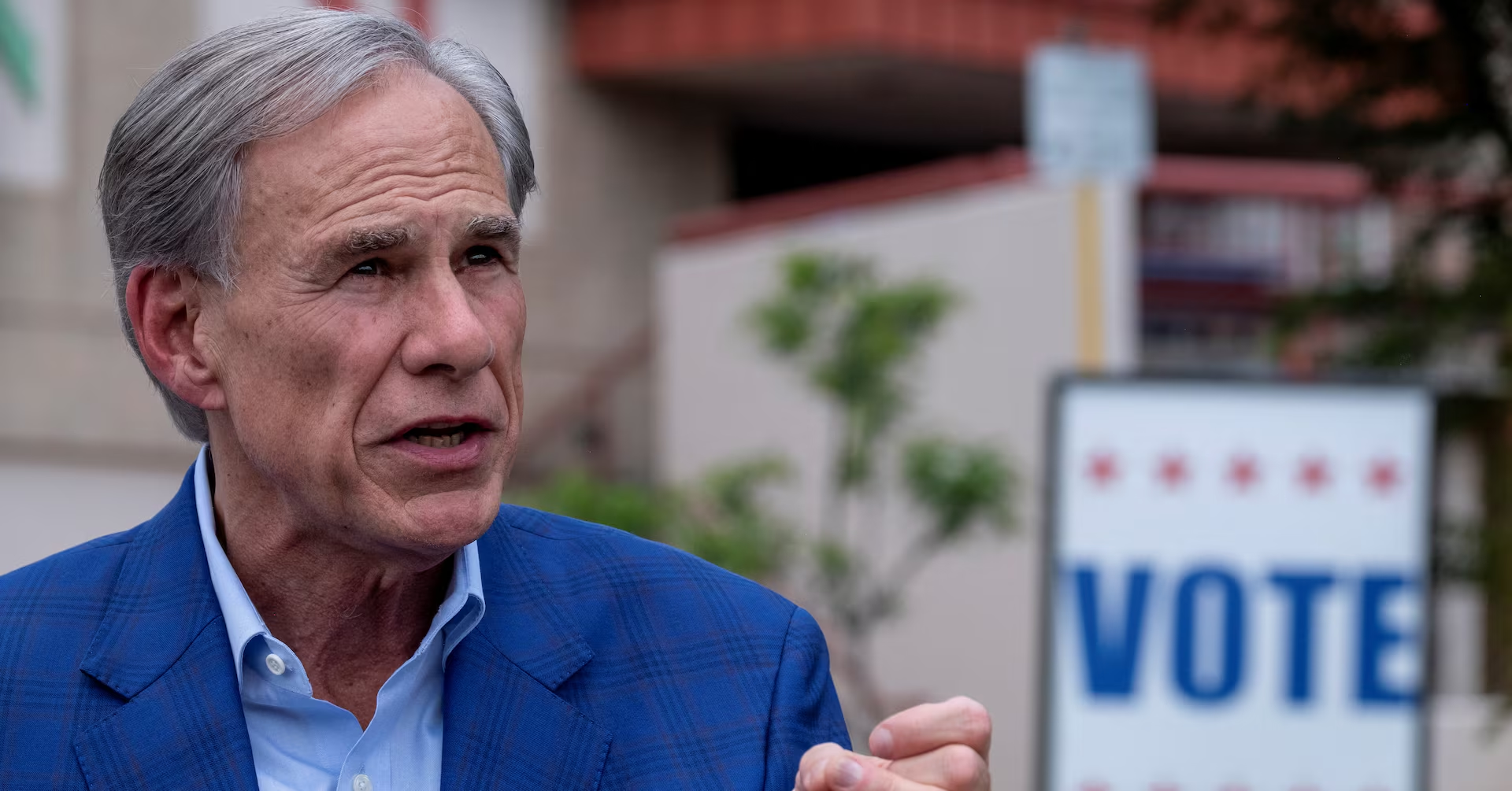
Data center backlash in Texas has reached a striking new level, with Gov. Greg Abbott declaring that the companies building AI infrastructure across his state effectively brought the public anger on themselves.
Abbott’s comments mark one of the sharpest rebukes yet from a Republican official toward an industry he once championed enthusiastically, and they reflect how quickly local opposition has become a serious political force nationwide.
A Governor’s Reversal
Abbott’s shift stands out because of how recently he embraced the opposite position. Just last November, he described Texas as the epicenter of AI development while standing alongside Google to announce a $40 billion investment spread across three data center campuses.
The tone changed markedly by June, when Abbott directed state regulators to require data centers to cover the full cost of the electrical infrastructure their operations demand, while also calling for a phase-out of tax incentives previously offered to attract them. Earlier this month, he went further, ordering regulators to audit any data center seeking to connect to the Texas power grid before allowing projects to proceed.
What Abbott Actually Said
Speaking with ABC’s Jonathan Karl on “This Week,” Abbott attributed the backlash to two factors: the sheer speed at which projects have been built, and developers moving into communities without first securing local buy-in.
He was blunt about where responsibility lies, saying that companies essentially created their own problem and are now facing the consequences they earned. He emphasized that winning support from local communities is not optional but essential to how these projects should proceed.
Abbott also revealed a telling data point from Fox News Sunday last week: fewer than 10% of data center companies responded to a state request for information needed to project future electricity demand, a response rate that suggests the industry has been reluctant to engage transparently with regulators even as scrutiny intensifies.
Not Just a Texas Problem
Abbott is far from alone among governors recalibrating their stance.
Pennsylvania Gov. Josh Shapiro, a Democrat who celebrated a $20 billion Amazon data center investment just last year, imposed new restrictions on the industry this week. New York Gov. Kathy Hochul, also a Democrat, ordered a one-year moratorium on hyperscaler data centers last month.
The bipartisan nature of this shift underscores that voter frustration over data centers isn’t confined to one party or region. It’s a national trend cutting across red and blue states alike.
A Warning for Republicans
The political stakes extend beyond individual governors. Axios previously reported that the National Republican Senatorial Committee warned major AI companies directly that voter anger over data centers threatened Republican chances of holding a competitive Ohio Senate seat.
That warning illustrates how quickly the issue has moved from a local zoning dispute to a factor genuinely capable of swinging federal elections.
Trump Pushes Back
President Trump has publicly criticized Abbott’s approach, arguing that Texas rejecting data centers would be a mistake given that the industry could eventually surpass oil in economic significance.
That tension between the White House’s enthusiasm for AI infrastructure and a red-state governor’s newfound caution highlights a genuine split within the Republican coalition over how to balance economic opportunity against constituent anger.
What the Numbers Show
Public opinion data helps explain why officials across the spectrum are recalculating their positions.
According to an Annenberg Public Policy Center survey conducted last month, 61% of Americans now oppose construction of a new data center in their area, up sharply from 49% in March.
The opposition breaks down along partisan lines but remains substantial everywhere:
69% of Democrats oppose new data centers in their area
54% of Republicans share that opposition
53% of independents oppose them as well
That level of cross-partisan agreement is unusual for almost any contested policy issue, which helps explain why politicians in both parties are moving quickly to reposition themselves.
Why Communities Are Pushing Back
For years, the central questions surrounding the AI buildout concerned whether the technology would justify the hype, whether companies could secure sufficient chips and electricity, and whether the enormous levels of spending made financial sense.
Now, the more immediate obstacle has shifted to whether voters will tolerate the physical infrastructure required to power that boom. Data centers bring substantial electricity demand, heavy water usage, new transmission infrastructure and large-scale construction directly into residential communities.
Compounding the frustration, these facilities typically generate fewer permanent jobs than the warehousing and manufacturing projects that traditionally justify similar tax incentives, leaving many residents feeling they bear the costs without receiving proportional benefits.
Why Texas Became a Hotspot
Texas has emerged as one of the most active data center markets in the country, drawn by a business-friendly regulatory environment, abundant natural gas and renewable energy resources, substantial existing energy infrastructure, and large amounts of available land.
Those same advantages that attracted developers are now colliding with a rapidly organizing constituency of residents concerned about strain on local power grids and water supplies.
What’s at Stake for the Industry
Data center investment has grown large enough to matter for the broader American economy and has become central to efforts to maintain a competitive edge in the global AI race.
If voter anger continues hardening into additional moratoriums, slower permitting processes or abandoned projects, it could meaningfully constrain the computing infrastructure that AI companies are counting on to scale their operations. That, in turn, could weaken one of the fastest-growing categories of investment currently driving the broader U.S. economy.
The industry now faces pressure to shift its approach quickly, engaging communities proactively and addressing infrastructure costs upfront, or risk a political environment that grows more hostile the longer current patterns continue. As Abbott’s reversal demonstrates, even the states most eager to attract this investment are no longer willing to do so unconditionally.
Author