Canada US trade talks collapse this weekend, and with them went something harder to quantify than any tariff schedule: a set of assumptions that shaped Canadian foreign policy for generations.
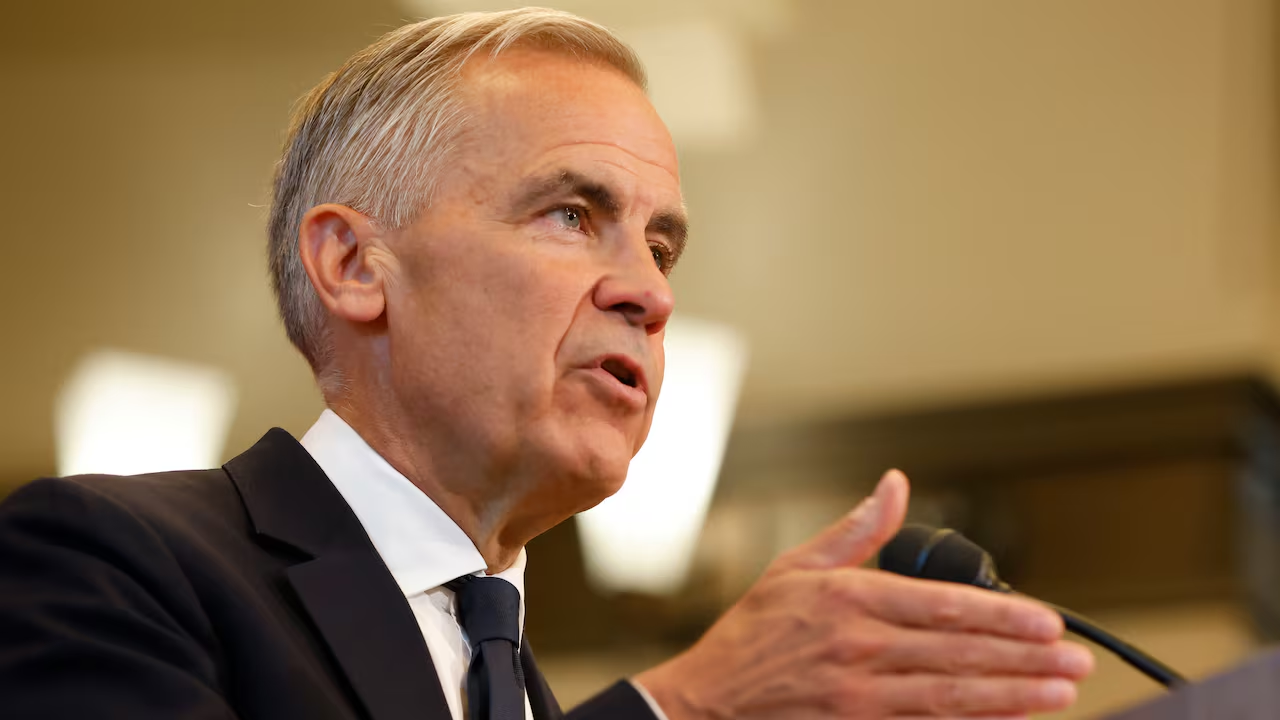
Canadians are furious. Admittedly, this can be hard for outsiders to detect, given a national reputation for emotional restraint broken only by the occasional hockey riot. But the man who stepped in front of cameras Saturday morning was not the composed technocrat the world associates with Mark Carney. He was, by any reasonable reading, seething.
A Prime Minister Who Dropped the Diplomatic Register
Carney framed it plainly. Being attacked, he said, means you are at war, and Canada had been attacked. Then he pivoted to inventory: reserves, resilience, a plan, focus. The country would respond, he said, by concentrating on what it can actually control and on what it intends to build.
The rare press conference was notable less for its content than for its bluntness. Carney tends toward careful phrasing. This was not that.
Canada abandoned the negotiating table with an agreement seemingly within reach, walking out just hours before American tariffs of 50 percent were set to hit a range of Canadian exports. Matching retaliatory measures are scheduled to begin on 8 September.
What Actually Broke
Carney’s explanation pointed to eleventh-hour American demands he described as economically indefensible and as raising doubts about whether any resulting agreement could be relied upon. Washington rejected that account entirely, arguing the late demands came from the Canadian side.
Canada’s ambassador to the United States, Mark Wiseman, offered a more granular picture in subsequent interviews. There was no single deal-breaking clause, he suggested. Instead, across multiple files, the language that ended up in the text, or at least the American reading of that language, diverged from what Canadian negotiators believed had been settled.
The sticking points reportedly clustered around several areas:
Tariff treatment of automobiles and auto components. Digital and cultural policy, long a sensitive file in Ottawa. And most strikingly, an asserted American right to veto Canadian trade agreements with third countries.
That last item deserves attention. A veto over whom your neighbour may trade with is not a commercial provision. It is a sovereignty provision.
Compounding all of it is a simple credibility problem. This administration has imposed tariffs unilaterally and repeatedly, including within the past week. Carney’s summary was memorable: sometimes an American signature on a trade agreement is written in pencil.
Public Opinion Hardened, Not Softened
Here is what may surprise observers abroad. Canadian voters, already lukewarm about signing anything new with Washington, have rallied firmly behind the prime minister, despite knowing the walkout carries a genuine economic cost.
The anger is not really about trade mechanics. Very few Canadians hold passionate views on rules-of-origin thresholds for auto parts, softwood lumber arrangements or supply-managed dairy quotas. In healthier times these are the routine irritants that surface between any two heavily entangled economies. Friends argue about them and move on.
What has changed is the sense that these disputes are being used as pretext.
A Feeling of Betrayal, Not a Trade Dispute
The prevailing emotion is closer to betrayal than frustration. Canada shares continental defence obligations with the United States. It permitted its economy to become deeply, structurally intertwined with the American one, on the understanding that the relationship was among equals who wished each other well.
The current reading in Canada is that ordinary trade grievances are being deployed as cover for something else: coercion aimed at subordination, and possibly at absorption. Few Canadians believe this is a negotiation about goods.
That is why comments from Washington land so badly. When the U.S. transportation secretary appeared on television after the collapse to claim that America provides Canada’s security while Canadians take advantage, the response north of the border was not embarrassment. It was disbelief.
The United States does not provide Canadian security. Canada maintains its own armed forces and its own police services. The continental aerospace defence command is a jointly staffed, fully integrated body drawing on both militaries. Canadian commentators, this one included, have criticised the country’s inadequate defence spending for years. That is a fair argument. It is not the same argument.
Threats Nobody Is Meant to Take Literally
Then there are the repeated suggestions that Canada should become the fifty-first state, and the doctored maps showing an American flag draped across the entire continent. Canadians are instructed to treat these as serious but not literal, a formula that somehow never makes them less alarming.
Add threats to disregard border treaties, and an explicit reference to using economic force to bring Canada into the union, and the pattern stops looking like trolling.
Canadians do not want to become an American state. And even those few who might once have entertained the idea would not want to join whatever the United States is currently transforming into.
Nobody Chose This
No country in Canada’s position walks out of a negotiation with a superpower for sport. No nation this exposed, this dependent, this geographically adjacent tells the dominant power in its hemisphere to get lost unless every alternative has been exhausted.
The signal Carney is sending is aimed well beyond Washington. It is that the America everyone built their strategic assumptions around no longer exists, and that planning for a return to normal, even under a different administration, is wishful thinking.
A Warning to Everyone Else
Geography and economic integration mean Canada encounters the new American posture first. But that is a matter of sequence, not exemption.
To the commentators and politicians in Britain who imagine that some special relationship provides insulation: consider what Canada actually is. A smaller America, with a more stable political system and a monarch on the currency. Militarily integrated. Geographically inseparable. Culturally near-identical. If Washington is prepared to reduce Canada to a client, what accumulated goodwill do you believe will shield you?
A rupture in American values and objectives cannot be quarantined. It cannot be ignored into remission. When Carney described a historic break in the world order at Davos earlier this year, he meant it literally.
Canadians understand that defending sovereignty carries a price, and they have accepted it. This trade war was not sought. It follows only from a refusal to submit in advance to demands made in bad faith. Punishment will come.
Let the rest of the alliance take note. Prepare yourselves, and do it quickly.
Author