The prospect of Iran economic retaliation now hangs over global energy markets after Washington unveiled its latest attempt to choke off Tehran’s revenue streams. The Islamic Republic has responded not with concessions but with a set of threats aimed at making any economic squeeze expensive for everyone involved.
What Washington Actually Announced
Treasury Secretary Scott Bessent laid out the new approach at a Monday news conference, describing an effort to dismantle the elaborate network Iran has constructed over years to work around existing sanctions.
The measures fall under secondary sanctions, meaning they punish third parties who do business with Iran rather than Iran directly. The targeted sectors include digital assets, technology, and shipping, all areas Tehran has leaned on to keep money flowing.
The announcement had been billed in advance as an economic D-Day. What arrived felt smaller than the buildup suggested. Rather than unleashing dramatic new restrictions, the administration largely widened the reach of tools already in place and promised tougher enforcement, while signaling that harsher penalties remain available for countries that refuse to sever their Iranian connections.
The timing matters. Six months into a war launched by the United States and Israel, the conflict has settled into a stalemate with no diplomatic off-ramp in sight.
Iran’s Posture
Tehran’s public response has been notably unbowed.
Foreign Ministry spokesperson Esmail Baghaei offered a memorable framing to reporters, saying Iran has long been a chess player but has also learned poker, and has been playing a mixture of the two for some time now. The implication was that Tehran is prepared to bluff, raise, and force opponents to guess.
Three broad avenues of retaliation have emerged from Iranian statements.
Squeezing the Oil Supply Further
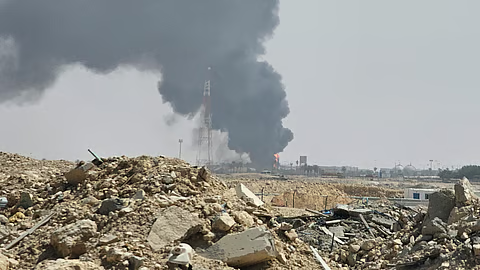
For months Iran has been obstructing traffic through the Strait of Hormuz, a chokepoint that once carried roughly a fifth of global oil and gas supply. Regional producers have been unable to move product through it at anything close to normal volumes.
The pressure has since spread. The Houthi movement in Yemen, aligned with Tehran, opened a second front in the Red Sea, striking Saudi export infrastructure.
Now Iranian military leadership is talking about going further. Mohsen Rezaei, who heads the Supreme National Security Council, wrote on X that if the economic war continues, no oil will leave the region at all, not through Hormuz and not from anywhere in the Persian Gulf. In a subsequent television interview he described the coming response as earthquake-like.
The threat extends specifically to the workarounds producers have devised.
Gulf oil companies from Saudi Arabia, Kuwait, Qatar, and the UAE have been switching off tanker transponders to avoid Iranian detection, operating with US Navy support. It has worked to a degree, though crossings remain far below prewar levels.
Saudi Arabia has redirected roughly 5 million barrels a day into its East-West pipeline, which reaches the Red Sea and skips Hormuz entirely. Other regional producers have rerouted an additional 2 million barrels daily.
Iran has made clear it is watching. Tehran published a list of 45 vessels it accuses of ignoring rules it is attempting to enforce in the strait, threatening fines, detention, or outright seizure for ships that do not comply.
Any successful strike on these alternative routes would push oil prices upward, with American drivers likely feeling it at the pump within weeks.
Widening the Map
The second threat involves geography.
Iran’s Foreign Ministry drew attention Monday to American refueling aircraft operating from Bulgarian territory, suggesting the EU and NATO member could become a target.
Baghaei framed it in legal terms, arguing Iran has a legitimate right to strike the origin point of any aggression against it, and that supporting American or Israeli military action amounts under international law to participation in that aggression.
Iran has already hit 11 countries during the conflict, concentrated in the Gulf. It is also thought to have struck a British facility in Cyprus and appears capable of reaching islands used by American forces far out in the Indian Ocean.
Striking a NATO member would be a categorically different act, potentially drawing in the alliance’s collective defense provisions. Rezaei stated that Iran will treat participation in or support for America’s economic campaign as an act of war.
The Nuclear Question
The third avenue is the most consequential and the least predictable.
Iran has consistently insisted its nuclear program serves peaceful purposes, rejecting American and Israeli claims that have justified repeated attacks on its facilities.
That position may be shifting. Supreme Leader Ayatollah Ali Khamenei, who had issued a prohibition on nuclear weapons, was killed in a US-Israeli operation. Since then, voices within Iranian officialdom have begun openly discussing withdrawal from the Nuclear Non-Proliferation Treaty, the agreement binding signatories never to build a weapon.
Roughly half a ton of highly enriched uranium remains inside Iran, material suitable for weapons construction. American intelligence assesses that Tehran has intensified work to secure and conceal the stockpile.
Iranian lawmakers say parliament is now considering legislation to exit the NPT. Rezaei added weight to that discussion in an unusual statement to state media, noting that people worldwide are questioning whether the treaty accomplishes anything, and asking why Iran should not pursue weapons of its own given the war being waged against it.
Why Pressure May Not Produce Surrender
Analysts are skeptical that blockade, sanctions, and military strikes combined will move Iran off its core demands, which center on economic relief and recognition of its authority over Hormuz traffic.
Sina Toossi of the Center for International Policy told CNN that Iran retains the ability to spread its own costs outward by threatening energy flows, infrastructure, and commerce across the region. He noted a structural problem in Washington’s approach: the more comprehensive the blockade, the more foreign governments must cooperate, and the more actors Tehran gains as potential pressure points.
Toossi expects Iran’s near-term strategy to blend adaptation with deterrence, building alternative economic lifelines where it can while demonstrating that attempts at total strangulation will carry regional consequences.
That leaves both sides betting the other will break first, with global energy markets waiting to see who is right.
Author