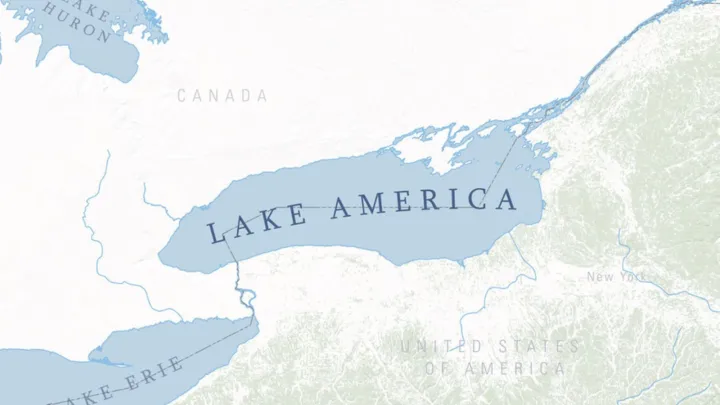
The Lake Ontario name change has spilled off government paperwork and onto phone screens, with Google Maps now displaying “Lake America” to users inside the United States. The shift arrived days after President Donald Trump ordered the renaming and had the US Geographic Names Information System updated to match.
What Users Will Actually See
Google explained its approach in a short statement. Because the company updates Maps to reflect official government sources, and GNIS serves that role in the United States, American users will see Lake America. Canadian users will continue to see Lake Ontario. Everyone else, anywhere outside the two countries, will see both names displayed together.
The company described this as consistent with a long-standing policy covering bodies of water whose names differ depending on which country you ask. The rollout has already begun.
It is a technically neutral position, though it has landed in an anything but neutral moment.
A Name With Deep Roots
Lake Ontario draws its name from the Wendat word “Ontari’io,” which translates roughly as big, beautiful lake. The Indigenous term came first. The province of Ontario to the north was subsequently named after the lake, not the other way around.
That sequence matters to critics of the change, who argue that overwriting a name of Indigenous origin carries weight beyond cartography.
Why This Happened Now
The renaming did not emerge from a geographic review. It arrived in the middle of a trade dispute between Washington and Ottawa that has been building for months.
The two governments had spent weeks trying to negotiate their way out of a conflict triggered by American tariffs on Canadian goods. Those talks collapsed when Canada withdrew. Prime Minister Mark Carney said late alterations to the terms were unfair, economically unsound, and raised doubts about whether any agreement could be relied upon.
Carney identified specific friction points, including American objections to:
- French-language product labeling requirements
- French content quotas for streaming services in Quebec
Those cultural and linguistic provisions proved harder to resolve than the tariff numbers themselves.
Ontario’s Response on the Shoreline
Premier Doug Ford answered on Saturday with a gesture aimed squarely at the cameras. He unveiled a sign on the lakeshore reading “Lake Ontario: Now and always,” printed in both English and French.
Ford was blunt about it, saying Trump could call the lake whatever he liked, but that the rest of the world would go on calling it Lake Ontario.
The bilingual wording was a pointed choice given that French-language rules were among the reasons talks broke down.
When the Change Crept Into Canadian Websites
The most awkward consequence was unintentional. Several Canadian government sites embed map data pulled directly from Google, and those pages began displaying the American label automatically.
Among them was the Liquor Control Board of Ontario, an agency that had already removed US alcohol from its shelves as part of the trade dispute. The irony of that particular site showing “Lake America” was not lost on anyone.
Ontario’s public services minister, Stephen Crawford, addressed the problem on Sunday evening. He confirmed that some provincial agency websites draw map data straight from Google and said a review was underway to ensure every page identifies the lake correctly as Lake Ontario.
The episode is a small but useful illustration of how much public infrastructure quietly depends on a handful of private platforms. A single database edit in Washington propagated through a commercial mapping service and surfaced on provincial government pages in another country within days.
Why Naming Disputes Are Rarely Just About Names
Geographic naming has long been a low-cost way for governments to make a point. It requires no legislation abroad, costs almost nothing, and generates immediate attention.
There are established precedents for split naming. Bodies of water that border multiple nations often carry different labels depending on the viewer’s location, and mapping companies have handled that ambiguity for years by localising what each user sees.
What makes this case notable is not the mechanism but the motive. The name did not change because of a border dispute or a historical claim. It changed during a commercial disagreement, which places it closer to a diplomatic message than a cartographic correction.
What Happens Next
Several threads remain open.
- Canada has given no indication it will alter its own official records, meaning the divergence will persist
- International users will keep seeing both names, which effectively preserves the original in global view
- Provincial agencies are working to override the automatic map feed on their sites
- The underlying trade dispute remains unresolved, and any renewed negotiation would likely have to address it eventually
For people who live along the shoreline, the practical effect is close to zero. The water has not moved. Local usage, road signs, school textbooks and everyday conversation in Ontario will continue as before.
What the dispute does reveal is how quickly a symbolic act can ripple outward in a digitally connected system, and how a five-hundred-kilometre lake with a name older than either country can become shorthand for a disagreement about tariffs, labeling laws and streaming quotas.
Whether the label sticks may depend less on cartography than on how long the trade fight lasts.
Author