The Cyprus ferry disaster has produced accounts that are difficult to read. Survivors described on Monday how a routine crossing turned into a scramble for exits, broken windows and open water, after the vessel capsized off the coast of northern Cyprus with 267 people aboard.
Eight people have died. Rescue teams are still searching for 18 who remain missing.
What Happened
The ferry departed Kyrenia, a port in breakaway northern Cyprus known in Turkish as Girne, on Sunday afternoon bound for Tasucu in Turkey. It went over roughly 7.5 kilometres, about four nautical miles, from the Cypriot coastline.
Survivors said the trouble began with a series of loud noises from below decks. The vessel then started listing and taking on water.
Serkan Kunduraci, who escaped by pulling himself through a broken window, said crew members inspected the situation and reassured passengers there was no serious issue, describing it as a loose gasket causing a leak.
By the time an evacuation order came, panic had already taken hold. Kunduraci said the ship began tilting as the captain apparently attempted to turn back toward Kyrenia.
Accounts From the Water
The testimony is unsparing.
Kunduraci described seeing people who could not swim die in the sea. He said some passengers, in their panic, failed to take life jackets, while others leapt into the water immediately out of fear. He recounted trying and failing to pull an elderly man to safety, and said he witnessed young children from one family drown.
He also described conditions inside the vessel as it went over, saying screaming filled the air and that many people were trapped toward the rear of the ship, unable to reach an exit. Bodies and people were piled on top of one another, he said, and those pinned underneath did not get out.
Deniz Ozpolat gave a similar account of the crush at the exits. He said passengers could not locate life jackets and that doors were closed on them, trapping the group until they were opened later. After jumping into the water, he and others broke windows to pull people out. He described a family stranded in open water with children.
The Rescue Effort
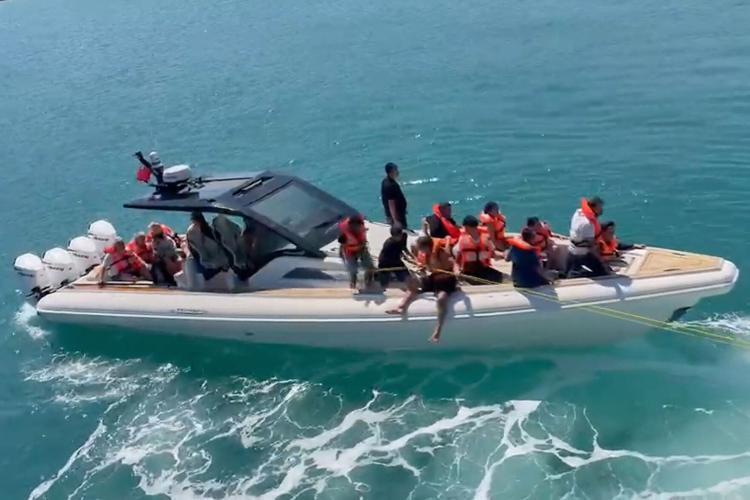
Muhammed Ozcelik, who operates a water sports business, said his boat was among the first to arrive and began pulling people from the sea.
He described being overwhelmed by the number of people calling out to be taken aboard, saying his boat exceeded its capacity because they could not refuse. People, he said, were fighting for their lives.
Images published in Turkish media showed passengers in orange life vests standing on the overturned hull, waiting for help. Others were later filmed coming ashore from small pleasure craft at a port.
The Turkish coast guard and military joined rescue teams from northern Cyprus in the operation.
Investigation Underway
Unal Ustel, prime minister of northern Cyprus, announced late Sunday that an inquiry had been opened and that the ferry’s eight crew members were taken into custody.
He said every aspect of the incident would be examined, that even minor negligence would be identified, and that anyone found responsible would face consequences.
Ustel described the sinking as the worst maritime disaster in Cypriot history.
The vessel was owned by Filo Denizcilik.
The Questions Investigators Will Face
Survivor accounts point toward several lines of inquiry, though none can be confirmed until the investigation progresses.
- What caused the initial noises and water ingress
- Whether the crew’s early assessment of a minor leak was accurate
- Why passengers reported difficulty locating life jackets
- Why some exit doors were reportedly closed during the evacuation
- Whether the decision to attempt a return to port affected the vessel’s stability
- Whether passenger numbers and safety drills complied with requirements
These are the standard questions after any capsizing, and the answers usually emerge slowly. The gap between what passengers experienced and what technical analysis eventually shows can be substantial.
The Political Context
The location adds complexity to any inquiry. Cyprus was divided along ethnic lines in 1974, and Turkish Cypriots declared independence in 1983. Only Turkey recognises the northern administration, where it stations more than 35,000 troops.
That status affects which regulatory frameworks apply, how international maritime bodies engage, and how findings will be received. Practical cooperation with Turkey is well established, as the joint rescue effort demonstrated, but the wider legal picture is less straightforward than it would be elsewhere in the Mediterranean.
What Remains
For the families involved, the immediate reality is the search still underway for 18 people, and the confirmed loss of eight others.
The survivor accounts share a common thread: confusion in the critical early minutes, uncertainty about whether the situation was serious, and then a compressed window in which everything depended on being near an exit. Several of those who escaped did so through windows they broke themselves.
That detail alone is likely to shape how the inquiry examines evacuation procedures aboard the vessel.
Author