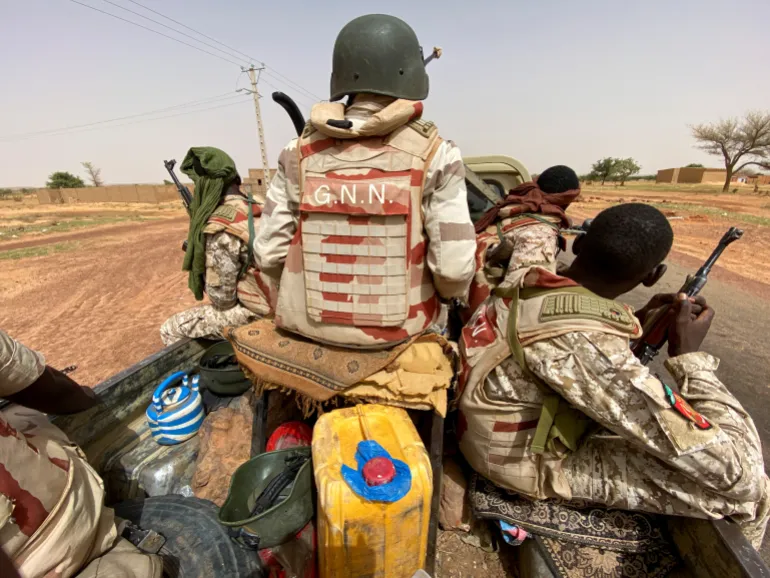
The Niger mutiny that erupted in Niamey over the weekend has been suppressed, but the episode has laid bare two uncomfortable realities for the country’s military government: an army under severe strain from years of losses, and a security arrangement in which Russian personnel now play a visible role in domestic crises.
Government forces regained control, yet the questions raised by the uprising are unlikely to fade quickly.
How the Uprising Unfolded
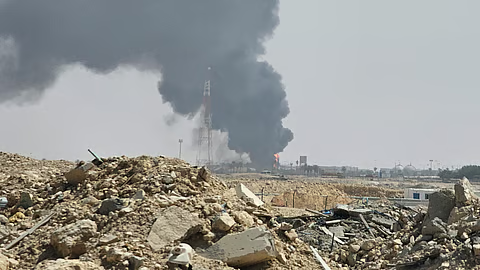
The trouble began Saturday at Base 101, a military installation located at Diori Hamani International Airport in Niamey.
According to the Associated Press, it started as a hostage situation, with soldiers seizing fellow servicemen before opening fire and moving against locations the Defence Ministry described as sensitive.
Fighting spread beyond the base. Gunfire and explosions were reported around the airport, the state broadcaster went off air temporarily, and the presidential palace was targeted, according to Reuters and Al Jazeera.
Niger’s army said it retook Base 101 after hours of combat. State media reported dozens of soldiers killed or detained, though Reuters noted it could not independently confirm those figures. Nigerien state outlets said hundreds of soldiers participated, a number that also remains unverified.
The Presidential Guard stayed loyal to General Abdourahamane Tiani, who took power in a coup in July 2023.
Who Was Involved and Why
The leadership and precise scale of the mutiny remain unclear, and no motives have been officially established.
Reports indicate some participants came from areas including Ouallam, Tera and Dosso in southwestern Niger, regions where the army has absorbed heavy casualties fighting armed groups.
Analysts and security sources have connected the unrest to frustration over deteriorating security and mounting losses.
- An ISIL affiliate attack earlier this month killed 18 Nigerien soldiers
- The airport complex housing Base 101 was attacked in January by an ISIL affiliate
- It was struck again in June by JNIM, al-Qaeda’s Sahel affiliate
The bitter irony is that Tiani and his fellow officers justified the 2023 coup by accusing the elected government of failing to contain armed groups. Three years on, the threat persists and the pressure has now surfaced inside the barracks.
This appears to be the most serious internal challenge Tiani has faced since taking power.
Russia’s Africa Corps Steps In
The most consequential detail is who helped put the mutiny down.
Africa Corps is a Russian force operating under the Ministry of Defence. It absorbed much of the Wagner Group’s role across Africa after Moscow restructured its operations following Yevgeny Prigozhin’s death in 2023, and it includes former Wagner personnel under direct state control.
AP reports the force maintains between 200 and 300 personnel in Niger, with some stationed at Base 101 itself.
Russia’s ambassador to Niger, Viktor Voropaev, said Nigerien authorities requested assistance in neutralising the mutineers. According to AP, Africa Corps supplied both ground and aerial support after loyalist forces struggled to retake the base.
That distinction matters. Russian personnel were not fighting insurgents in the countryside. They were assisting a government against elements of its own army.
Algeria and Regional Backing
Russia was not the only outside actor involved.
Niger’s presidential office said Algeria provided military assistance. Reuters reported this included four fighter jets, a transport aircraft and a refuelling tanker.
The Alliance of Sahel States, which Niger formed with Mali and Burkina Faso after all three moved away from ECOWAS, expressed support for the government. Turkiye voiced solidarity while calling for restraint.
It has not been confirmed whether Mali or Burkina Faso contributed forces. Political backing should not be read as evidence of military participation.
The Western Retreat
The crisis illustrates how thoroughly Western influence has receded.
France maintained a substantial military presence in Niger as part of its Sahel counterinsurgency effort. Those forces withdrew after relations collapsed following the 2023 coup. American forces later left Base 101 and other Nigerien installations.
No new French or British military response to this specific mutiny has been reported. France’s relevance now lies mainly in its absence, and the British role in Niger was always considerably smaller.
What Russia Gains
Moscow has cultivated military relationships with all three Alliance of Sahel States governments, and Africa Corps forms the operational core of that engagement in Niger.
The mutiny gave the partnership a new dimension. When the government faced an armed threat from within, Russian personnel were already positioned to help.
Whether that converts into greater political leverage over Tiani’s government is unclear. The episode does not demonstrate that Russia controls Niger’s armed forces. What it does demonstrate is dependence of a particular kind: a government able to reach for foreign troops during a domestic military crisis.
The Problem Russia Cannot Solve
Containing a mutiny is not the same as resolving the conflict that produced it.
Groups affiliated with al-Qaeda and ISIL remain active, particularly in western Niger. Soldiers continue dying at a rate that appears to be feeding resentment within the ranks.
Africa Corps can supply personnel, equipment and operational support. Nothing in this episode suggests it can address the underlying insecurity or the strain on front-line units.
The Contradiction Facing Tiani
The government seized power promising security and sovereignty. It now confronts a persistent armed insurgency, an army mounting internal challenges, and a security architecture that has shifted from Western dependence to Russian dependence rather than to genuine self-reliance.
The immediate threat has been contained. The conditions that generated it have not been.
Author