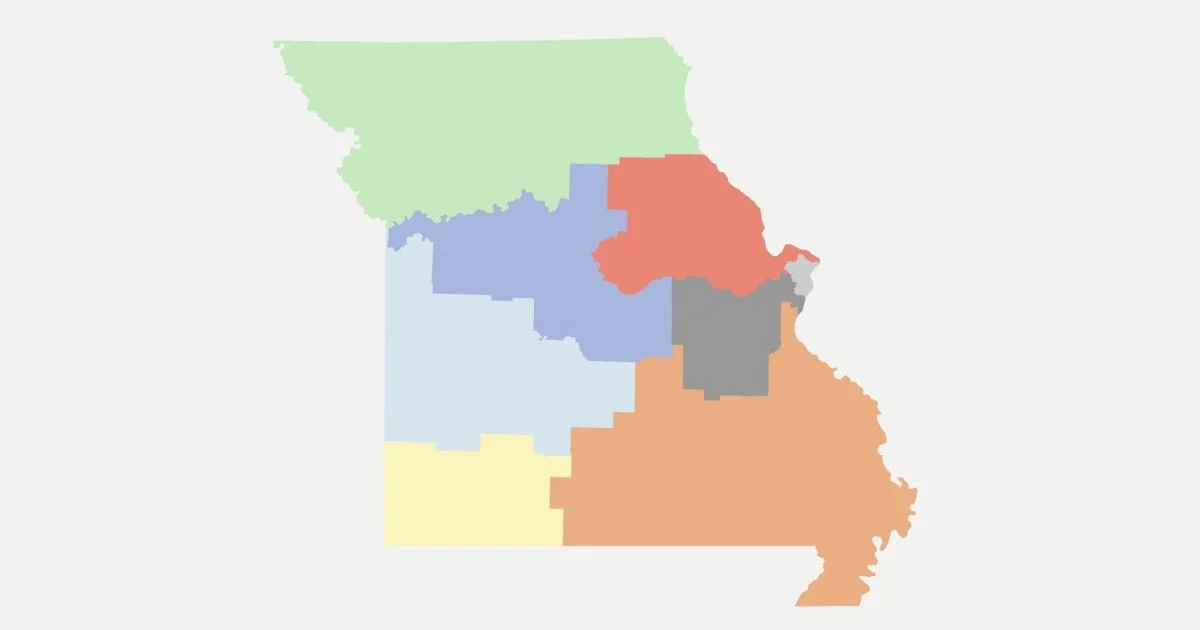
The Missouri congressional map drawn by Republican lawmakers will not be in play this November, after the state’s highest court ruled that voters — not the Legislature alone — get the final word on whether it survives.
In a decision handed down Thursday, the Missouri Supreme Court determined that a citizen-led referendum challenging the redrawn boundaries must appear on the general election ballot. Until that vote happens and the results take effect, the state has to fall back on the district lines it used before the rewrite. For Republicans who spent months pushing the new map through, it is a significant setback.
Why the New Map Was Drawn in the First Place
Missouri redrew its districts in 2025, well outside the usual once-a-decade cycle that follows the census. The push came after President Donald Trump encouraged several Republican-controlled states to revisit their maps as a way of protecting the party’s slim majority in the U.S. House.
The redesign had a clear target. Missouri sends just two Democrats to Congress, and the new lines were shaped to make one of those seats effectively unwinnable. Longtime Representative Emanuel Cleaver, who has represented the Kansas City area for years, would have found himself running in a district transformed from safely Democratic into solidly Republican territory.
The numbers illustrate the scale of the shift:
- Under the old lines, Cleaver won his 2024 race by roughly 24 percentage points.
- Under the redrawn 5th District, Trump would have carried the seat in 2024 by more than 17 points.
That is a swing of roughly 40 points on paper — the kind of redrawing that decides an election before a single ballot is cast.
A Signature Drive That Turned Into a Court Battle
Opponents did not go quietly. The advocacy group People Not Politicians Missouri launched a veto referendum campaign, a process that allows Missouri voters to overturn legislation passed by their lawmakers if enough signatures are collected.
The effort succeeded, and then some. Organizers turned in more than 300,000 signatures, comfortably clearing the threshold required to qualify for the ballot. But Missouri Secretary of State Denny Hoskins declined to certify the petition, arguing that the referendum itself was not constitutionally valid.
That refusal sent the dispute straight to the Missouri Supreme Court. Justices heard oral arguments on Wednesday and issued their ruling the following day — an unusually fast turnaround, driven by a hard deadline. The state had until September 8 to lock in the contents of its general election ballot.
What the Court Actually Ordered
Judge Ginger K. Gooch wrote the ruling, which bars Hoskins and anyone acting on his behalf from putting the new map into effect for the November 2026 general election or at any point afterward. The only path forward for the map runs through the voters: if Missourians approve it in November, it takes effect thirty days later. If they reject it, the redraw is dead.
In practical terms, that means the fall elections proceed under the old boundaries. Cleaver will run in the district he has held for years, one that leans heavily in his favor.
It is worth noting that the August primary was already conducted using the Republican-drawn lines — a detail that sits at the center of the legal fight now unfolding.
Reaction Splits Sharply Along Party Lines
Cleaver welcomed the outcome, framing it as a win for the hundreds of thousands of residents who signed the petition and describing the attempt to keep the question off the ballot as an effort to silence them. He characterized the ruling as democracy holding up under pressure.
Richard von Glahn, executive director of People Not Politicians, argued the significance stretches past Missouri’s borders. With map-drawing becoming a political instrument nationwide, he suggested other states and courts are paying close attention to what happens here, and that a referendum victory would demonstrate that voters retain real leverage.
Republicans saw it very differently.
Missouri Attorney General Catherine Hanaway announced plans to take the case to the U.S. Supreme Court, calling the decision unprecedented and warning that overturning a map between a primary and a general election has no historical parallel. She described the situation as a constitutional crisis and predicted federal courts would step in.
Trump weighed in on Truth Social, blasting the ruling in blunt terms and insisting the state should be allowed to use the same map that governed the primary just weeks earlier.
The Republican National Committee also pushed back, with Election Integrity Communications Director Ally Triolo saying the party is reviewing all available options to challenge the outcome.
The National Backdrop
House Democratic Leader Hakeem Jeffries used the moment to draw a comparison. He pointed to a U.S. Supreme Court decision in May that let stand a Virginia ruling striking down a voter-approved map favorable to Democrats. Jeffries said Democrats will be watching whether the federal court applies consistent reasoning in Missouri or bends toward Republican interests.
That comparison captures the broader environment. Missouri is one of several Republican-led states that pursued mid-decade redistricting at Trump’s urging, all with the same goal: adding safe seats ahead of a midterm cycle where control of the House looks genuinely uncertain. Democrats have responded with their own countermoves in states where they hold power.
A Rare Historical Echo
Referendums on congressional maps are extraordinarily uncommon in Missouri. The last one dates back to 1922, when the Republican-controlled Legislature redrew districts and voters were given the chance to weigh in. They rejected the map outright.
More than a century later, Missourians face a strikingly similar question. Whether the answer rhymes with 1922 will not be known until November — assuming the federal courts allow the vote to proceed at all.
Author