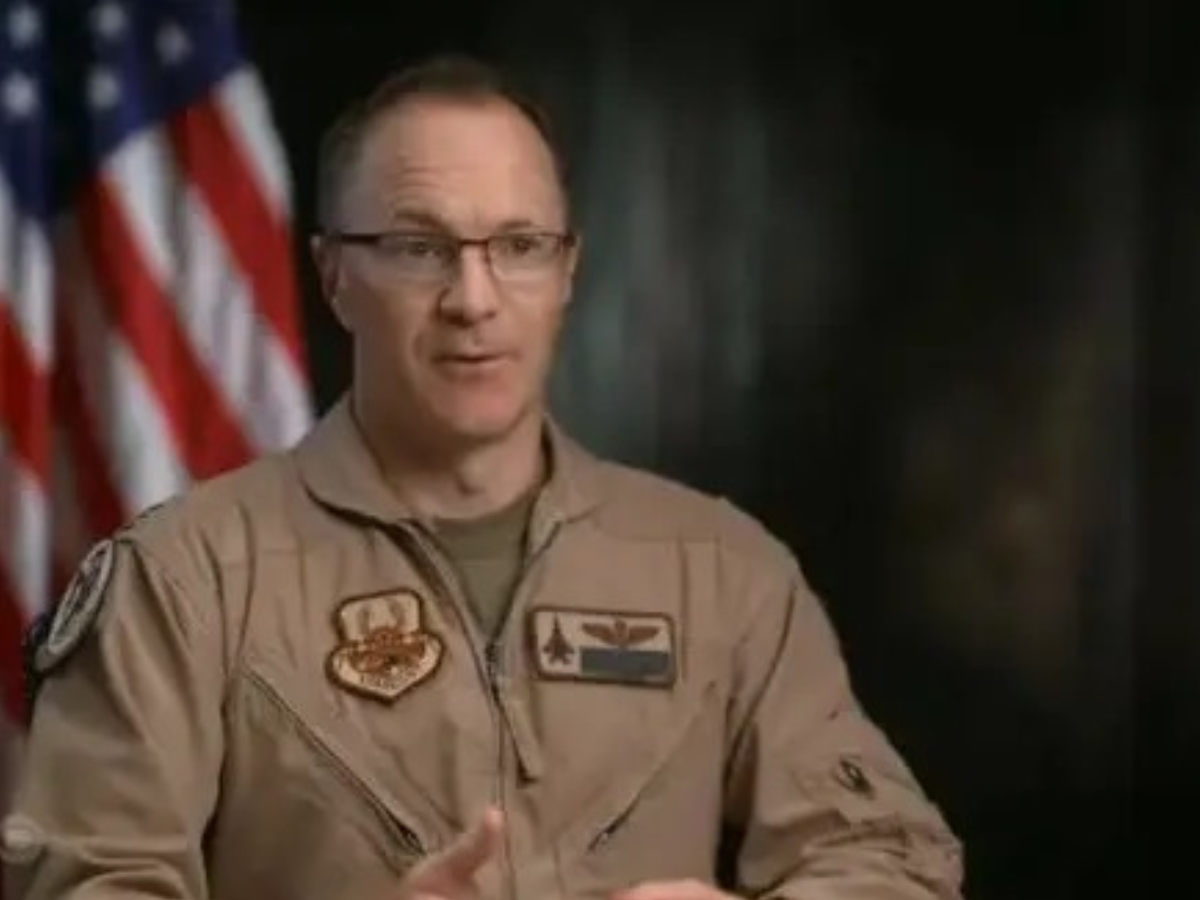
The airman rescued from Iran after his aircraft was shot down in April has spoken publicly for the first time, describing a 50-hour ordeal that began with a damaged parachute and ended on a mountain ridge with American special operators walking toward him.
He appeared on a 60 Minutes broadcast Sunday under the call sign Bravo, used to protect his identity. The Pentagon has not publicly named either crew member, citing safety concerns and the risk of exposing sensitive information.
The Fall
The parachute failed to deploy properly after the aircraft was hit.
During free fall, Bravo said, he did everything possible to unfurl or pull pieces of the parachute loose. He described it as the most terrifying thing he has ever seen.
The impact broke his back, an arm and a shoulder. He also sustained a sprained ankle and bloody scrapes across his head and face.
Moving With Broken Bones
What followed is difficult to reconcile with those injuries.
After ejecting from the F-15, the weapon systems officer avoided detection by advancing Iranian forces and climbed a 7,000-foot ridge. His equipment amounted to a pistol, a communication device and a tracking beacon.
The aircraft’s pilot was recovered shortly after the crash. Bravo waited 50 hours.
The First Message
Once he found ground offering some concealment, he began working toward communication.
He told CBS’s Norah O’Donnell that when he reached the point where he could pause and absorb what he had been through, the first message he transmitted was God is good.
What It Took to Reach Him
The recovery effort involved hundreds of American military and intelligence personnel.
Special operations forces included Army Delta Force and Navy SEAL Team Six. Ahead of the operation, CIA operatives ran a deception campaign designed to mislead Iranian forces, whose leadership had reportedly offered a bounty for the airman’s capture.
Bravo described hiding alone in a mountain crevice for hours while elite American service members moved toward him, supported by US aircraft dropping bombs to clear the area.
The broadcast included declassified Pentagon video showing Air Force pararescue operators approaching his position. He declined to share what they said to him when they arrived.
The Part That Nearly Went Wrong
The operation contained a serious complication that has received little attention.
Two MC-130J special operations transport aircraft were waiting to carry the commandos and the rescued airman out of the country. Both became damaged at some point during the mission, leaving more than 90 special operators briefly stranded inside Iran.
After those personnel were eventually extracted, the US destroyed the disabled aircraft to prevent them falling into Iranian hands, then sent replacement planes.
A rescue mission that required its own rescue is not a small detail.
The Dispute Over the Interview
The broadcast itself became a story before it aired.
CNN reported Saturday that Defense Secretary Pete Hegseth and political appointees within his department pushed for both crew members to participate in the exclusive and heavily publicised segment, according to multiple sources familiar with the matter.
Three of those sources said both airmen initially expressed reservations, while military officials worried about disclosing classified details of the rescue. The pilot ultimately declined to take part. CNN also reported that political appointees in Hegseth’s office insisted the interview proceed over objections raised within the military chain of command.
Chief Pentagon spokesperson Sean Parnell rejected the account entirely, calling the story a complete lie.
The decision to participate belonged to each pilot alone, Parnell said, because it is their story. He noted that one chose to appear and one did not, and added that the department took considerable care to protect operational security, sources and methods.
What Bravo Said About It
The airman offered no comment on the controversy surrounding his appearance. What he did describe was the moment that ended his ordeal.
Seeing his rescuers arrive on the ridge line where he was hiding, he said, was one of the greatest moments of his life. He added that he does not know how to express it more clearly than thank you for everything they did.
Why This Case Stands Out
Combat search and rescue operations of this scale are rare, and successful ones deep inside hostile territory are rarer still.
The elements here were extraordinary on every axis. A severely injured airman evaded capture for more than two days while a bounty hung over him. Two of the most capable special operations units in the American military deployed alongside an intelligence deception campaign. Aircraft were deliberately destroyed to protect technology. Ninety-plus operators were temporarily stranded.
All of it happened to retrieve one person.
That calculation, and the willingness to accept that risk, is the part of the story Bravo seemed most focused on when he thanked the people who came for him.
Author