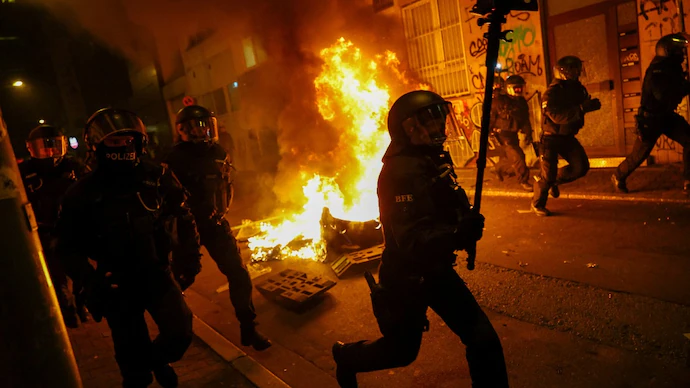
Gen Z protests in Germany turned from peaceful marches into scenes of chaos on Saturday night, as hooded demonstrators smashed shop windows and looted stores in central Frankfurt. The unrest capped a day in which tens of thousands of young people filled the streets of the country’s biggest cities, demanding more money for schools and hospitals, relief from soaring living costs, and an end to compulsory military service.
A Nationwide Day of Action
The demonstrations were coordinated by a campaign calling itself “Gen Z regelt,” a phrase that roughly translates to “Gen Z takes charge.” Rallies were staged in 34 cities, with the largest crowds gathering in Berlin, Frankfurt and Munich. The scale of the mobilisation reflected a growing sense among younger Germans that their concerns are being sidelined by a government focused elsewhere.
The movement did not emerge in isolation. Across Europe this year, young people have been taking to the streets in unusually large numbers. In Serbia, student organisers were central to a campaign that eventually pushed the country’s long-standing leader out of office through the ballot box. In France, youth-led demonstrations have at times spiralled into rioting and looting, producing images that German officials were clearly hoping to avoid.
Frankfurt Descends Into Violence
That hope was dashed in Frankfurt. As night fell, groups of demonstrators with their faces covered began targeting shops in the city centre. At least two stores were looted and several others were damaged, according to a witness working for Reuters. Officers found it difficult to regain control of the area.
Frankfurt police used social media to warn the public, describing ongoing violent disturbances and confirming that windows had been broken at multiple businesses. Most alarmingly, they reported that Molotov cocktails were being thrown at emergency responders. Residents were urged to stay away from the city centre entirely or to leave if they were already there.
Trouble was not confined to Frankfurt. In Hamburg, demonstrators set fire to makeshift barricades. Even so, authorities stressed that the overwhelming majority of the day’s events had passed off peacefully, while cautioning that radical factions might try to hijack the gatherings for their own purposes.
What the Protesters Want
Beneath the headlines about violence lies a set of fairly concrete demands. The campaign has pulled together young people who object to being conscripted into the military and who want the state to spend more on education, healthcare and other public services. Many say that getting by in Europe’s largest economy has become increasingly difficult as prices climb.
Speaking at the Berlin rally, Gen Z regelt spokesperson Lina Friedrich framed the movement as a stand for peace and personal freedom rather than war and compulsion. She said the group’s top priorities were stronger health and education systems, an end to mandatory military service, and a fairer sharing of society’s burdens.
An 18-year-old named Steve, scheduled to speak in Munich, aimed his remarks directly at Chancellor Friedrich Merz. He accused the government of responding to young people’s worries with nothing but further cuts and additional pressure, and vowed that protesters would keep exercising their right to assemble until they were no longer ignored.
Turnout Falls Short of Expectations
Despite the energy on display, the crowds were considerably smaller than organisers had hoped. Ahead of the event, the campaign predicted that around 182,000 people would take part. Police estimates for Frankfurt, Munich and Berlin combined came to roughly 18,000. Even the campaign’s own website claimed only 36,000 participants, about double the police figure but still a fraction of the original projection.
The gap between ambition and reality has prompted questions about how deep the movement’s support actually runs, and whether it truly speaks for a generation or for a narrower slice of politically active youth.
Government Raises Alarm Over Extremists
Federal officials have been watching the campaign closely. Germany’s interior ministry said that elements of the far-left extremist scene, along with certain groups connected to foreign extremist movements, had been involved in drumming up participation for the demonstrations.
Roman Poseck, interior minister for the state of Hesse, where Frankfurt is located, made pointed reference to the unrest seen across the border in France. He said the images of looting, burning buildings, torched police vehicles and assaults on officers were fresh in everyone’s memory, and insisted that France should not be treated as an example to follow.
Businesses had already braced for trouble. In several cities, shop owners boarded up their windows and planned early closures. Even retailers along Berlin’s exclusive Kurfuerstendamm shopping street took such precautions.
A Generation Under Pressure
The organisers describe the protests as a reaction to mounting financial and social strain on younger Germans. The country has struggled to revive economic growth in recent years, and demographic shifts are adding to the pressure. As baby boomers leave the workforce and the number of working-age people shrinks, the costs of pensions and public services are increasingly landing on the shoulders of the young.
Military conscription has become a particularly sore point. For many participants, the idea of being required to serve while the state simultaneously trims spending on schools and healthcare feels like a double injustice.
Doubts About Who Is Really in Charge
Not everyone is convinced the campaign represents young people as broadly as it claims. The initiative has drawn in a wide mix of political and civil society organisations, which has fuelled speculation about who is actually steering it. Germany’s national umbrella body for school students, known as BSK, has publicly distanced itself from Gen Z regelt and announced that it will hold its own separate day of protest on November 20.
That split suggests the youth movement in Germany is far from unified. While the grievances about cost of living, public services and conscription appear widely shared, the question of who gets to speak for Gen Z remains very much open.
What Comes Next
With a second protest day already on the calendar and the government showing little sign of changing course, the standoff between young Germans and their leaders looks set to continue. The violence in Frankfurt may complicate the movement’s message, giving critics an easy way to dismiss it. But for the thousands who marched peacefully, the underlying frustration is unlikely to fade anytime soon.
Author