Indonesia Volcano Eruption Kills Three as Search for 20 Missing Hikers Continues on Halmahera
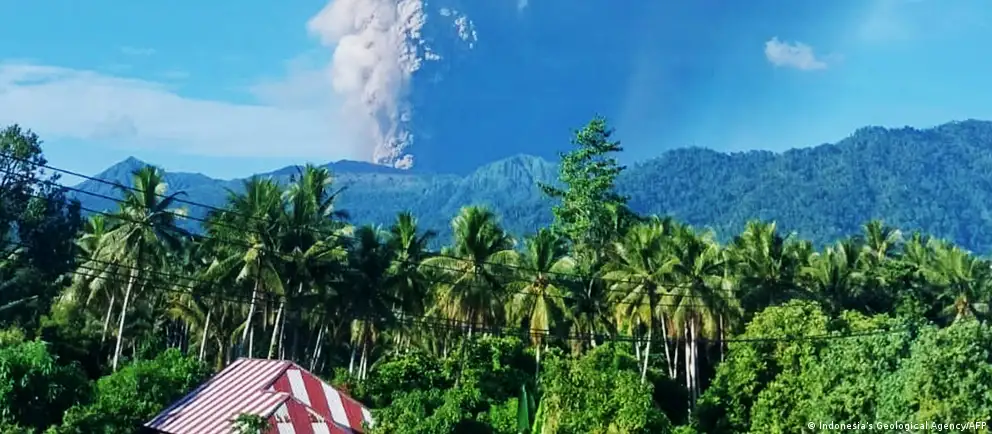
A powerful Indonesia volcano eruption has thrown the eastern island of Halmahera into chaos, leaving at least three people dead and 20 hikers missing. Mount Dukono, one of the country’s most active volcanoes, erupted on Friday morning, sending a massive ash plume into the sky and triggering one of the largest emergency response operations the region has seen this year.
Authorities are now in a frantic race against time, hoping to find survivors as conditions on the mountain remain dangerous and unpredictable.
A Sudden, Violent Eruption
Mount Dukono erupted at 07:41 local time (22:41 GMT on Thursday), unleashing a tower of volcanic ash that climbed as high as 10 kilometres (around 6.21 miles) into the sky. According to Indonesia’s Center for Volcanology and Geological Hazard Mitigation, the eruption was also accompanied by a “weak to strong booming sound” — a chilling soundtrack to a disaster that unfolded in moments.
For people on the ground, especially hikers near the mountain, the eruption left almost no time to react.
Three Confirmed Dead, Including Foreign Tourists
Police chief Erlichson Pasaribu of North Halmahera confirmed that three hikers have died in the eruption, two of whom are foreign nationals. The news has cast a sombre mood over what is normally a popular trekking destination.
While their nationalities have not all been disclosed, authorities have confirmed that several foreigners were on the mountain at the time of the eruption — including hikers from Singapore.
20 Hikers Still Missing
The fate of 20 other hikers remains unknown. According to Iwan Ramdani, head of the local rescue agency, nine of the missing are believed to be from Singapore.
Search and rescue teams are pushing through difficult terrain, with personnel that include:
- Local rescue agency staff
- Police units
- Volunteer search teams
- Medical responders prepared for trauma cases
The challenges they face are enormous: thick ash, unstable ground, lingering volcanic activity, and the ever-present risk of follow-up eruptions or lava flows.
Why Were Hikers Even There?
Perhaps the most troubling detail of this tragedy is that the area had been officially closed to visitors since April 17. Scientists had been monitoring rising volcanic activity for weeks and warned that conditions were becoming dangerous.
Despite the closure, hikers reportedly entered the restricted zone — a decision that has now turned catastrophic.
This raises serious questions for authorities and the broader trekking community, including:
- How were tourists able to access a closed volcanic zone?
- Were warnings communicated clearly enough to international visitors?
- Should patrols and entry checks be strengthened around active volcanoes?
These are issues Indonesian officials are likely to confront in the days ahead.
Authorities Issue Strong Safety Warnings
Following the eruption, Indonesian authorities have issued a series of urgent safety advisories. Both residents and tourists have been told to stay at least 4 kilometres (2.4 miles) away from the Malupang Warirang crater, which is currently the centre of volcanic activity.
Officials are warning of multiple ongoing dangers, including:
- Volcanic ash rain affecting nearby towns
- Direct threats from ejected rocks
- Potential lava flows
- Reduced visibility and respiratory hazards from heavy ash
The ash cloud has been drifting north, leading the government’s volcano agency to issue a specific warning for residents of Tobelo town. Communities in the path of the ashfall have been advised to wear masks, secure water sources, and stay indoors when possible.
A Long History of Activity
Mount Dukono is no stranger to eruptions. In fact, it ranks among the most active volcanoes in Indonesia — and that’s saying something for a country that sits on the famously volatile “Ring of Fire.”
Some key facts:
- Mount Dukono has produced nearly 200 eruptions since March
- It has been in a near-constant state of activity for years
- It is closely monitored due to its frequent ash emissions
- Its location on Halmahera puts surrounding villages and tourist trails at constant risk
While most of its eruptions are small and pose limited danger, Friday’s event was significantly more powerful, catching even some experienced observers off guard.
What Comes Next
Search and rescue teams are continuing operations as conditions allow, but officials caution that the work will be difficult and slow. Ash continues to fall, and any sudden change in volcanic behaviour could force a temporary halt to ground searches.
The next steps for authorities are likely to include:
- Locating and recovering survivors as quickly as possible
- Identifying victims and notifying families
- Coordinating with foreign embassies, particularly Singapore’s
- Reviewing access controls for closed volcanic zones
- Reassessing tourism advisories in areas with active volcanoes
International support and assistance may also play a role, especially as the eruption involves multiple foreign nationals.
A Tragic Reminder of Nature’s Power
This eruption serves as a stark reminder that volcanoes — particularly those as active as Mount Dukono — are unpredictable and unforgiving. Even with modern monitoring systems, advanced warning networks, and clear safety zones, nature can shift suddenly and devastatingly.
For the families of the missing hikers, the next few hours and days will be agonising. For Indonesia, it’s another sobering moment in a country that has long lived in the shadows of its volcanoes.
Final Thoughts
The Indonesia volcano eruption at Mount Dukono is a tragedy unfolding in real time. With three dead, 20 missing, and an entire region under volcanic threat, the situation is critical. The full scale of the disaster won’t be clear for some time, but what’s already certain is that this event will leave deep marks — emotionally, environmentally, and politically.
As rescue teams push deeper into the ash-covered terrain, the world watches and hopes for survivors. And for many travellers, this disaster is a powerful reminder: when scientists warn that a volcano is too dangerous to climb, those warnings exist for a reason.
Author