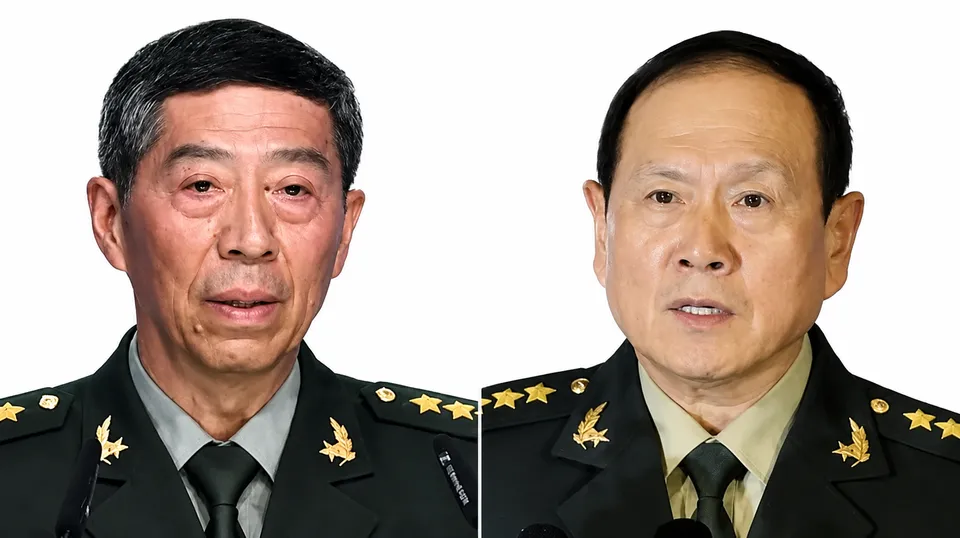
Former China Defence Ministers Sentenced to Suspended Death in Sweeping Military Corruption Purge
Two former China defence ministers have been hit with some of the harshest punishments yet in Beijing’s sweeping crackdown on military corruption. Li Shangfu and Wei Fenghe — both once among China’s most powerful military figures — have been handed suspended death sentences for bribery, marking a dramatic escalation in President Xi Jinping’s years-long campaign to clean up the People’s Liberation Army (PLA).
The convictions are sending shockwaves through China’s military establishment, signalling that even the country’s most senior generals are no longer safe from punishment.
A Major Verdict from China’s Military Court
According to Chinese state media outlet Xinhua, both Li Shangfu and Wei Fenghe were convicted on Thursday and sentenced to death with a two-year reprieve. In China, this type of sentence is typically commuted to life imprisonment if the convicted individual demonstrates “good behaviour” during the reprieve period.
But this case carries unusually harsh terms. The state media report confirmed that:
- Neither man will be eligible for parole
- Both have been stripped of their political rights for life
- All personal property has been confiscated
- Their sentences are intended to be especially severe
In effect, both former defence ministers are facing the practical equivalent of life imprisonment — a punishment few in China’s military elite ever expected to face.
A Warning to the Country’s Top Brass
These verdicts are widely seen as more than just a punishment for two officials. Analysts argue they’re a direct message to the rest of China’s senior military leadership.
The clear takeaway: seniority, political connections, and powerful military positions no longer guarantee immunity from corruption probes. Xi Jinping’s anti-graft campaign is willing to take down even those with the highest ranks and the deepest networks within the Communist Party.
For other generals in the PLA, the message is equally blunt — the rules have changed.
Who Are Li Shangfu and Wei Fenghe?
Both men once held some of the most influential roles in China’s military.
Li Shangfu served as defence minister for just seven months in 2023, but his career stretches back through several powerful positions. From 2017 to 2022, he led the PLA’s military equipment procurement department, giving him control over enormous defence budgets and access to highly sensitive technologies.
State media previously accused him of:
- Serious violations of Party discipline
- Seeking improper benefits in personnel decisions
- Using his roles to secure favours for himself and others
- Accepting massive sums in cash and valuables
Wei Fenghe, his predecessor as defence minister, served in that role for five years. Before that, he was the head of the PLA Rocket Force — a critical command responsible for China’s nuclear arsenal and strategic missile programmes. That makes his fall particularly significant.
While the position of defence minister in China carries less raw power than its Western equivalents (real military authority lies with the Central Military Commission), both men’s previous postings gave them direct access to massive budgets, advanced weapons systems, and lucrative procurement decisions.
How Big Is Xi’s Military Purge?
The convictions of Li and Wei aren’t isolated events. They are part of a much larger crackdown that has rocked China’s armed forces since 2022.
According to a study by the Center for Strategic and International Studies (CSIS), more than 100 senior military officers have been purged or are believed to have been purged in recent years. The number includes:
- Officials publicly stripped of their positions
- High-ranking figures placed under investigation
- Generals and officers who simply vanished from public view with no explanation
The pace and scope of the purge are unprecedented in modern Chinese history, and they’re raising serious questions about the operational stability of the PLA.
Why Xi Jinping Is Pushing So Hard
Since coming to power in 2012, Xi Jinping has made his anti-corruption campaign one of the defining themes of his rule. Initially focused on civilian officials and party cadres, the crackdown has increasingly turned toward the military — particularly elite branches like the Rocket Force.
There are several reasons Xi is intensifying the pressure on the PLA:
- He wants to ensure absolute loyalty within the armed forces
- He aims to root out networks of influence that could rival his authority
- He hopes to clean up procurement scandals that have weakened readiness
- He sees corruption as a direct threat to China’s long-term military modernisation
While the campaign is publicly framed as a fight against graft, many analysts also view it as a tool for political consolidation.
Concerns About PLA Readiness
The flip side of these purges is the toll they’re taking on China’s military structure. Removing more than 100 senior officers in just a few years has serious consequences for any armed force, including:
- Disruption of long-term planning
- Loss of institutional knowledge
- Reshuffles in command chains
- Lowered morale among senior leadership
- Potential delays in modernisation programmes
Some Western analysts have noted that the Rocket Force — China’s nuclear backbone — has been particularly affected. With multiple senior figures removed and Wei Fenghe now sentenced, the unit’s stability has been a topic of intense international interest.
Xi Targets China’s Top General
Earlier this year, Xi delivered another powerful blow to the PLA’s top tier. In January, he purged Zhang Youxia, the second-highest ranking commander in China’s military — a position outranked only by Xi himself.
The move was extraordinary for several reasons:
- It targeted someone deeply entrenched in the PLA’s senior leadership
- It signalled that no rank, no matter how high, was untouchable
- It hinted at deeper political tensions inside the military hierarchy
- It highlighted the scale of Xi’s grip on China’s armed forces
The Zhang case set the tone for what was already shaping up to be a defining year for military reform — one that has now been further escalated by the suspended death sentences against Li and Wei.
Why These Sentences Matter Internationally
These sentences are also being closely watched by foreign governments and analysts. They reveal several important things about the current state of China:
- The Communist Party is willing to publicly punish even its most senior military figures
- Xi remains firmly in control of the political and military leadership
- Internal discipline is being prioritised over external optics
- China’s military restructuring is far from finished
For neighbouring countries — particularly Taiwan, Japan, India, and the United States — the verdicts also raise questions about how the PLA will recalibrate its leadership during a period of intense geopolitical tension.
Final Thoughts
The convictions of two former China defence ministers mark one of the most significant moments yet in Xi Jinping’s expanding crackdown on military corruption. With suspended death sentences, lifetime bans on parole, full property seizures, and the loss of all political rights, Li Shangfu and Wei Fenghe serve as stark examples of the high stakes of falling out of favour in Beijing.
As the purge continues to reshape the PLA, the message from China’s top leadership is unmistakable: no rank is too high, no record too distinguished, and no past loyalty strong enough to shield anyone from accountability.
In a country where political power and military influence are deeply intertwined, these verdicts may be remembered not just as punishments — but as a turning point in modern Chinese governance.
Author