Russia Scales Back Victory Day Celebrations Amid Ukraine’s Daring Drone Strikes
The annual Russia Victory Day celebrations have always been more than just a holiday — they’re a powerful symbol of national pride, military strength, and historical memory. But this year, as Ukraine ramps up deep strikes into Russian territory, the once-mighty May 9 parade is being noticeably trimmed down. Tanks, missiles, and cadets are being held back, and Moscow is treading more cautiously than at any point in nearly two decades.
The shift speaks volumes about the new realities Russia is facing in the third year of its war in Ukraine.
Why May 9 Matters So Much in Russia
For most Russians, May 9 isn’t just another date on the calendar. It marks the anniversary of the Soviet Union’s victory over Nazi Germany in World War II — known in Russia as the Great Patriotic War.
Oleg Ignatov, senior Russia analyst at Crisis Group, says the day occupies a unique cultural space:
- It’s widely seen as the country’s “main holiday”
- Many Russians rank it above New Year, the country’s other major celebration
- It’s a moment of multi-generational national pride, tied to the immense sacrifices of the Soviet era
Roughly 27 million Soviet citizens — including millions of Ukrainians — died during World War II, more than any other nation. That memory still weighs heavily on Russian identity.
A Smaller, Quieter Parade in 2026
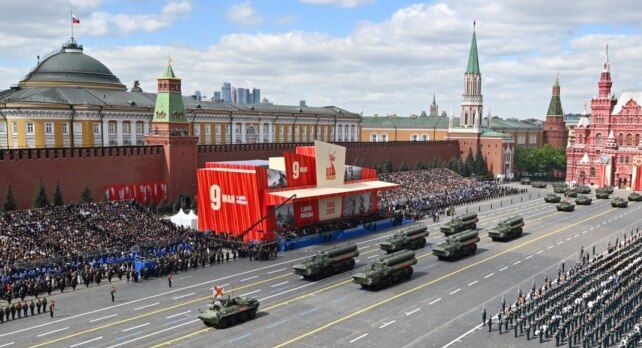
This year’s celebration looks very different from past versions. For the first time in nearly 20 years, no tanks, missile systems, or junior cadets will roll down Red Square. Instead, the focus will be on:
- Personnel from senior military academies marching on foot
- A traditional aerobatic flyover
- A team of Sukhoi Su-25 fighter jets painting the Russian flag’s colours across the sky
Officially, the Kremlin says the changes reflect “the current operational situation” and ongoing concerns about “Ukrainian terrorist activity.” Unofficially, the message is clear: Russia is taking no chances.
Ukraine’s Drone Attacks Are Hitting Deeper Than Ever
The biggest reason for the scaled-back celebrations is Ukraine’s growing drone capability. Kyiv’s forces are striking deeper inside Russia almost every day, hitting:
- Oil refineries
- Military airfields
- Logistical hubs
- Strategic infrastructure
Recent strikes on the Tuapse oil refinery on Russia’s Black Sea coast caused such severe damage that an ecological disaster was declared, and parts of the town had to be evacuated.
Olha Polishchuk, research manager at the Armed Conflict Location & Event Data project (ACLED), explains why drones have become so dominant in this war:
- They’re cheap and easy to modify
- They can travel long distances
- They’re hard to intercept in large numbers
- They allow precise targeting at minimal risk to operators
Since 2025, drone strikes have, in her words, “completely overshadowed” all other types of attacks. Even when most are intercepted, sending enough of them ensures that some inevitably get through.
Moscow’s Defences Are on Maximum Alert
Following several drone incidents in 2023, including one that struck the Kremlin itself, Russia has dramatically beefed up the capital’s defences. In the days leading up to Victory Day, security measures often include:
- Mobile internet outages in Moscow, Saint Petersburg, and other regions
- Activation of multiple layers of air-defence systems
- Increased patrols and electronic warfare measures
- Closure or restriction of certain airspace areas
Polishchuk notes that Moscow is protected by a “multilayered” defensive system that includes:
- Surface-to-air missile systems
- Short-range air defences
- Small arms units
- Electronic warfare tools
She says Ukraine rarely targets the capital because doing so would require a massive drone swarm — and because there are higher-value military targets elsewhere with fewer civilian risks.
The Real Worry: Small Drones, Big Symbolism
Ironically, the Kremlin’s biggest fear isn’t the long-range Ukrainian drones flying in from the front lines. It’s the smaller drones smuggled inside Russia and launched from within — the type that drove the daring 2025 sabotage operation known as Operation Spiderweb.
Even one small drone striking near a parade could be devastating, not because of physical damage, but because of the political and psychological fallout. As Ignatov puts it, the worry isn’t casualties — it’s the demonstrative effect of a successful breach during one of Russia’s most televised events.
A single moment of disruption could:
- Undermine the parade’s narrative of strength
- Send a damaging message to international observers
- Embolden Russia’s domestic critics
- Reinforce Ukraine’s image as a capable, modern force
That’s a risk the Kremlin clearly wants to minimise.
A Tradition That Has Already Been Through Many Changes
Today’s Victory Day parade is steeped in Soviet tradition. Originally meant to showcase military might and let citizens glimpse senior Soviet officials, the parade was actually shelved for nearly two decades after the USSR collapsed in 1991. President Vladimir Putin revived it in 2008, and it has since become an essential symbol of state power.
Since the full-scale invasion of Ukraine in 2022, the parade has gone through multiple downgrades:
- In 2024, only a single Soviet-era T-34 tank rolled across Red Square
- Other vehicles like APCs and mobile missile launchers still featured but in reduced numbers
- In 2025, the parade rebounded with modern tanks, TOS-2 flamethrower systems, and Iskander ballistic missiles
- Last year also featured Russian and Chinese troops marching together, with Xi Jinping seated beside Putin
Among 27 visiting heads of state in 2025 were Brazilian President Lula da Silva and Burkina Faso’s Ibrahim Traore — a turnout the Kremlin used to argue Russia wasn’t isolated despite global condemnation.
This year’s slimmed-down version stands in sharp contrast.
Two Very Different Versions of History
Victory Day has always carried different meanings for different countries. British historian Geoffrey Roberts described it as “the most sacred date on Russia’s political calendar,” celebrating not just a Soviet triumph but a global victory over fascism — including contributions from millions of Ukrainians.
But many critics, including Ukraine, argue that modern Russia has weaponised the holiday. Polishchuk notes that the once-common phrase “never again” has been increasingly replaced in Russia by the slogan “we can do it again,” reflecting a far more aggressive narrative.
She argues this messaging supports several key political functions:
- Reinforces the idea that Russia is strong and undefeated
- Justifies ongoing military action
- Helps defend the war in Ukraine domestically
- Pushes back against criticism of military setbacks
According to open-source tracker Oryx, Russia has lost more than 14,000 tanks, armoured vehicles, and other combat platforms since the war began. The Kremlin’s narrative of strength contrasts sharply with the realities on the battlefield.
Will Ukraine Strike During Victory Day?
For now, analysts believe Ukraine is unlikely to launch a major attack on Moscow during the parade. Polishchuk argues that Kyiv tends to focus on militarily meaningful targets rather than purely symbolic ones, and Russia’s air defences will be on maximum alert.
That said, the very threat of an attack is enough to reshape the celebration:
- Russia has reduced participation
- Foreign dignitaries may think twice before attending
- Security forces will operate at unprecedented levels
- Civilians will see the difference compared to past parades
Even without a strike, Ukraine has already influenced how Russia presents itself on its most important holiday.
Final Thoughts
The Russia Victory Day celebrations of 2026 will look unmistakably different — quieter, smaller, and more cautious. With Ukraine’s drones flying deeper into Russian territory, ecological disasters unfolding at major refineries, and political pressure mounting at home, the Kremlin can no longer treat May 9 as a guaranteed showcase of strength.
What was once the country’s most powerful display of military pride is now navigating a new and complicated reality — one shaped by a war that hasn’t gone according to plan and an opponent that continues to rewrite the rules of modern conflict.
For Russia, this year’s Victory Day is less about projecting power and more about managing risk. And in many ways, that quiet truth may be the loudest signal of all.
Author