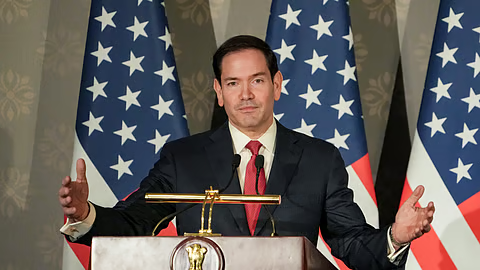
A potential US-Iran deal could be just around the corner, according to remarks made on Monday by U.S. Secretary of State Marco Rubio. Speaking during a high-profile diplomatic visit to India, Rubio suggested that meaningful progress is being made and that an announcement could even come within the same day. His comments quickly rippled through international markets, sending global stocks soaring and pushing oil prices sharply lower amid renewed optimism for peace in the Middle East.
Rubio Signals Progress in New Delhi
While speaking to reporters in New Delhi, Rubio struck a cautiously optimistic tone, suggesting that the United States might have news to share on the Iran deal “maybe today.” Though he was careful not to promise any breakthroughs, his comments hinted that diplomatic efforts have moved closer to an actual agreement than at any previous point.
Rubio described the current proposal as a “pretty solid thing on the table,” pointing to two major elements:
- Iran’s willingness to open up the Strait of Hormuz to international shipping
- A time-limited negotiation framework focused on nuclear matters
This suggests the deal could deliver immediate economic relief through restored maritime trade while opening a path for longer-term diplomatic engagement on nuclear concerns.
Why the Delay?
When asked about what was holding up the announcement, Rubio explained that the delay was primarily due to the response time of the Iranian system. According to him, communications and decision-making within the Iranian government tend to move more slowly, which has affected the pace of negotiations.
However, Rubio emphasized that the deal has gained widespread backing in the Gulf region and across much of the international community. He echoed President Donald Trump’s position that the U.S. is unwilling to rush into a poor agreement, no matter how much pressure exists to deliver quick results.
Diplomacy First, Alternatives Later
Throughout his remarks, Rubio made it clear that diplomacy remains Washington’s preferred path forward. He stated that the United States will give negotiations every reasonable chance to succeed before considering “alternatives.”
That said, he also issued a subtle warning. If a sound agreement cannot be reached, the U.S. is prepared to “deal with it another way.” Still, Rubio emphasized that a “good agreement” is the outcome Washington truly wants — one that benefits both regional stability and global security.
Global Markets Respond With Strong Optimism
The mere possibility of a US-Iran deal had an immediate and powerful effect on financial markets around the world. While U.S. markets remained closed in observance of Memorial Day, exchanges across Europe and Asia rallied strongly.
Asian Markets
- Japan’s Nikkei 225 surged by 2.87%, leading gains across the region
- South Korea’s KOSPI rose by 0.41%
- Hong Kong’s Hang Seng climbed 0.86%
- India’s BSE Sensex jumped 1.2%
European Markets
- Germany’s DAX Index gained 1.08%
- France’s CAC 40 advanced 1.07%
These market movements reflect investor confidence that a successful agreement could reduce geopolitical tensions, stabilize global supply chains, and ease economic uncertainty.
Oil Prices Tumble Amid Hopes of Reopened Strait
Perhaps the most dramatic market reaction came from the oil sector. The Strait of Hormuz, a critical chokepoint for global crude shipments, has been at the center of tensions between Iran and the United States. News of potential reopening sent oil prices sharply lower.
- Brent Crude futures dropped to $98.60 per barrel, falling nearly $5 from the previous week
- West Texas Intermediate (WTI) declined more than $4.50, settling at $91.95 per barrel
According to reports from Bloomberg, signs of easing tensions were already evident over the weekend. At least one supertanker carrying Iraqi crude oil reportedly crossed the Strait of Hormuz and is now en route to China. Additionally, Abu Dhabi’s state-owned oil company is said to have used its own tankers to move oil, gas, and fuel through the strait, even as it remains technically blockaded by both Iran and the U.S.
Why the Strait of Hormuz Matters
The Strait of Hormuz is one of the world’s most strategically important waterways, carrying roughly a fifth of global oil shipments. Any disruption to traffic through this narrow passage has the potential to trigger major shifts in oil prices and global trade flows.
A reopening of the strait would mean:
- Lower oil prices for consumers worldwide
- More stable shipping routes for energy companies
- Reduced inflationary pressure on global economies
- Improved trade conditions for Asian and European importers
What Iranian Officials Are Saying
Despite the optimism flowing out of Washington, Iranian officials have taken a more measured tone. Iranian Foreign Ministry spokesperson Esmaeil Baqaei dismissed the importance of statements made by U.S. officials, including President Trump, saying that Iran has “far more important matters to deal with.”
Baqaei suggested that Iran would not respond to every social media post or media statement coming from the U.S. side, indicating that Tehran prefers to focus on its own priorities and pace. However, he did note that Iran would respond when it considered the timing appropriate.
Adding to the mix, Iranian President Masoud Pezeshkian made a notable statement on Sunday, declaring that Iran is “ready to assure the world” that it is not seeking nuclear weapons. Such public statements suggest that Tehran is also open to dialogue, even if the official tone remains cautious.
A Critical Moment for Middle East Diplomacy
The potential US-Iran deal represents one of the most significant diplomatic moments in recent years. If finalized, it could:
- Reduce the risk of military escalation in the Middle East
- Help stabilize energy markets globally
- Reopen critical shipping lanes
- Pave the way for renewed nuclear negotiations
- Improve diplomatic relations between Tehran and Washington
However, history has shown that talks involving Iran and the United States can be unpredictable. Both governments face significant domestic political pressures, and any final agreement will need to satisfy both regional allies and skeptical critics.
Final Thoughts
The growing speculation around a US-Iran deal has injected fresh optimism into global markets and reignited hopes for a more stable Middle East. With Marco Rubio suggesting that meaningful news could break at any moment, all eyes are now on Washington and Tehran to see whether diplomacy can deliver a breakthrough.
For investors, energy traders, and policymakers around the world, the next few days could prove pivotal. Whether the agreement materializes today, tomorrow, or in the weeks ahead, one thing is clear — the world is watching closely, hoping that this time, diplomacy will succeed.
Author