The Apache helicopter crash that killed two soldiers near Fort Hood, Texas, this week has prompted the U.S. Army to suspend training flights for the entire aircraft type while investigators work to determine what went wrong.
The Army announced the pause on Friday, saying the stand-down will stay in place until officials have a clearer picture of what caused the accident.
What Happened
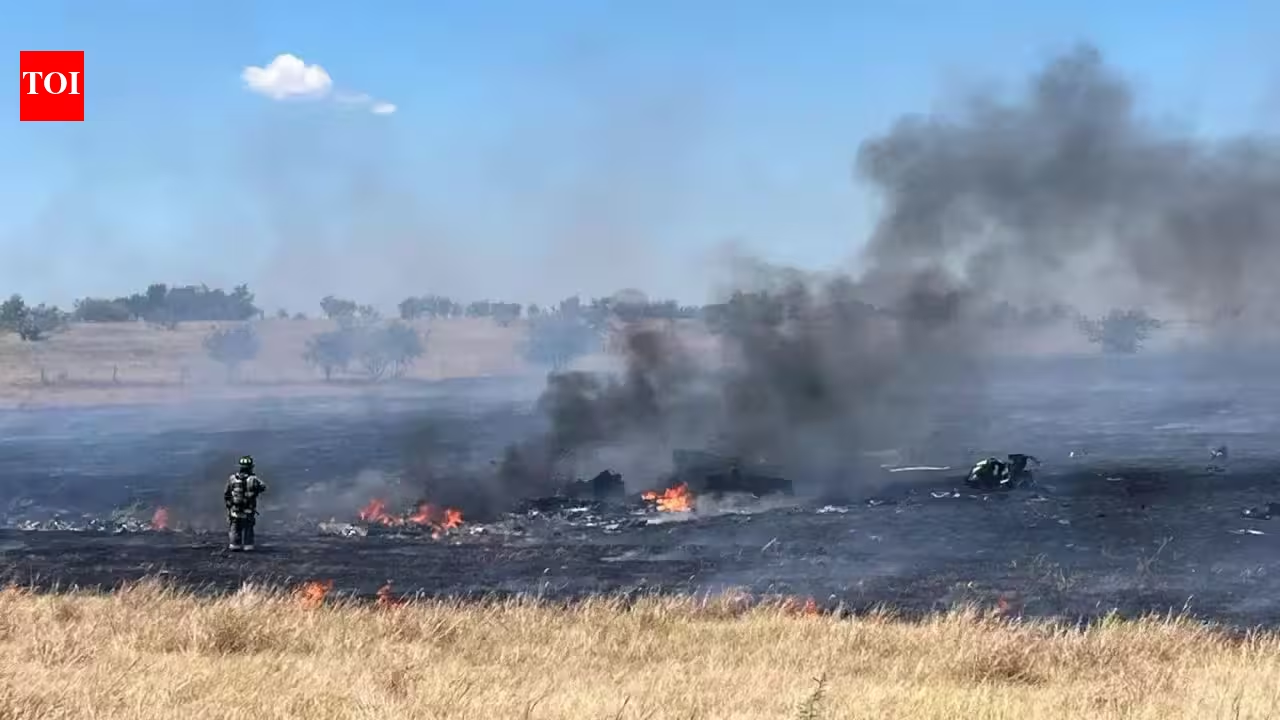
An AH-64 Apache attack helicopter went down Wednesday in an open field in rural Salado, Texas, a short distance from its home base at Fort Hood. Both the Army and local law enforcement confirmed the crash.
The two aviators killed were identified as Chief Warrant Officer 2 Deontre T. Huey, 34, and Warrant Officer Seth L. Olmsted, 25. Both men were natives of Texas.
Bell County Sheriff’s Office spokesperson Bill Coleman described the scene as clearly indicating a violent impact. He noted that the aircraft did not strike any structures on the ground, but the wreckage ignited a wildfire in the surrounding area.
No cause has been made public. Investigations into military aviation accidents typically take months and examine maintenance records, flight data, weather conditions, crew procedures and mechanical systems before reaching conclusions.
Why a Stand-Down Happens
Grounding an entire fleet of training aircraft may sound dramatic, but it is a standard response within military aviation after a fatal accident with an unclear cause.
The logic is straightforward. If a mechanical fault, a maintenance oversight or a procedural issue contributed to the crash, the same risk could exist across other aircraft of the same type. Pausing flights removes crews from exposure until investigators can rule that out.
Stand-downs also give units time to review safety procedures, inspect airframes and reinforce training protocols. They are usually lifted in stages rather than all at once, often beginning with limited flight profiles.
The Army’s Statement
In its Friday remarks, the Army said it was deeply saddened by the loss of the two soldiers and expressed condolences to their families, friends and unit, describing the period as extraordinarily difficult for those affected.
The service did not provide a timeline for when Apache training would resume.
About the Aircraft
The AH-64 Apache is among the most recognizable combat aircraft in the U.S. inventory. Boeing has manufactured the platform since the late 1990s in its current lineage, and the Army has described the newest variant as the most advanced aerial fighting vehicle anywhere in the world.
Key features include:
- Twin-engine design built for survivability in contested airspace
- A two-person crew, typically a pilot and a co-pilot gunner
- A rapid-fire chain gun mounted beneath the nose
- The ability to carry and launch Hellfire missiles
- Advanced targeting and sensor systems for day and night operations
Hundreds of Apaches are in service across active Army and National Guard units, making it one of the most widely operated attack helicopters in the world.
Recent Operational Demands
The stand-down comes at a moment when the platform has been heavily engaged. Apaches have flown missions during the conflict with Iran, adding operational strain on top of routine training requirements.
In June, an Apache conducting patrols over the Strait of Hormuz was brought down by an Iranian drone, an incident announced publicly by President Trump. Both pilots in that case survived and were recovered by a sea drone in what was reported as a first-of-its-kind rescue.
That episode underscored both the risks the aircraft face in current operations and the pace at which the fleet is being used.
The Human Cost
Behind the fleet statistics and investigation procedures are two young aviators who will not come home.
Warrant officers in Army aviation follow a demanding path. They are selected specifically to fly, train intensively on complex systems, and spend their careers building expertise in a single platform. Losing two experienced crew members represents a loss not only to their families but to the units that depend on their skill.
Both men were from Texas, serving at a base within their own state.
What Comes Next
Investigators will work to reconstruct the flight and identify contributing factors. Their findings will determine when training resumes and whether any changes to maintenance schedules, inspection requirements or flight procedures are warranted across the fleet.
Until then, Apache training flights remain paused. Operational missions and the broader aviation community will be watching closely for the outcome, since any systemic issue identified would carry implications well beyond a single unit at Fort Hood.
The Army has said it will share information as the investigation progresses.
Author
-
Lucienne Albrecht is Luxe Chronicle’s wealth and lifestyle editor, celebrated for her elegant perspective on finance, legacy, and global luxury culture. With a flair for blending sophistication with insight, she brings a distinctly feminine voice to the world of high society and wealth.