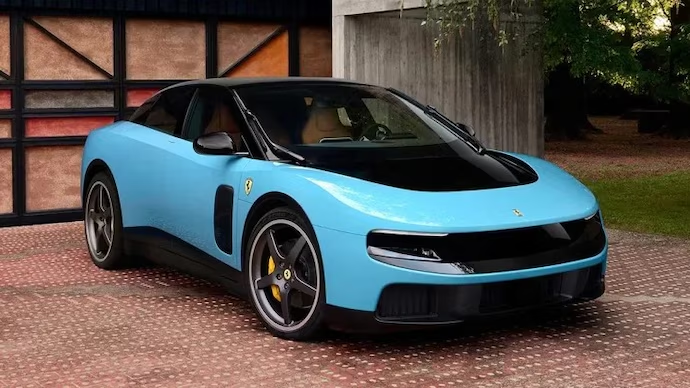
The Ferrari Luce electric supercar has officially arrived, and it’s unlike anything the Prancing Horse has produced in its storied history. Drenched in glass, sculpted with light, and crafted in partnership with former Apple design legend Jony Ive, the Luce signals a daring new chapter for Europe’s most valuable carmaker. Pronounced “loo-chay,” the name borrows the Italian word for light, a fitting tribute to a vehicle built around transparency, brilliance, and reinvention.
A Bold Departure From Tradition
On Sunday, Ferrari pulled the covers off its first fully electric model, a milestone that breaks from nearly eight decades of roaring combustion engines. The launch took place at Rome’s Vela di Calatrava, a striking venue with a sail-like concrete arch built for the Vatican’s 2025 Jubilee. The evening blended Italian flair with futuristic ambition, complete with tortellini prepared by acclaimed chef Massimo Bottura and dramatic footage of Formula One champions Lewis Hamilton and Charles Leclerc pushing the new model to its limits.
Ferrari Chairman John Elkann described the project as a chance to step into uncharted territory. According to him, the company wanted to attempt what had never been possible before, and the Luce reflects that ambition in every detail.
Pricing the Ferrari Luce Electric Supercar
The Ferrari Luce electric supercar will start at roughly 550,000 euros in Italy, which translates to about $640,000. That price tag places it among the most expensive non-limited-production Ferraris ever offered. The launch arrives at a tricky moment, however, since electric vehicle demand has cooled significantly across the United States, the largest market for luxury automobiles. Still, Ferrari is betting that its devoted clientele will embrace the change.
Designed Inside and Out by Jony Ive
The car’s distinctive look comes from a collaboration with Jony Ive and his longtime partner Marc Newson. Elkann reportedly approached the duo after admiring their reimagining of the Apple Watch, calling it one of the finest examples of transforming an analog product into a digital experience.
Their influence is unmistakable. The upper half of the Luce and many of its interior fittings are crafted from glass, with much of it sourced from American manufacturer Corning, the same company now riding high on its artificial intelligence partnerships. Elkann admits that the result does not resemble what most people picture when they imagine a sports car.
Inside, the cabin embraces a hybrid of physical and digital. There’s still a traditional steering wheel along with familiar knobs and levers, but the displays use OLED screens that skip backlighting to deliver a softer, more analog feel. Elkann argues that going electric should not mean turning a car into a gadget, criticizing what he sees as a misstep by the broader industry over the past decade.
Performance That Lives Up to the Badge
Despite being Ferrari’s first EV, the Luce delivers the kind of performance fans expect. The five-seat layout, made possible by removing the traditional axle setup, is a first for the brand. Yet it still launches from 0 to 60 mph in under 2.5 seconds and tops out beyond 190 mph, powered by four individual motors, one per wheel.
Range, however, takes a backseat to acceleration. The Luce covers around 330 miles between charges, well below offerings from BMW and Volvo that exceed 500 miles. Ferrari insists the priority was thrill, not endurance.
To preserve the visceral feel of a Ferrari, engineers built an external amplification system that broadcasts the natural hum of the electric axles outside the car. Drivers can also activate the sound inside the cabin during performance mode. The company compares the concept to an electric guitar, where sound is shaped rather than suppressed.
Why Ferrari Stayed the Course on EVs
While rivals like Porsche, Lamborghini, and McLaren have hesitated or pulled back on electric sports cars, Ferrari pressed forward. Mass-market giants such as Ford and Stellantis have absorbed billions in write-downs after racing into EVs too quickly. Ferrari took a different path, investing roughly $230 million in a new Maranello facility in 2024 to produce EVs alongside hybrids and combustion models.
Elkann credits CEO Benedetto Vigna, a former microchip executive hired in 2022, for steadying the ship. Vigna noted that internal hesitation existed when he joined, but his background in technology helped build trust in the transition.
Protecting Ferrari’s Forever Promise
Ferrari estimates that around 90% of every car it has ever built is still on the road, and the company treats longevity as sacred. Striking a balance between cutting-edge EV technology and timeless ownership required years of planning and significant investment.
To reassure buyers, Ferrari has rolled out an extended warranty program covering battery replacements every eight years, similar to the support offered for its plug-in hybrids. The Luce will receive comparable coverage for its electronics and battery.
A Calculated Bet on the Future
With waiting lists stretching into late 2027 and a loyal customer base willing to follow the brand into new territory, Ferrari has the financial cushion to take risks others cannot. As Vigna puts it, a luxury brand cannot afford to dwell in the past. The Ferrari Luce electric supercar is the company’s brightest statement yet that the future belongs to those bold enough to redesign it.
Author