Lebanon First Responders Killed: Heroes Trapped Between Service and Sorrow
Lebanon first responders killed in the line of duty have become some of the most heartbreaking symbols of the ongoing war in the country’s south. In a region already torn apart by years of instability, paramedics, rescue workers, and civil defense teams continue to put their lives on the line every day, often paying the ultimate price for trying to help others.
The story of Hussein Jaber, a 32-year-old veteran first responder, captures the unbearable weight of this moment. He was killed on May 12 in Nabatieh, alongside his colleague Ahmad Noura, while attempting to rescue a man wounded in an earlier Israeli airstrike. His death came just days before what would have been his first wedding anniversary.
In Sidon, his widow, Nareej Ramal, was seen weeping in the arms of her father-in-law, her late husband’s civil defense uniform draped around her shoulders like a final embrace.
A Pattern That Refuses to End
Jaber and Noura are just two of more than 100 first responders killed in Israeli airstrikes since the war between Israel and Hezbollah reignited on March 2. Even after a ceasefire was announced in April, the deaths have continued.
Israel has repeatedly accused Hezbollah of using ambulances and medical facilities for military purposes, claims that Lebanon’s health ministry strongly denies. International humanitarian law clearly protects hospitals, rescue workers, and ambulance crews, but in practice, those protections are increasingly being ignored on the ground.
Mona Boud Zeid, director of Al Najdeh al-Shaabiyeh Hospital in Nabatieh, can literally see airstrikes from her hospital’s location. Her concern is grim and direct, comparing the situation to what has unfolded in Gaza, where over 1,700 medical personnel and first responders have reportedly been killed during the war.
Doctors Without Borders Sounds the Alarm
The international aid organization Doctors Without Borders, which has staff at the Nabatieh hospital, confirmed that Jaber and Noura died after rushing to assist victims of a separate Israeli strike. A third medic accompanying them was injured.
The group described the killings as part of “an alarming pattern” of attacks against rescue workers in southern Lebanon. Their warning highlights how dangerous it has become for medical responders to do what should be one of the most universally respected jobs in any conflict zone.
Mourning Becomes a Daily Ritual
On May 13, a dozen uniformed first responders gathered outside the hospital morgue, lifting the bodies of their colleagues into a waiting ambulance. Hospital staff, fellow responders, and family members wept openly.
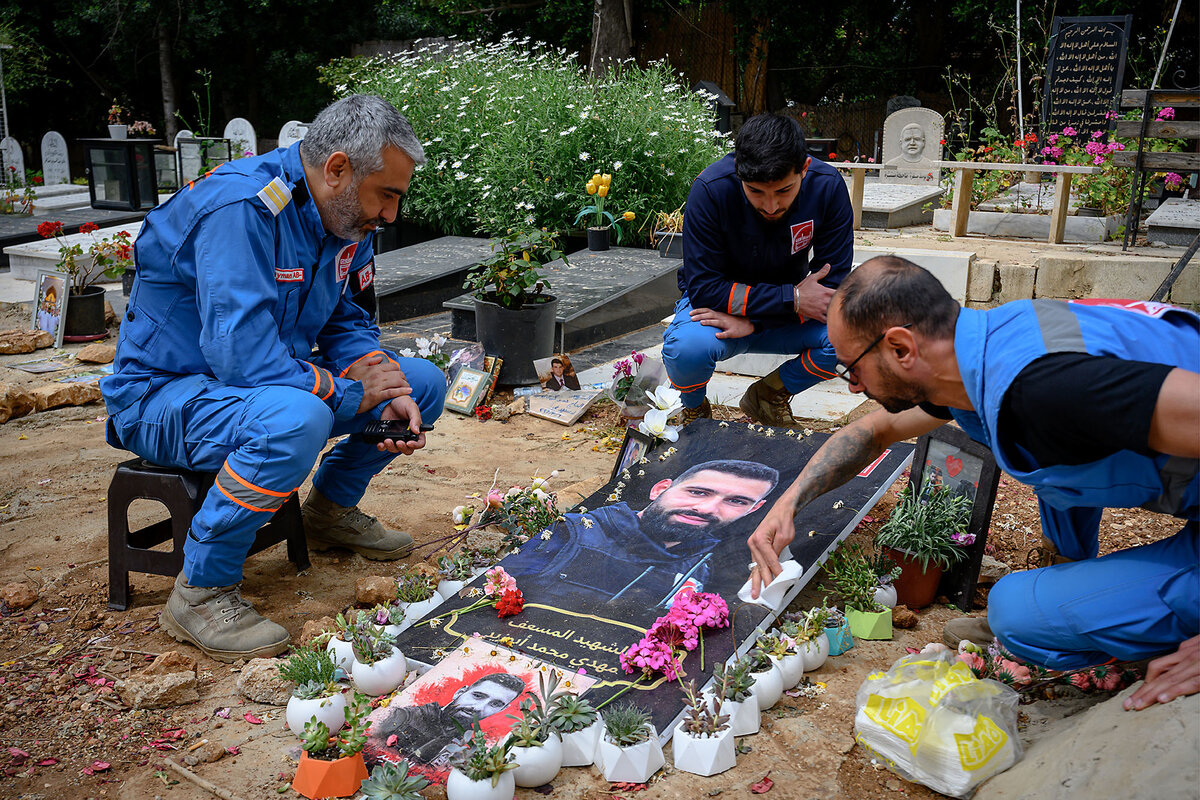
Wrapped in white shrouds and covered with flowers, the bodies of Jaber and Noura were taken to Haret Saida, near Sidon, for temporary burial. Their families couldn’t bury them in their home villages because of ongoing attacks. For many in the region, the painful reality means saying goodbye to their loved ones twice, first in temporary graves, then again when conditions eventually allow.
Voices of Loss From the Frontlines
The grief weighs heavily on team leaders like Abdallah Hallal, a search-and-rescue veteran with more than 20 years of frontline experience. Speaking through tears, he described Noura not just as a colleague but as a lifelong companion. The two had shared decades of dangerous missions, navigating disasters, wars, and unimaginable tragedies side by side.
“They were never just colleagues,” Hallal said, his voice breaking. He emphasized that no words could truly capture the loss.
A War That Doesn’t Spare Anyone
Throughout the war, the same tragic scenes have played out again and again. In late April, in the southern city of Tyre, helmets, stretchers, and rescue vehicles were left motionless at the headquarters of fallen responders, transforming them into silent symbols of sacrifice.
A formal ceremony was held in Tyre for Hadi Daher, Hussein Al-Sati, and Hussein Ghadbouni, first responders killed in the town of Majdal Zoun. The mourners gathered under the sound of:
- The Lebanese national anthem
- Patriotic songs
- Fireworks lit in honor of the fallen
- Silent prayers from grieving families
Even within these emotional tributes, the temporary graveyards stretched across the soil served as a sober reminder that the cost of this war continues to grow.
Civilians and Journalists Among the Dead
The cost is not limited to first responders. Civilians continue to suffer enormous losses. Just weeks before Jaber’s death, mourners gathered at the home of Amal Khalil, a journalist for the Lebanese daily Al-Akhbar, who was killed in an Israeli strike in the southern town of Baisariyah. Her colleague, freelance photojournalist Zeinab Faraj, was wounded in the same attack.
The numbers paint a devastating picture:
- More than 380 people have been killed since the ceasefire began in April
- Israeli attacks have killed at least 2,896 people in Lebanon since the war began
- Nearly one million people have been displaced from southern Lebanon
- Israel has reported 18 soldiers and four civilians killed by Hezbollah strikes since March
These statistics tell only part of the story. Behind every number is a family, a community, and a future cut short.
Returning to Duty Despite the Pain
What’s perhaps most striking is the unwavering commitment of those who survive. Many first responders go back to work soon after losing close friends and colleagues. Their sense of duty remains stronger than fear.
Ali Al Rida Hammoud, a paramedic in Nabatieh, was injured at the start of the war but continues to serve. Each shift carries the painful memory of his fallen friends, including Joud Suleiman, the son of Nabatieh’s chief paramedic, who was killed in March along with 24-year-old Ali Jaber while on their way to a rescue mission.
Despite the constant danger, Hammoud insists he isn’t a hero. He simply believes there is no other choice. “I’m not afraid,” he said. “I’ve witnessed so many things, but I believe I can protect my people, my country. Despite everything, you have to keep moving. Where should we go? This is our country.”
The Human Cost Behind Every Siren
The sirens that ring out across southern Lebanon have come to represent something deeper than emergencies. They symbolize the courage of those who answer the call again and again, knowing the risks. They also reveal the harsh truth that international laws meant to protect the wounded and the helpers are no longer being respected the way they once were.
Each death of a first responder doesn’t just leave behind a grieving family. It also weakens the systems people rely on most during moments of crisis, leaving entire communities more vulnerable.
The Silence From Israel
NPR reached out to the Israeli military for comment about the deaths of Lebanese medics but did not receive a response. The lack of accountability adds to the growing frustration among Lebanon’s first responders, aid organizations, and grieving families, who feel that international protections meant for medical workers are being ignored.
Final Thoughts
Lebanon first responders killed in this war represent more than just statistics. They embody the cost of conflict on the people who choose to serve others when everything else falls apart. Their courage shines through every siren, every rescue, and every farewell. As the war continues despite ceasefire promises, the world is left to ask how long these heroes will be expected to give everything, often with no protection in return. Their dedication is remarkable, but the question of how to safeguard them in conflict zones has never been more urgent.
Author