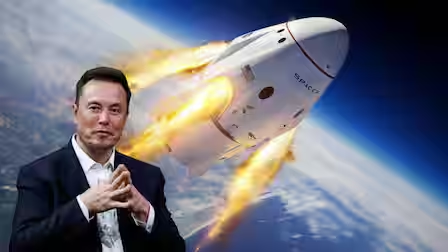
The SpaceX IPO Elon Musk risk story has officially arrived — and it’s unlike any public offering Wall Street has seen in years. SpaceX’s long-anticipated filing isn’t just historic for its scale; it could potentially make Elon Musk the world’s first trillionaire. But hidden within the company’s 330-page Form S-1 lies a far more revealing narrative: the dense, sometimes uncomfortable web of business relationships between Musk’s many ventures, and the candid acknowledgment that the man behind the empire is both its biggest asset and its biggest liability.
For investors, journalists, and policy watchers, the filing offers a rare, structured look into how SpaceX functions, how its money moves, and how deeply intertwined it is with Tesla, xAI, the Boring Company, Neuralink, and X.
A Filing Filled With Familiar Names
A simple keyword search through SpaceX’s S-1 paints a vivid picture of just how interconnected Musk’s empire really is. Within the document:
- “Tesla” appears 87 times
- “xAI” appears 356 times
- “X” appears 267 times
- “The Boring Company” appears 7 times
- “Neuralink” appears 3 times
The frequency isn’t accidental. SpaceX’s business is heavily interlaced with the rest of Musk’s portfolio — from rocket launches and satellite infrastructure to data centers, AI computing, and even electric vehicles.
Cross-Ownership and Cross-Selling
The filing also pulls back the curtain on how Musk’s companies invest in one another and conduct business. Some of the most notable revelations include:
- Tesla owns nearly 19 million shares of SpaceX’s Class A common stock — less than 1% of total outstanding stock.
- Tesla’s xAI stake was converted into SpaceX shares after Musk merged xAI with SpaceX in February.
- SpaceX purchased $131 million worth of Cybertrucks at Tesla’s manufacturer-suggested retail price.
- SpaceX bought $697 million worth of Megapacks from Tesla in 2024 and 2025 to support its Colossus I and II data centers in Memphis.
- The Boring Company paid about $1.2 million to SpaceX in office leases.
- SpaceX paid The Boring Company roughly $1 million to dig a tunnel at its Bastrop, Texas headquarters.
The relationships are extensive, financially significant, and increasingly inseparable.
The Cybertruck Connection
One of the most curious details concerns the Cybertruck. SpaceX’s massive purchase order may have significantly influenced quarterly sales figures for Tesla’s polarizing electric pickup. According to earlier reports, SpaceX bought 1,279 Cybertrucks in the fourth quarter of 2025 alone. The IPO suggests that number may have grown further.
Without these internal purchases, Cybertruck registrations could have actually declined year-over-year — a detail that has not escaped the attention of investors and analysts.
A Trillion-Dollar Valuation After the xAI Merger
SpaceX was already operating at unprecedented scale, but the xAI merger pushed its valuation to roughly $1.25 trillion. Combined with Musk’s plans for Mars colonization, satellite expansion, and AI-driven infrastructure, the company’s growth ambitions are as bold as ever.
However, the merger came at a steep cost:
- SpaceX directed about 60% of its 2025 capital spending toward xAI — approximately $20 billion.
- xAI itself lost billions in 2024 despite only modest revenue growth of around 22%.
Investors will need to weigh whether SpaceX’s spending on Musk’s AI ambitions is a long-term advantage or a financial drag.
The Risk Factors Section Is the Real Story
Every IPO requires companies to disclose risk factors — but SpaceX’s filing breaks new ground by listing Elon Musk himself as a major risk. The document explicitly states that SpaceX is “highly dependent on the continued services of Mr. Musk.”
Key acknowledgments include:
- SpaceX’s success depends heavily on Musk’s leadership, vision, and technical expertise.
- Musk is involved in multiple other companies that may divert his time.
- Musk is not restricted from competing directly with SpaceX through his other ventures.
- Conflicts of interest may arise — and may affect investors.
- Musk’s other businesses may compete with SpaceX for capital, opportunities, components, and even AI resources.
These statements are unusually candid for an IPO document, but they reflect the unique structure of Musk’s business universe.
Musk’s Other Roles
The filing also makes clear that Musk has historically split his time across multiple high-stakes ventures. As listed in the S-1, his roles have included:
- “Technoking” and CEO of Tesla
- Founder and CEO of SpaceX
- Founder of Neuralink
- Founder of The Boring Company
- Founder of xAI
- Owner of X
- Former Senior Advisor to the U.S. President
Any reduction in Musk’s involvement in SpaceX could, per the filing, lead to a “material adverse effect” on the company’s operations, business prospects, and stock performance.
Public Attention: A Double-Edged Sword
SpaceX’s S-1 also acknowledges something rarely admitted by major corporations — the impact of Musk’s personal behavior on the company. The document notes that media attention surrounding Musk and his ventures can either help or harm SpaceX, depending on the situation. His public statements often draw scrutiny, sometimes affecting customer relationships, regulatory perceptions, and stock prices.
In short: Musk can move markets just by tweeting — and that goes both ways.
A Resource War Within His Own Empire
One of the more striking dynamics revealed by the filing is how Musk’s companies compete with one another for valuable resources. With AI chips, computing power, satellite components, and engineering talent in short supply, his companies effectively jockey for limited capacity. This includes:
- Competing for AI accelerator chips between xAI and Tesla
- Competing for energy and compute resources
- Competing for skilled engineering talent
Shareholders have noticed. In 2024, Tesla investors sued Musk, claiming he knowingly diverted resources and talent away from Tesla and toward xAI. That lawsuit is still pending.
Investors Are Betting on Vision — and on Musk
Investors weighing whether to buy into the SpaceX IPO are essentially making a bet on:
- SpaceX’s dominance in commercial space
- The growth of Starlink and satellite-based connectivity
- The viability of Mars colonization plans
- The success of the integrated SpaceX-xAI vision
- The leadership and long-term focus of Elon Musk himself
Musk could earn billions if SpaceX successfully establishes a “permanent” colony on Mars with at least one million inhabitants — a milestone built into his compensation framework. It’s an audacious vision that mixes business ambition with civilizational aspiration.
A Public Offering Like No Other
SpaceX’s IPO is shaping up to be one of the most consequential financial events in modern history. It blends rocket technology, AI ambitions, energy storage, autonomous vehicles, and futurist colonization plans into a single, sprawling investment opportunity.
But the filing also forces investors to confront a sobering truth: SpaceX’s future is inseparable from Elon Musk’s. His leadership powers the company forward, while his entanglements, controversies, and distractions create unavoidable risks.
The Bottom Line
SpaceX’s S-1 reveals more than just financial metrics. It exposes a tightly woven empire where companies share resources, swap ownership stakes, and depend on a single individual whose decisions reverberate across industries.
For some investors, that’s the appeal. Musk is one of the few figures capable of building, scaling, and reshaping multiple industries simultaneously. For others, it’s a warning. A company that openly states it cannot function without one man — and admits that man may compete with it — is offering a level of transparency rarely seen in public markets.
Either way, the SpaceX IPO is more than a financial event. It’s a glimpse into the future of business, technology, and ambition itself — and at the center of it all stands Elon Musk, equal parts visionary and risk factor.
Author