Strait of Hormuz US territory talk moved from speculation to the president’s own remarks this week, sharpening an already tense standoff between Washington and Tehran just days before a fragile ceasefire is due to lapse.
Speaking Friday, President Donald Trump suggested he might soon designate the narrow waterway as American territory once the campaign against Iran concludes. The comment drew an immediate rebuttal from Iranian officials and added fresh uncertainty to a corridor that carries a substantial share of the world’s seaborne oil.
What Trump Actually Said
Trump has argued for weeks that the United States effectively controls the strait. On Friday he pushed the framing further, saying that before long he would be declaring the Hormuz Strait a territory of the United States.
The statement carries no immediate legal weight. Territorial waters and international straits are governed by long-established maritime law, and unilateral declarations by any single government would face steep challenges from both regional states and the broader international community. Still, the remark signalled how far the administration is willing to go rhetorically as the conflict drags on.
Tehran’s Response
Iran dismissed the idea outright. The country’s deputy foreign minister posted on X that the strait cannot be seized by tweet, by aircraft carrier, by executive order, or by campaign rhetoric.
That line captured Tehran’s broader position: that control of the waterway is not something Washington can assert through pressure alone, and that Iranian access to the strait remains non-negotiable regardless of military circumstances.
A Ceasefire About to Expire
The immediate flashpoint is timing. A memorandum of understanding signed in June included a 60-day ceasefire, and that window closes Monday.
Iranian officials have said no decision has been reached on when negotiations with Washington might restart, leaving the deadline as the clearest near-term test of whether diplomacy can survive the current friction. If the pause lapses without an extension or a resumption of talks, both sides will be operating without even a temporary framework.
Blockade Reshapes Commercial Traffic
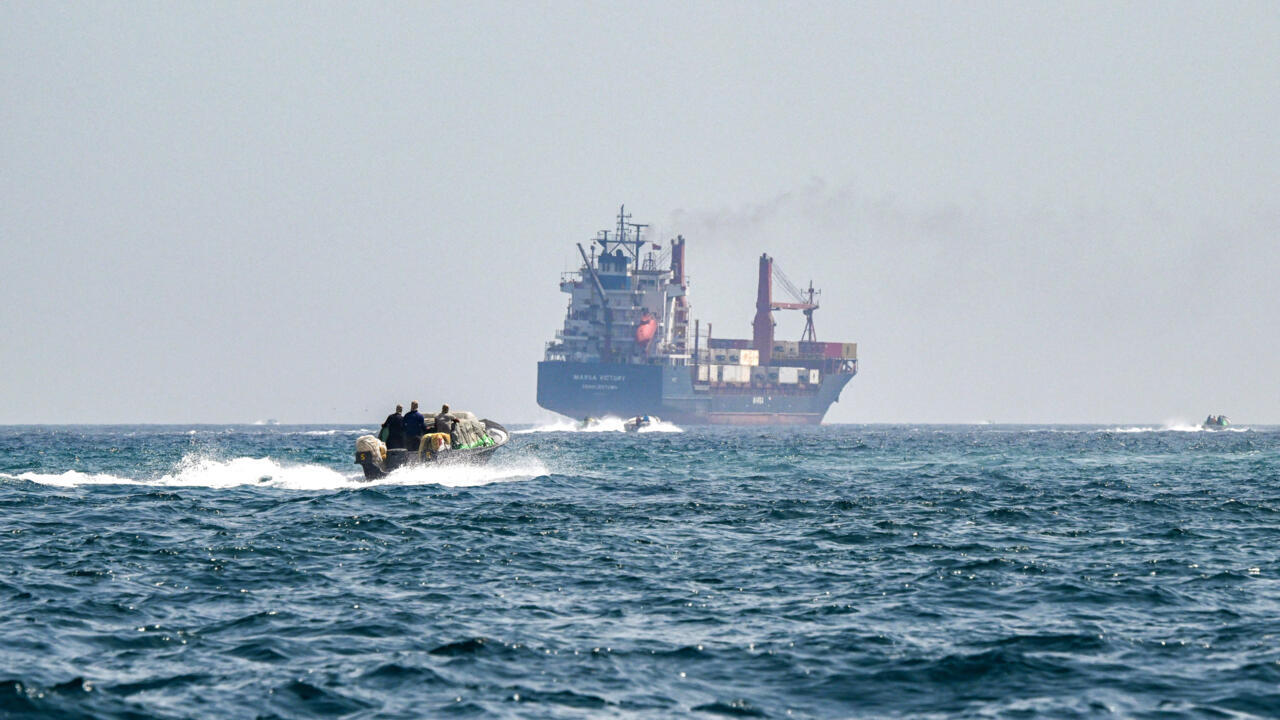
On the water, the practical consequences are already visible. U.S. Central Command reported that as of Friday, the ongoing American blockade of Iranian ports had redirected 62 commercial vessels.
Reporting from the region on Saturday put the figure at more than 60 ships rerouted as the naval presence in the strait holds firm. For shipping companies, insurers and energy traders, that translates into longer routes, higher premiums and a persistent question about how long the corridor stays functional.
Another Vessel Attacked
Security incidents have continued alongside the blockade. The Abu Dhabi National Oil Company said early Saturday that one of its vessels was attacked Friday evening while transiting the strait.
It was not the first such episode involving ADNOC-linked ships. The United Arab Emirates has previously attributed similar attacks to Iran, though attribution in the strait is frequently contested and difficult to verify independently.
The Carrier at the Center of a Domestic Fight
Separately, a debate has erupted at home over the USS Abraham Lincoln, which has now been deployed for more than 260 days in support of Operation Epic Fury.
Trump said the carrier is being replaced with another very similar ship. Secretary of War Pete Hegseth accused news outlets of deliberately distorting conditions aboard the vessel and defended the sailors and Marines who have served through the extended combat rotation.
The dispute widened when Medal of Honor recipient and Marine Corps veteran Dakota Meyer criticised what he described as an attempt to frame the crew as victims of a difficult deployment. Writing on X, Meyer argued that hardship is intrinsic to military service and that the oath taken by service members is unconditional. He said commitment does not depend on comfort, proximity to family, or personal agreement with a given mission, and suggested that anyone unwilling to meet that standard should leave the force.
Meyer was reacting to Navy Secretary Hung Cao’s public defence of the Lincoln’s crew amid growing scrutiny of the deployment’s length.
Critics of that framing argue the concern is less about comfort than about readiness, retention and the strain that repeated extensions place on personnel and equipment. That tension between duty and sustainability is a recurring feature of prolonged operations.
Calls for a Harder Line
Former Secretary of State and CIA Director Mike Pompeo used a Saturday television appearance to argue for escalation rather than de-escalation.
Pompeo said he hopes covert American support for Iranian opposition groups is already in motion, while acknowledging he has seen no evidence confirming it. He proposed that the United States and Israel jointly identify suitable organisations and supply them with munitions, communications equipment and other capabilities.
Combined with sustained economic pressure, he said, further military action would likely be required, contending that additional targets remain. Reopening the strait alone, in his view, would be necessary but insufficient, and he warned that permitting Iran to control the waterway or levy tolls on passage could encourage other adversaries to test similar tactics.
Pompeo framed the objective as a strategic victory that remains achievable if Washington holds its course.
The Wider Stakes
Not all observers share that assessment. Critics of expanded involvement point to the risk of a widening regional war, the historical difficulty of arming opposition movements without unintended consequences, and the economic damage a prolonged closure of the strait would inflict on global energy markets, including on countries with no stake in the dispute.
With the ceasefire expiring Monday, dozens of ships rerouted and attacks continuing at sea, the coming week is likely to determine whether the standoff cools or enters a more dangerous phase.
Author
-
Lucienne Albrecht is Luxe Chronicle’s wealth and lifestyle editor, celebrated for her elegant perspective on finance, legacy, and global luxury culture. With a flair for blending sophistication with insight, she brings a distinctly feminine voice to the world of high society and wealth.