The Fedorov dismissal Ukraine protests that filled Kyiv’s squares for three consecutive nights turned a personnel decision into the most exposed civil-military rupture since 2024 — and it arrived precisely as Ukraine’s strike campaigns were putting Russia under pressure on four fronts at once.
A Six-Month Tenure That Reshaped a Ministry
President Volodymyr Zelenskyy dismissed Defence Minister Mykhailo Fedorov on 15 July, half a year into the job.
Fedorov had come from the digital transformation portfolio and rapidly built a reputation as the most consequential reformer in the ministry’s wartime history. His record included persuading Elon Musk to restrict Russian military access to Starlink, forcing competitive tendering through a procurement system long known for corruption, and opening a captured-weapons database to partner nations so countermeasures could be developed faster.
The Clash Behind It
The removal followed months of friction with Commander-in-Chief Oleksandr Syrskyi.
Ukrainian reporting framed the conflict in generational terms: a data-driven technocrat against a general accused of Soviet-style micromanagement, heavy personnel losses, and resistance to reform.
Zelenskyy chose Syrskyi.
At a press conference afterward, Fedorov listed eleven problems he believed were preventing the Ukrainian military from operating at full capacity — constant replacement of commanders, fighting at a purely tactical level, isolation and toxic treatment of successful commanders, and failure to employ the Corps structure properly among them.
The Streets Respond
Civil society reacted immediately.
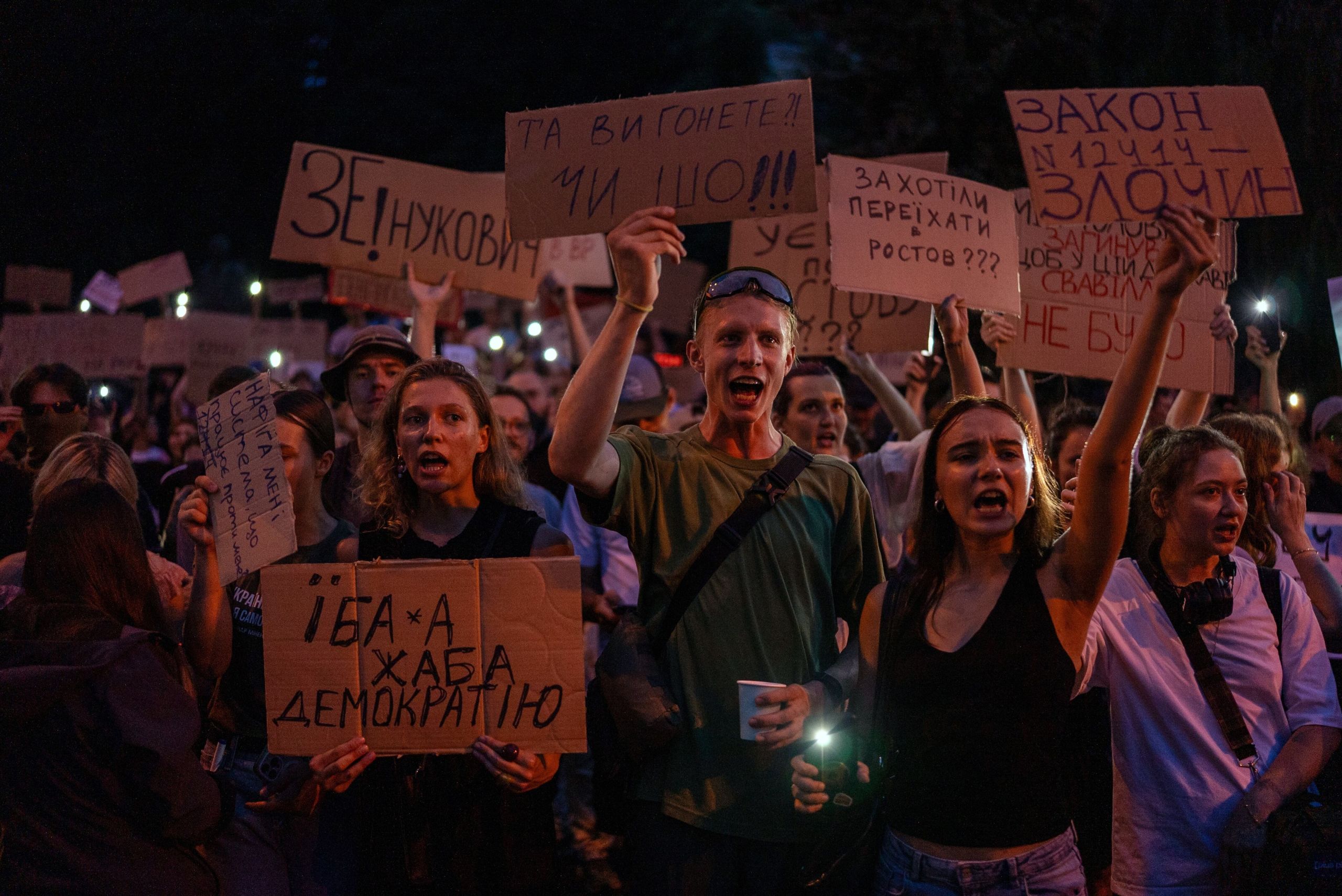
Protesters gathered in Kyiv on three consecutive evenings from 16 to 18 July, with crowds passing five thousand on Ivan Franko Square by the second night. Solidarity rallies spread to Lviv, Kharkiv, Odesa, Dnipro and more than a dozen other cities, along with demonstrations in London, Prague, Vienna, Brussels and Sydney.
The placards summarised the argument better than any analysis could: “Bring Misha back” and “You cannot win a war in 2026 with the Soviet system.”
Demands escalated quickly from reinstating Fedorov to sacking Syrskyi.
Zelenskyy Offers Process, Not Reversal
The president has so far responded with appointments rather than a climbdown.
Yevhen Khmara, former chief of the SBU’s Alpha special-operations unit, became acting defence minister. Oleksandr Poklad — a figure associated with the 2025 pressure campaign against Ukraine’s anti-corruption bodies — became acting SBU chief.
That second appointment did nothing to reassure the protesters.
In the past 24 hours, however, Zelenskyy has posted that he held discussions with Fedorov. There is separate speculation that he is searching for a replacement commander-in-chief. If Syrskyi goes, he would be the third since February 2022.
Resignations Follow
The ripple effects moved through the programmes Fedorov built:
- Air Force deputy commander Pavlo Yelizarov resigned in protest
- Serhii Sternenko, a leading drone volunteer, stepped down from his ministry advisory role
- Serhii “Flash” Beskrestnov chose the opposite path, accepting a role as the president’s personal adviser on defence technologies, arguing that only the enemy benefits when qualified people walk away
Why the Timing Is So Awkward
Fedorov’s tenure coincided with genuine improvement — a better exchange ratio, a stronger long-range strike campaign, and a defensive line holding against a stalled Russian offensive.
Even on mobilisation, the war’s most contentious issue, he had begun auditing battlefield losses and building a voluntary contract system aimed at root causes: conditions inside infantry and assault units rather than headline recruitment numbers.
Critics argue removing him now risks handing Moscow an advantage at the moment Ukraine holds the initiative. European analysts have framed the sacking as fitting a pattern of removing officials who become politically popular ahead of an eventual election, rather than those who underperform.
NATO and EU officials reacted publicly. Presidential Office adviser Serhii Leshchenko drew an explicit parallel to the summer 2025 protests that forced Zelenskyy to reverse legislation gutting anti-corruption bodies — hinting the president may expect, and eventually accept, a similar retreat.
The 40-Day Campaign
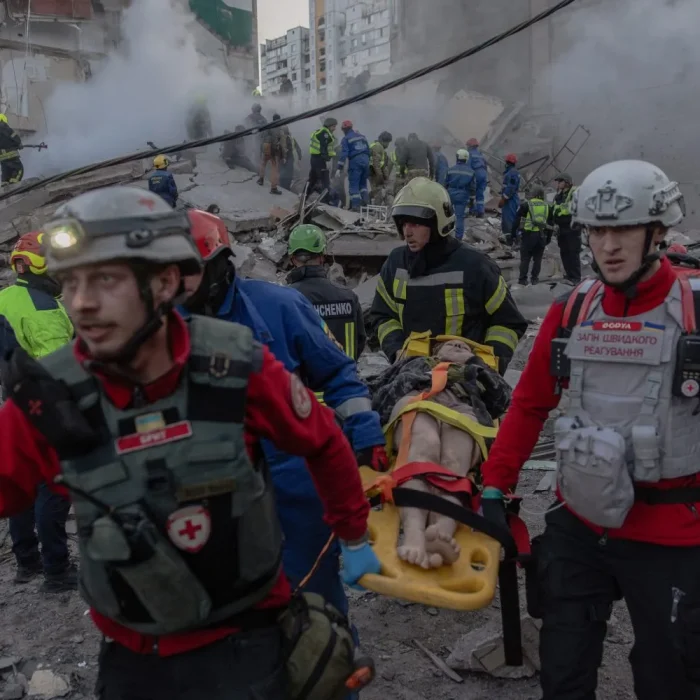
While the politics unravelled, the strikes did not stop.
Zelenskyy approved a forty-day operation in late June run by the Security Service of Ukraine — coordinated strikes on refineries, military facilities and logistics hubs intended to push Moscow toward negotiations by attriting the war economy.
By early July, Ukraine’s General Staff claimed more than forty percent of Russian refining capacity had been disabled: eight refineries hit in a month, with cumulative industry losses estimated at $13.5 billion since August 2025.
The past week added strikes on the Yaroslavl refinery and pumping station, an oil depot at Noginsk fifty kilometres from the Kremlin on the night of 17-18 July, and fires at logistics warehouses in Elektrostal and Tambov Oblast. Fuel shortages have pushed Moscow to extend export bans and sales restrictions across more than forty regions.
A Wildberries depot near Moscow was struck within the past day, producing a blaze visible for kilometres.
The Interdiction Layer
Running alongside the deep strikes is what Ukrainian officials call the middle-strike campaign, launched in April by the Unmanned Systems Forces and scaled through Fedorov’s “Logistical Lockdown” programme.
Targets include bridges, rail junctions, fuel depots, and the Rostov-on-Don to Simferopol corridor — the so-called Highway of Death supplying Russian forces in Crimea and southern Ukraine.
Officials claim the campaign has quadrupled destruction of Russian logistics infrastructure in occupied territory. It remains under-reported precisely because its effects appear as delay and shortage rather than dramatic footage.
Ukraine’s General Staff reported this week that drone units have struck more than one million targets since the start of 2026, including close to two hundred thousand Russian troops, with unmanned systems now accounting for roughly ninety percent of all Russian targets hit.
Turning Crimea Into an Island
The most visible interdiction effort has been against Crimea’s energy and logistics grid.
On 12-13 July, Unmanned Systems Forces struck the Kuban-Crimea power bridge — the peninsula’s main link to mainland Russian electricity — plus eleven further energy hubs. Between 1 and 8 July, fifty energy facilities in occupied territory were hit.
The objective, in Fedorov’s own phrasing before his dismissal, was to turn Crimea into an island: degraded air defence, exhausted fuel, isolated logistics.
Conditions inside occupied Crimea reflect it. Petrol reportedly costs six to seven times mainland Russian rates, and the Kerch Strait is closed to Russian shipping with no announced reopening.
The Sea Campaign
Operation MoLoCHKa — a Ukrainian acronym roughly meaning “Moscow will fall because of Crimea” — is the newest addition, a large-scale anti-ship effort across the Black Sea and Sea of Azov.
As of 19 July it has struck 172 vessels of Russia’s sanctions-evading shadow fleet.
Russia’s response reveals the strain. It has pulled Rubicon, its most capable drone-warfare unit, deploying up to two hundred groups partially off the front line to guard tanker traffic, alongside elements of the 51st Air Defense Division and a Black Sea Fleet anti-aircraft regiment. Navigation through the Don-Azov Canal is suspended, and new Kerch Strait passage applications have halted.
Analysts describe the Azov basin as becoming too dangerous for Russia to operate the fleet that funds a meaningful share of the Kremlin’s war chest.
The Ground War Barely Moves
The front line stayed dynamic but static in territorial terms. Limited Russian gains near Kostyantynivka-Druzhkivka and in northern Kharkiv Oblast, a small Ukrainian advance near Oleksandrivka.
Russia Matters reports Russian gains over the past month of between 5 square miles by ISW’s assessment and 15 by DeepState’s. Russian recruitment is reportedly failing to offset the casualties those marginal advances cost.
Separately, Euromaidan reported that Ukraine has now netted over 1,000 kilometres of road near the front to shield both military convoys and civilian traffic from drones.
A Second War Draining the Same Stockpile
The US-Iran truce sealed by memorandum on 17 June has collapsed.
American strikes on Iranian military sites resumed this week, hitting dozens of targets over consecutive nights. Iran struck commercial shipping in the Strait of Hormuz and formally declared the framework void on 15 July, saying it now fights an existential war. Overnight, Iranian attacks on American bases killed two service members and injured others.
The consequence for Kyiv is direct. Patriot interceptors — already scarce — are being consumed on two fronts simultaneously, with production trailing consumption.
Trump’s announcement at the Ankara NATO summit that Washington would license Ukraine to build its own Patriots was billed as a watershed. The timelines argue otherwise: Japan needed three years to build a factory, and Germany has yet to produce a single missile despite starting in 2022.
Iran Is Learning
Iran appears to have employed ballistic missiles with manoeuvrable warheads in recent strikes on American bases, making them very difficult to track and intercept.
ISW’s most recent report notes US official concerns, relayed to the Wall Street Journal on 18 July, that China and Russia are supporting Iranian targeting of American assets.
That fits a broader pattern of authoritarian learning and adaptation across Iran, China, Russia and North Korea.
Beijing Tests the Boundaries
China’s own moves this week reinforced the picture:
- Papua New Guinea ordered Taiwan’s representative office in Port Moresby closed on 15 July, citing one China policy. Taiwan is reviewing LNG purchases that account for roughly a third of PNG’s exports. The US State Department called it deeply concerning
- Fourteen nations plus a separate EU statement marked the tenth anniversary of the 2016 South China Sea arbitral ruling on 12 July. China again dismissed it as waste paper
- A 6 July submarine missile launch into the South Pacific was timed to coincide with allied exercises
Taiwan Scrambles to Adapt
Taiwan spent the week absorbing the consequences of legislative cuts to its defence allocation.
Speaking on 17 July, President Lai Ching-te warned that a NT$470 billion cut to the original NT$1.25 trillion package in May left funds for US arms purchases but almost nothing for indigenous uncrewed systems. He urged passage of a further NT$210 billion standalone budget.
Lai cited Ukraine, the Israel-Arab conflicts and the US-Iran war in describing drones as the quintessential asymmetric warfare capability.
Taiwan’s Ocean Affairs Council announced plans for twenty-five unmanned surface vessels and two underwater drones, developed with US firm Maritime Tactical Systems, explicitly modelled on Ukraine’s sea-drone campaign against the Black Sea Fleet. Taiwan and the US also confirmed joint production of the Mighty Hornet I attack drone.
A five-day joint defence exercise moved Marine Corps units into metropolitan Taipei ahead of Han Kuang Exercise No. 42, beginning 5 August. Taiwan’s National Security Council warned that more than 110 PLA Navy and coast guard vessels are now deployed along the First Island Chain.
Uncrewed Logistics
American manufacturer Saronic — builder of the Corsair attack boats used against Iran’s Bandar Abbas naval base on 12 July — announced a new Texas shipyard capable of producing large uncrewed cargo vessels.
The comparison worth noting: a WWII Victory ship ran about 450 feet and carried over 10,000 tons. Saronic’s yard could produce vessels up to 850 feet.
Merchant shipping carried the overwhelming logistics load in the Pacific during the Second World War and would again. Expanding that fleet with uncrewed hulls matters enormously for any future Pacific operation.
The Assessment
Ukraine is winning a technological war while mismanaging its home front.
Moscow cannot simultaneously defend Crimea, its shadow fleet, its refineries and its capital against a widening drone campaign without stripping forces from somewhere. Rubicon’s withdrawal from the front line is the clearest proof of that squeeze. Elite discontent is surfacing publicly, with Jamestown’s Pavel Baev citing debate over billionaire Andrei Melnichenko’s widely reprinted essay questioning the war’s course and escalating repression against business figures including the Rotenbergs.
Yet Ukraine chose this moment to remove the official most associated with the reforms behind its gains, replacing him with figures whose reputations are unproven at best.
The protest movement is the genuinely new variable. It has fused anger over one personnel decision with a generational argument about how the war should be fought — technology and transparency against mass and hierarchy. Zelenskyy cannot dismiss it without alienating the volunteer, veteran and technical communities driving Ukraine’s innovation.
Meanwhile, limited American bandwidth, declining munitions stockpiles and attention split three ways define the global picture. Authoritarian adversaries in Europe, the Middle East and the Pacific appear increasingly aware of that overstretch and willing to exploit it.
The war Ukraine is winning technologically could still be lost politically — at home, and among partners now watching Kyiv’s internal disputes with new concern.
Author