The Xi Jinping AI cooperation pitch delivered in Shanghai on Friday was framed as an invitation to the world. Read closely, it is also a strategy for making sure the world’s AI infrastructure runs on Chinese terms rather than American ones.
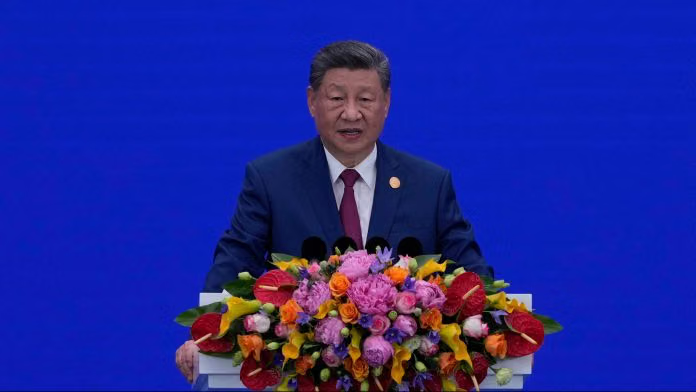
It was Xi’s first in-person appearance at the World Artificial Intelligence Conference, China’s largest AI event, and his long-awaited debut speech took a position deliberately opposite to that of President Donald Trump.
The Line Everyone Quoted
Xi reached for a Chinese proverb to make his point, telling the Shanghai audience that a single string cannot make music and a single tree does not make a forest.
AI development, he said, should not be a solo performance by one country but a symphony of international cooperation.
He returned to the theme repeatedly, calling on nations to seize what he described as a rare historic opportunity to encourage open source, openness, collaboration and sharing — and positioning China as a responsible major country committed to providing international public goods related to AI.
Why He Has Reason to Say It
The rhetoric follows the competitive logic.
The United States currently leads, with frontier labs including OpenAI and Anthropic and, critically, Nvidia as the world’s dominant chip supplier.
But Chinese firms are closing the gap, releasing open models that outperform some closed offerings from American Big Tech. Those performance jumps have pushed the Trump administration toward tighter restrictions on AI trade with China.
Openness, for a party that is behind on frontier capability but strong on distribution, is not charity. It is the faster route to relevance.
Nvidia’s Warning, Inverted
Nvidia CEO Jensen Huang has argued forcefully against decoupling, and his reasoning maps almost exactly onto what Xi is now attempting.
Huang’s position has been that widespread use of American technology abroad — especially in China — would leave Chinese AI dependent on American hardware, effectively locking in U.S. hegemony.
At Nvidia’s first GTC held in Washington, D.C. late last year, he warned lawmakers that the dynamic could reverse. If Silicon Valley withdraws entirely from the Chinese market while Beijing pushes open-source AI, the United States would be ill-prepared for the moment Chinese software permeates the world.
Huang was making the case for American dominance through ubiquity. Xi appears to have adopted the same theory and applied it in the other direction.
The Coalition Becomes Official
China is not merely calling for solidarity. It is building institutions.
At last year’s conference, Chinese officials floated a global AI cooperation organization headquartered in Shanghai. This year Beijing formally launched it — the World Artificial Intelligence Cooperation Organization — announcing 29 member nations including Brazil and Russia.
The structure accomplishes two goals simultaneously: accelerating AI development inside China, and ensuring that global development proceeds according to Chinese principles under Chinese sponsorship.
Targeting the Global South
The most strategically significant element may be where China is directing its attention.
Xi committed on Friday to:
- Providing developing countries with 5,000 AI training opportunities over the next five years
- Establishing international AI application cooperation centers across the Global South
He described the effort as answering the call of the Global South and uniting the international community, calling it an important milestone in AI history.
The logic is straightforward. In economies where AI ecosystems are still forming, whoever supplies the models, the training and the standards early tends to shape what gets built for a long time afterward. China is moving to occupy that position before anyone else does.
A Different Message Behind Closed Doors
Xi’s public language celebrates true multilateralism. Reporting suggests Beijing behaves differently when the United States is involved.
According to Reuters, Chinese officials have met with domestic labs to discuss limiting overseas access to both open-source and proprietary models.
Other actions point the same direction:
- Chinese authorities forced Meta to dismantle its acquisition of AI startup Manus and suspend all data sharing
- Chinese AI developers are increasingly abandoning Nvidia for domestic silicon suppliers, at government encouragement
Taken together, these suggest a cooperation framework with a specific exclusion built in. Even if Washington softened its trade posture, the Chinese vision of open AI may not have a seat reserved for American firms.
The Safety Argument as a Weapon
Xi also staked out a pro-regulation position, distinguishing Beijing from the Trump administration on governance while landing a pointed criticism.
He called for laws and regulations, technological monitoring, early warning systems and emergency response mechanisms to prevent abuse and malicious use, and to keep AI under human control.
Then came the second half. Countries should jointly oppose overstretching the national security concept in AI, he said, and reject placing one nation’s security above that of others.
What He Was Pointing At
That line has a specific referent.
Last month, Trump barred Anthropic from sharing Mythos — its latest model, reported to have powerful hacking capabilities — with foreign nationals inside or outside the United States. He has since partially lifted the restriction, permitting the company to share the model with selected companies and agencies.
Chinese entities are almost certainly not among them. When Washington invokes national security in AI contexts, the concern being described is usually China.
Xi’s framing turns that restriction into evidence for his broader argument: that American policy treats AI as a national asset to be guarded rather than a global technology to be shared.
Two Competing Visions
What emerged from Shanghai is a genuine strategic divergence, not just a rhetorical one.
The American approach treats frontier capability as a strategic advantage worth protecting through export controls and access restrictions. The Chinese approach treats distribution as the advantage — releasing capable open models widely, building institutional frameworks, and training the next generation of developers in markets that have not yet chosen a side.
Both theories could be right about different things. Restriction may preserve a capability lead. Openness may determine whose systems the rest of the world actually runs.
The Question Underneath
Xi’s speech insisted that no country should dominate AI. The institutions being built around that speech are headquartered in Shanghai, funded by Beijing, and increasingly closed to American participation.
Whether that counts as multilateralism or as a different flavor of dominance depends largely on which side of the coalition a country finds itself on — and 29 nations have now made that choice.
Author