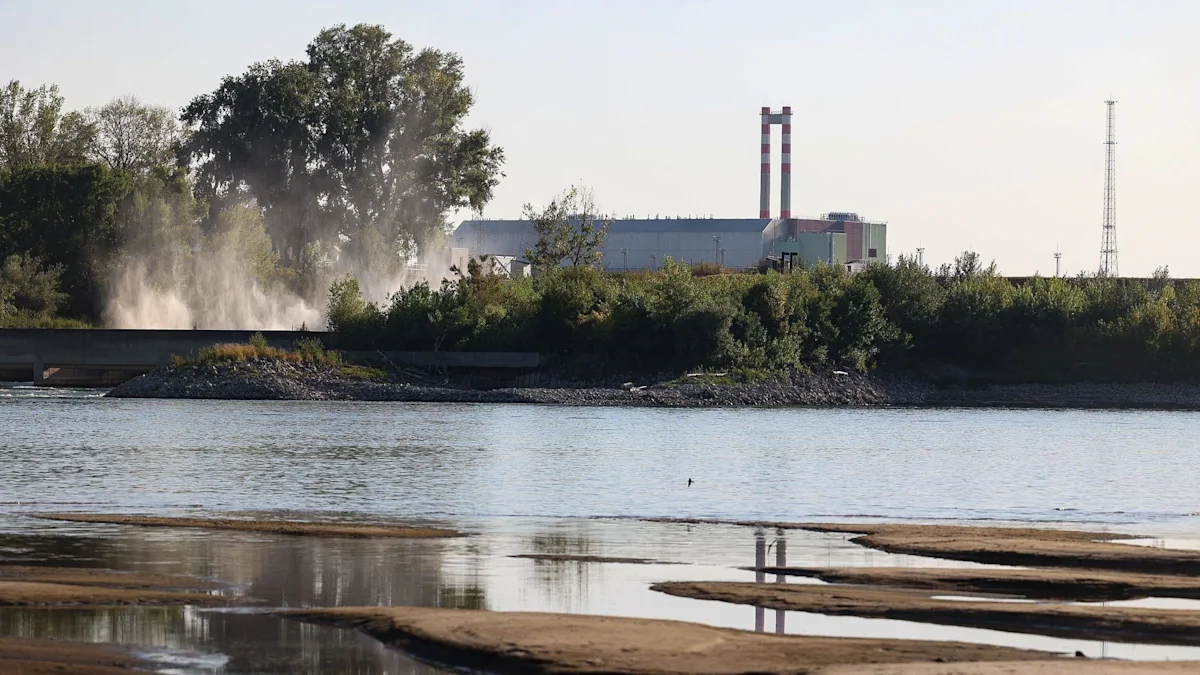
Thirty-One Centimetres: How a Shrinking Danube Switched Off Hungary’s Nuclear Power
On Tuesday morning, Hungarian water managers recorded a number that had never appeared in the gauge records of the Danube at Budapest: 31 centimetres.
Days later, the country’s only nuclear power plant is shutting down for the first time in its 44-year operating history — not because of a fault, an accident or a safety concern, but because the river has dropped below the level at which the plant’s pumps can reach it.
Prime Minister Péter Magyar has warned that Hungary’s electricity market could face critical conditions from Monday.
The Detail That Actually Matters
The Paks plant sits about 100 kilometres south of Budapest and comprises four Soviet-supplied reactors that came online between 1982 and 1987. Together they produce roughly 2,000 megawatts — somewhere between 40 and 50 percent of Hungary’s electricity, depending on the measure used.
The plant uses once-through cooling, drawing water directly from the Danube.
The operator, MVM, was precise about the problem and stressed there is no safety issue. Even at current extremely low flows, the river carries enough water to cool the reactors. What has failed is access: the suction level of the pumps required to draw that water now sits above the surface of the river, and levels are expected to keep falling.
The plant cannot lift water it cannot reach.
MVM noted that the Danube is now 28 centimetres below the previous record set in 2018 — which was itself a full metre below the 100-year minimum water level used when Paks was designed.
That last figure is the one worth pausing on. The engineering assumptions have been overtaken twice in eight years.
What Hungary Is Asking
Magyar said in a video address that the plant would be shut by Monday at the latest and was unlikely to restart soon given the sustained drought.
Compounding matters, the Dunamenti power plant went offline after a malfunction, removing a further 400 megawatts, though repairs were expected to be completed quickly.
The government’s response has several layers:
- Households asked to limit heavy electricity use between 5 p.m. and 10 p.m., including EV charging and air conditioning
- Large industrial users, including carmakers and battery manufacturers, asked to cut consumption voluntarily
- Mandatory limits being prepared if voluntary measures prove insufficient
- A list being compiled of electricity and water consumers whose use could be restricted
- A possible rotational shutdown regime to keep the grid balanced
Hungary intends to increase imports from neighbours, with import infrastructure capable of handling roughly 3,600 to 3,800 megawatts. The difficulty is that Austria, Slovakia and Ukraine are managing the same heatwave.
Temperatures in Hungary are forecast to hover around 37°C for a week.
Romania Is in the Same Position
At the Cernavoda plant, which supplies about 20 percent of Romania’s electricity, one of two 706-megawatt reactors was shut down earlier this week for the same reason. State operator Nuclearelectrica was working Thursday to avoid taking the second offline.
If it does, Romania joins Hungary in having no nuclear generation at all.
The hydrology explains why. Romania’s National Institute of Hydrology puts average July flow where the Danube enters the country at 4,700 cubic metres per second. On Wednesday it measured 1,600 — roughly a third of normal. The forecast is for 1,500 by Tuesday.
A River in Trouble Along Its Whole Length
The Danube runs 2,857 kilometres through 19 countries, from Germany through Bratislava, down through the Hungarian plain and the Serbian-Romanian border, and out through Bulgaria into the delta and the Black Sea.
Levels are at 30-year lows in several countries. Serbian hydrologist Dejan Vladiković told broadcaster N1 that the river has fallen to levels not seen in 50 to 60 years, and that climatologists expect no improvement before mid-September.
He also made an important point about causation: this is not simply a product of current temperatures. Rainfall through the spring was well below normal, meaning the catchment entered summer already depleted.
Serbia’s Sava and Tisa, both Danube tributaries, are similarly low. Temperatures there were forecast to reach 38°C, locally 40°C, with overnight lows in Belgrade around 26°C.
Shipping Has Stopped
In Bulgaria, river traffic has halted entirely.
Border police evacuated 186 passengers from the cruise vessel Viking Ullur earlier this week after it ran aground near Vidin, on the Romanian border. The ship could not dock, a second boat sent to assist could not get close enough, and passengers were running low on food and water by the time they were taken off.
Ivan Zhekov, head of river supervision at Bulgaria’s maritime administration agency, told the national news agency he had never heard of levels this low and that nothing comparable had occurred since 1990.
What the River Has Uncovered
Receding water has exposed things that have been submerged for a long time.
The remains of a sunken Hungarian cargo ship have resurfaced in Croatia. The hulks of a German river flotilla have appeared in Serbia — vessels of that kind, scuttled during the Second World War, emerge periodically during severe droughts.
Near the northeastern Bulgarian city of Ruse, a resident found bones on the riverbed that experts identified as mammoth remains, including a lower jaw, two tusks and possibly a rib.
The Underlying Trend
Europe is the fastest-warming continent on the planet, heating at roughly twice the global average according to the Copernicus Climate Change Service. The consequences it identifies are exactly what is playing out: more frequent and intense heatwaves, mounting pressure on water resources, and more severe wildfires.
Forecasters expect fire-prone conditions to spread toward central Europe in the coming days, with Greece and Turkey among the worst affected.
The Larger Lesson
There is a systemic point buried in this story that extends well beyond two nuclear plants.
Thermal generation — nuclear, coal and gas alike — depends on water for cooling. Plants across Europe and North America have repeatedly been forced to reduce output during heatwaves, either because rivers ran too low or because discharge water would exceed environmental temperature limits.
That means electricity supply is most constrained precisely when demand peaks, since heatwaves drive air conditioning use. It is an unusually awkward form of correlated risk.
Paks illustrates the specific version of the problem: infrastructure designed against a century of hydrological records now operating in conditions those records did not contain.
What Happens Next
Magyar has said coordinated action and self-restraint will be needed to avoid more serious consequences, and asked for public cooperation.
Whether Hungary avoids rationing depends on three things it does not control — the weather, the availability of imports, and how quickly the Dunamenti unit returns.
Rain is not in the forecast, and the Alpine catchments feeding the upper Danube are not expected to deliver relief soon.
Author
-
Lucienne Albrecht is Luxe Chronicle’s wealth and lifestyle editor, celebrated for her elegant perspective on finance, legacy, and global luxury culture. With a flair for blending sophistication with insight, she brings a distinctly feminine voice to the world of high society and wealth.