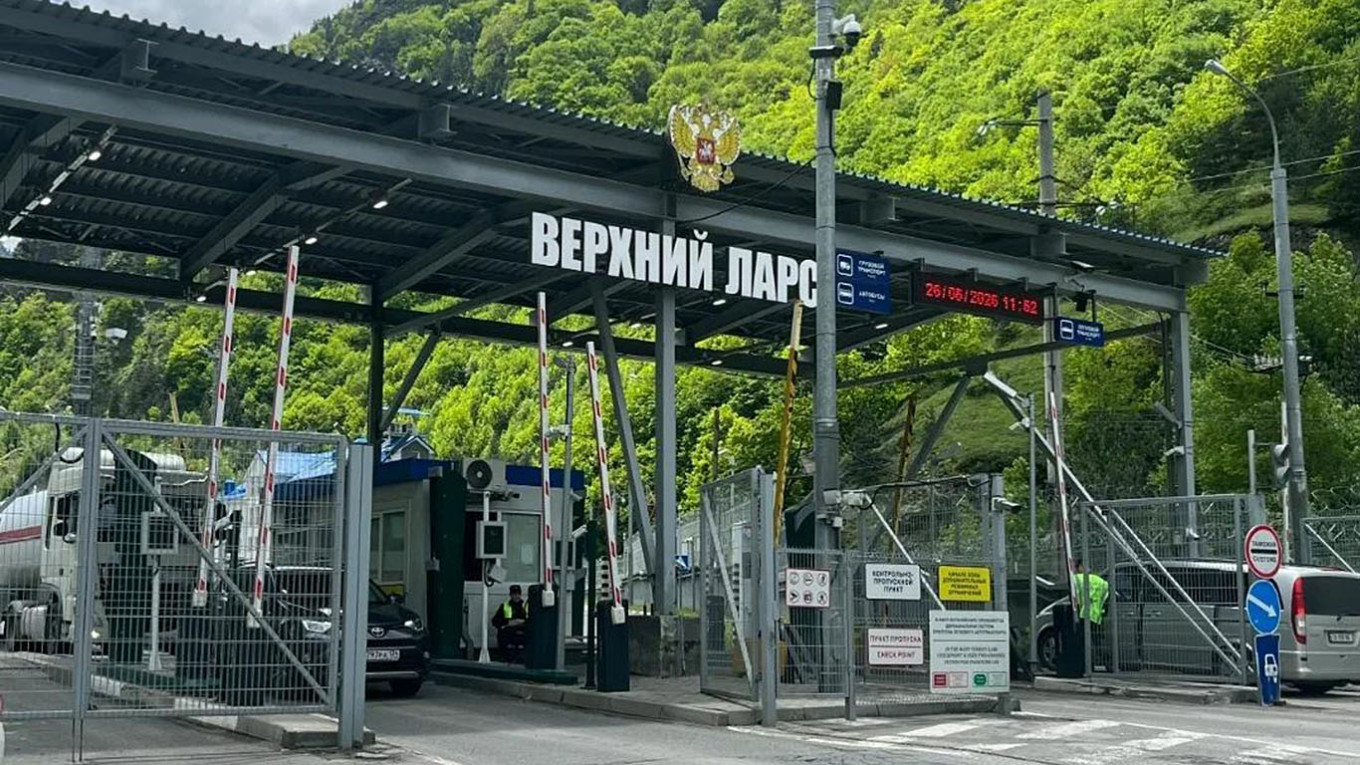
More than 113,000 Russians crossing into Georgia in the space of a single week has turned rumors of a new draft into something visible on the ground — long queues of vehicles at a mountain border post, and a pattern that Russians recognize from 2022.
The exodus moved through the Verkhny Lars checkpoint, the main land crossing between Russia and Georgia.
The Numbers
On August 20 alone, more than 20,000 people passed through the border point.
Russia’s Federal Customs Service confirmed that the figure substantially exceeds volumes recorded in previous years, according to reporting by Politico.
Border crossings of that magnitude do not happen spontaneously. They reflect a shared calculation among tens of thousands of people that leaving now is safer than waiting to find out what happens next.
What the Kremlin Has Been Doing
The rumors did not appear from nowhere. Several developments over recent months point in a consistent direction.
Russian authorities have intensified recruitment efforts for contract soldiers. They have stepped up data collection on reservists. And they have expanded the powers of the Russian National Guard.
Each measure individually could be explained as administrative. Together, they read as preparation.
The Official Denial
Moscow has publicly rejected the interpretation.
Vasily Nebenzya, Russia’s permanent representative to the United Nations, stated on August 20 — the same day 20,000 people crossed into Georgia — that a new mobilization is neither planned nor expected.
The gap between that statement and the movement at the border illustrates how little confidence many Russians place in official assurances on this particular subject. The 2022 mobilization was also denied until it was announced.
The Recruitment Shortfall
Underlying the speculation is a numbers problem the Kremlin has not solved.
Sources indicate Russia has been unable to consistently recruit more than 30,000 contract soldiers per month this year, with the figure dropping to around 27,000 in some months.
Contract recruitment has been the preferred approach precisely because it avoids the political cost of compulsory service. Financial incentives have been raised repeatedly to sustain the flow. If that pipeline is no longer sufficient to meet requirements, the alternative sources narrow considerably.
That is why attention has shifted toward reservists — primarily men under 55 who previously completed compulsory military service and remain on record as available.
What Ukrainian Intelligence Expects
Ukrainian intelligence assessments describe a substantially larger plan.
According to those assessments, Russia intends an additional mobilization wave totaling 600,000 people across 2026 and 2027 — 300,000 this year and another 300,000 next.
Intelligence estimates from a party to the conflict warrant caution. But the figure aligns with the observable recruitment shortfall and the administrative preparations underway.
Armenia Opens Its Door
Georgia is not the only destination. Armenia may again serve as a reception point for those leaving, as it did during the autumn of 2022.
Alen Simonyan, Secretary of Armenia’s Security Council, told TV Rain that Yerevan will not obstruct people seeking to avoid deployment to the Ukrainian front, according to The Moscow Times.
His message to Russians was direct: welcome to Armenia. He said the country loves and respects everyone, that arrivals would find what they came looking for, and that they could return to Russia whenever it suited them.
That posture reflects both humanitarian positioning and the practical reality that Armenia has absorbed similar arrivals before.
A Country Bracing for Worse
The border movement sits within a broader mood of apprehension inside Russia.
A state-run poll conducted by the Russian Public Opinion Research Center in July 2026 found that 66 percent of citizens believed difficult times lay ahead for the country. That represents a 16 percentage point increase in pessimism since the start of the year.
The drivers are multiple: economic deterioration, long-range drone strikes hitting key infrastructure, and the continuing war in Ukraine.
The resulting anxiety has reached levels not recorded since the Soviet collapse in 1991 and the hyperinflation crisis that followed in 1992 — comparisons that carry enormous weight for anyone who lived through that period.
Why This Matters
The 2022 mobilization produced an immediate and lasting effect on Russian society. Hundreds of thousands left. Many did not return. The labor market lost skilled workers, and the political system absorbed a shock it has been careful not to repeat.
A second wave would compound that. The people crossing at Verkhny Lars this month are disproportionately young, educated, and mobile — precisely the demographic an economy under strain can least afford to lose.
What Happens Next
The government maintains that no mobilization is coming. The recruitment numbers suggest pressure that must be resolved somehow. The border traffic indicates that a large number of Russians have drawn their own conclusion.
Which of these proves accurate will become clear in the coming months. Until then, the queues at the Georgian frontier remain the most honest available indicator of what people inside Russia actually expect.
Author