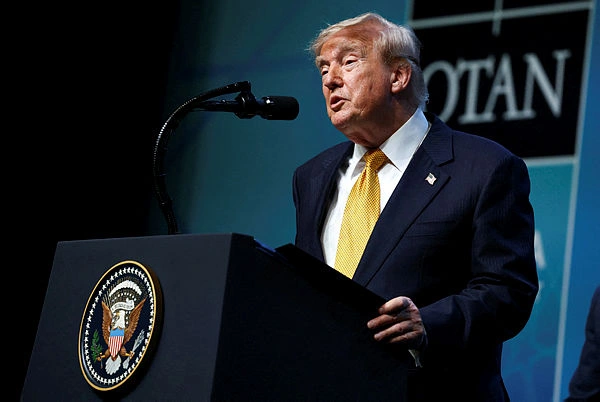
The bipartisan housing bill that Congress spent months negotiating quietly became law at midnight on Saturday — not with a ceremonial pen stroke, but with the absence of one. President Trump declined to sign it, and under the Constitution, that silence was enough.
It is an unusual footnote to what supporters call the most sweeping housing legislation in a generation.
How a Bill Becomes Law Without a Signature
The mechanics are straightforward, if rarely invoked. Once both chambers of Congress pass a bill and send it to the White House, the president has ten days — Sundays excluded — to sign it or veto it. Do neither, and the bill becomes law anyway.
That is precisely what happened here. House Speaker Mike Johnson transmitted the legislation to the president on June 29, starting the clock. The president never picked up the pen. He also never issued a veto. When the deadline expired, the 21st Century ROAD to Housing Act took effect on its own.
The Protest Behind the Refusal
The president’s reasoning had nothing to do with housing policy itself. It centered instead on a separate piece of legislation stalled in the Senate: the SAVE America Act, an elections bill that would tighten voting and voter registration requirements.
Trump had originally planned a bill signing ceremony on Capitol Hill shortly after the housing measure cleared both chambers with wide bipartisan support. Then, just hours before the event, he called it off — and announced he would withhold his signature until the Senate moved on the elections bill.
He restated that position on Friday morning in a Truth Social post, declaring he would not sign the housing legislation as a protest against the Senate’s failure to advance the SAVE America Act, which he claimed enjoys overwhelming support among Republicans.
The elections bill would ban mail voting, require proof of citizenship to register, and mandate photo identification at the polls. Senate Republican leaders, however, have repeatedly acknowledged what the president has not: the votes simply are not there.
A Political Headache for Republicans
The standoff left GOP lawmakers in an awkward spot. Housing costs and affordability rank among voters’ most persistent concerns heading into the midterm elections, and the bill represented a rare, genuine bipartisan win that Republicans could have campaigned on.
Instead, the moment was overshadowed. The president dismissed the legislation publicly as “a yawn,” and when reporters asked him what he intended to do with it, he said he did not know — adding that he considered it unimportant compared to the elections bill.
Johnson worked to smooth things over. He suggested the president had not read the legislation line by line, noting that Trump “has a lot going on.” The Speaker described the bill as substantive and full of meaningful reforms, and said he had urged the president to sign it with “the fattest black marker you have,” predicting the results would benefit Americans significantly.
He also acknowledged the outcome either way. If the president signed it, great. If not, Johnson said, the bill would still become law and Republicans would still celebrate it — while the president made his point about election integrity.
Democrats Seize the Moment
Senator Elizabeth Warren, the Massachusetts Democrat who drove the bill through the Senate, was considerably less diplomatic.
In a statement issued after the midnight deadline passed, Warren questioned why the president had sat on the legislation for more than two weeks. Her answer was blunt: there was nothing in it for him personally. No luxury perks, no foreign gifts, no lucrative side deals — just measures designed to make housing cheaper for ordinary families.
Trump, she argued, could not bring himself to sign it because lowering costs for American households simply was not a priority.
What the New Housing Law Actually Does
Lost in the political theater is the substance of the law itself, which contains more than 45 separate provisions. Most are aimed squarely at one goal: building more homes, faster and cheaper.
Key elements include:
- Cutting regulatory barriers and streamlining environmental reviews that slow down affordable housing development
- Launching a pilot program to help local governments convert vacant commercial buildings into residential housing
- Expanding federal funding for factory-built homes, a lower-cost construction method
- Scrapping an outdated rule requiring certain homes to be built on a steel chassis used for transport
- Creating an innovation fund to reward communities that successfully expand their housing supply
- Strengthening housing opportunities for veterans
- Restricting institutional investors from buying up certain single-family homes
The Investor Provision Explained
The last item has drawn the most attention — and the most debate.
For years, homebuyers have complained about competing against deep-pocketed financial firms that can pay cash and close quickly. The new restrictions are designed to reduce that pressure and give individual buyers a fairer shot.
Crucially, the limits apply to existing single-family homes rather than new construction. That distinction is deliberate. Lawmakers wanted to curb speculation in the existing housing stock without discouraging investment firms from financing new builds, which the country badly needs.
The Bottom Line
The bipartisan housing bill is now law, regardless of how it got there. Its provisions will begin reshaping housing policy in the months ahead, whether or not a signing photo ever existed.
What the episode really illustrates is the widening gap between legislative accomplishment and political messaging. A measure that passed with broad support from both parties — addressing an issue voters consistently rank near the top of their concerns — ended up becoming law almost by accident, overshadowed by a fight over an entirely unrelated bill.
For homeowners, renters, and builders, the practical question is simpler: does it work? That answer will take years, not headlines. But the law is on the books now, signature or not.
Author