The way Iran war casualties are being counted has become its own political fight, and veterans who spent careers in uniform say the Pentagon’s latest bookkeeping decision reads as an insult to the families of the dead. A quiet database change made over the weekend now sorts four Americans killed by Iranian forces into a newly invented category, one that does not carry the name of the war they died in.
What the Pentagon Changed
The alteration was made to the Defense Casualty Analysis System, the public-facing database the military uses to track killed and wounded personnel. The Department of Defense, rebranded as the Department of War under President Donald Trump, added more than 140 wounded service members to the record.
More significantly, it created a fresh classification called “Overseas Operations,” covering personnel killed or wounded beginning July 7. The effect is to split the casualty ledger, separating losses after that date from those recorded during the earlier phase of the US-Israel war on Iran.
Four Americans killed in action fall under the new heading: 1st Lt Tyler James Feehan, Pvt Isabella Gonzales, Sgt Angel S. Rampersad and Sgt Michael Emmanuel Swinton.
The Pentagon was asked to comment and had not offered an explanation.
Why the Date of July 7 Matters
The change is not arbitrary. It follows directly from a legal argument the administration has been making for months.
Under the War Powers Act of 1973, a president must wind down military operations within 60 days unless Congress votes to authorize an extension. Congress has not done so. The administration’s position is that the ceasefire reached with Iran in April stopped the clock on May 1, closing out the conflict’s initial period. Restarting the casualty count on July 7 fits that timeline neatly.
Critics see the logic running in the opposite direction: that the interpretation exists to serve the calendar rather than the other way around.
“An Absurd Ruse,” Says a Republican Critic
Thomas Massie, the Kentucky Republican who lost his House primary earlier this year after repeatedly breaking with the president, put it bluntly on social media. He described the Pentagon as pretending two separate Iran wars had occurred, divided by a short pause in fighting. In his reading, the operation has now run past 90 days without congressional authorization, which means Defense Secretary Pete Hegseth is violating the law and should answer for it.
Sen. Kirsten Gillibrand of New York, a Democrat who sits on the armed services committee, framed the issue around transparency, saying Americans are entitled to an honest accounting of what the war has cost in lives and that she would keep pressing the administration until service members and their families get it.
Veterans Hear Something Familiar
For those who have served, the dispute is less about database architecture than about what the government is willing to say out loud.
Michael E. Smith, a retired US rear admiral who founded National Security Leaders for America, called the move a profound insult to grieving families. Suggesting these deaths were not caused by the war but merely occurred during overseas operations, he said, is indefensible.
Smith, who served combat tours in Iraq, Bosnia and Kosovo, drew a direct line to the way casualty figures were handled during Vietnam. His read on the motive is unsparing. He argued the president is visibly uncomfortable with the death toll, noting Trump has taken to comparing the conflict with Korea and Vietnam, and suggested that when leadership does not want to hear about losses, reducing the apparent number becomes an attractive option.
A Nineteen-Year-Old From Carrollton
Tristeza Ordex, a Marine Corps veteran who works as national organizer of partnerships and engagement at VoteVets, said the question goes beyond arithmetic and into accountability.
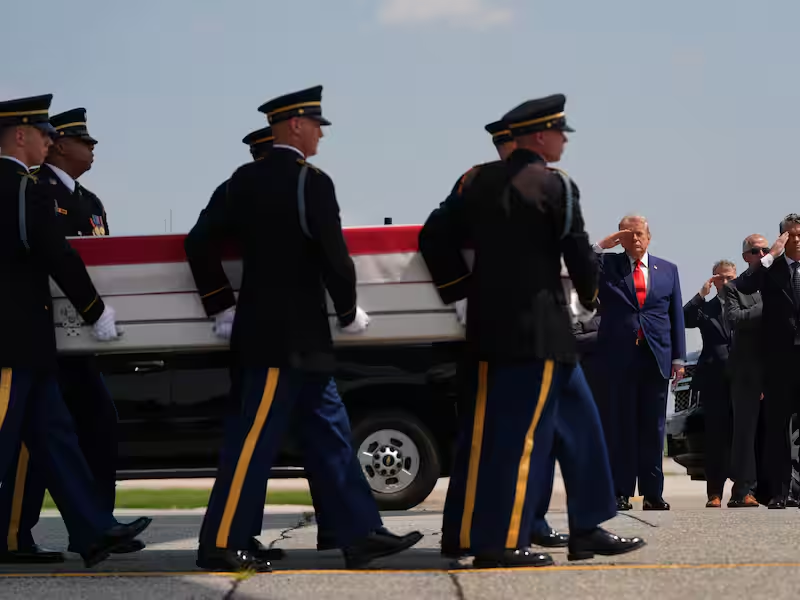
She recalled the ramp ceremonies she attended while deployed to Afghanistan, the airfield gatherings held to honor a fallen service member before the casket is carried onto the aircraft for the flight home. Those rituals exist because militaries have long understood that how the dead are acknowledged matters.
Isabella Gonzales was 19 and came from Carrollton, Texas, not far from Ordex’s own home outside Dallas. Ordex noted that Gonzales had not yet been born when she herself enlisted in 2004. Talking about it now, she said, brings the emotion close to the surface.
She placed the omission in a broader context, arguing that Latinos are already being pushed out of public recognition and targeted in other arenas, and that someone who gave everything for the country is now not even being counted among the war’s dead. The word she used for it was erasure.
Why the Label Carries Real Weight
It would be easy to dismiss this as a fight over a dropdown menu on a government website, but classifications carry consequences that extend well past presentation.
Official casualty categories shape the historical record of a conflict. They inform how future policymakers and historians measure what an operation cost. They feed into public understanding of whether a war is expanding or winding down. And for families, the designation attached to a death is a formal statement by the government about why their child or spouse died.
There is also a legal dimension. If the casualty record treats the fighting as two distinct episodes, it reinforces the administration’s argument that the War Powers clock reset, weakening the case that congressional authorization is overdue. Critics like Massie argue that is precisely the point, and that a database entry is being used to shore up a position Congress never endorsed.
An Unresolved Standoff
For now, the four names sit in a category that describes geography rather than conflict. Lawmakers in both parties have raised objections, the Pentagon has not publicly defended the change, and Congress has still not voted to authorize the operation that continues.
The families of Feehan, Gonzales, Rampersad and Swinton are left in the middle of an argument about paperwork that, for them, is nothing of the kind.
Author
-
Lucienne Albrecht is Luxe Chronicle’s wealth and lifestyle editor, celebrated for her elegant perspective on finance, legacy, and global luxury culture. With a flair for blending sophistication with insight, she brings a distinctly feminine voice to the world of high society and wealth.