The Apalachee High School shooter was sentenced Tuesday to life without the possibility of parole, closing the criminal chapter of an attack that killed four people and left a Georgia community permanently altered.
Colt Gray, now 16, was 14 when he opened fire at the school in Winder on September 4, 2024. Two teachers and two students died. Another teacher and eight additional students were wounded, seven of them by gunfire. He was charged as an adult and pleaded guilty last Friday to all 55 counts against him, including murder.
Because there was no negotiated agreement with prosecutors, the question of parole eligibility fell entirely to the court. Barrow County Superior Court Judge Nicholas Primm heard from victims’ families and from both sides before deciding.
Gray declined to speak at his own sentencing.
The Four Who Died
Richard Aspinwall, known to nearly everyone as Ricky, was 39 and taught at the school. Cristina Irimie was 53 and also taught there. Mason Schermerhorn and Christian Angulo were both 14 years old.
Their families addressed the court on Friday, and their statements shaped the proceeding as much as anything the attorneys argued.
Shayna Aspinwall described what her husband’s death has meant for their two daughters, who were five and two when he was killed. Their lives, she told the court, will always carry the shape of his absence. She called it a life sentence of grief for everyone left standing.
Breanna Schermerhorn, Mason’s mother, acknowledged that adults in Gray’s life had failed him. She said that did not transfer responsibility. The choices, she told the court, belonged to him alone.
The judge reached the same conclusion.
The Court’s Reasoning
Primm was unusually direct in explaining the sentence.
He told Gray that he did not appear tormented by what he had done, describing him instead as someone who seemed to take pride in following the path of the killers he admired. There was no guilt on display, the judge said.
Primm rejected the explanations that often surface after school attacks. Four lives were taken, he said, two of them barely begun. It was not fear. It was not anger. Gray had not been bullied at the school, and he did not know any of the people he shot. What drove it, in the court’s assessment, was the pursuit of notoriety.
The judge also pushed back on any suggestion that the attack was impulsive. He characterized the planning as something that developed slowly over roughly a year, sustained by fantasy rather than crisis.
Primm closed without any pretense of satisfaction. There is no joy here, he said, only a partial measure of closure. The dead do not return. The wounded do not forget. And a boy of 16 will grow old and die behind bars.
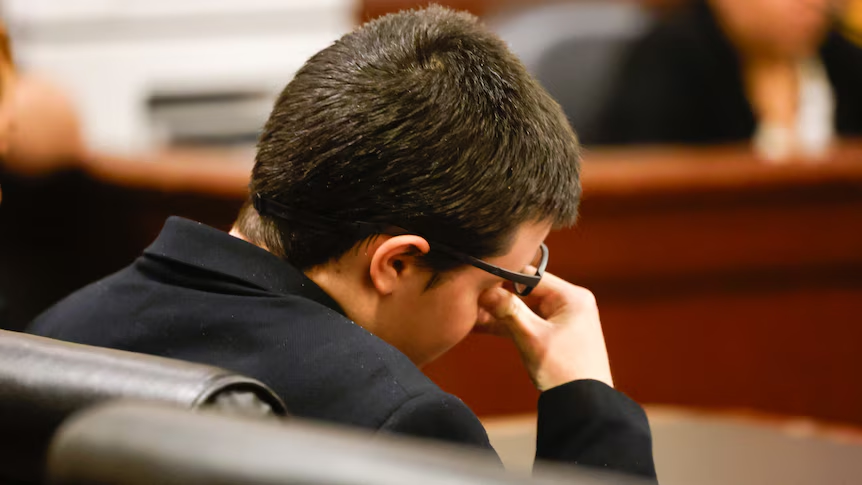
Gasps ran through the courtroom when the sentence was read. Before deputies led him out in handcuffs, Gray looked briefly toward the gallery where his grandmother, Debbie Polhamus, had been seated.
The sentence matches the one imposed four years ago on the man who carried out the 2018 attack at a Florida high school that killed seventeen people — a figure Gray had fixated on.
What the Defense Presented
The defense called psychologist Kevin Richards, who described Gray as a lonely and dysfunctional teenager who grew up in chaotic circumstances.
Richards testified that Gray’s parents struggled with drug use, financial instability and frequent conflict. The family moved often, and there were extended periods when Gray was not enrolled in school at all. Isolated and largely unsupervised, he drifted into online true crime communities and became consumed by school shootings.
Polhamus, his grandmother, told the court that Gray spent long stretches at her home because his parents’ household was so unstable. There were always problems, she said, describing heavy drinking and mounting unpaid bills.
Prosecutors did not dispute the difficult childhood. They argued it did not explain the crime. An investigator with the Barrow County District Attorney’s Office testified about the volume of material Gray had collected about the Florida gunman, including thousands of saved images. The state also played recorded jail calls between Gray and his mother from the fall of 2024, in which he sounded gratified by comparisons to other mass killers.
The Firearm and the Warnings
One thread ran through the case from the beginning: how a 14-year-old obtained the rifle.
Polhamus testified that Gray’s father, Colin Gray, kept dozens of firearms in the house and did not secure all of them. She said he bought his son the weapon as a way to build a relationship, wanting something the two of them could share.
That decision carried legal consequences. A jury convicted Colin Gray in March on charges including second-degree murder and involuntary manslaughter for providing the gun. Court records show he also purchased ammunition and shooting accessories for his son over time.
There were earlier signals. Sheriff’s deputies interviewed both father and son in May 2023 about an online threat traced to the teenager, which he denied making. Testimony at the father’s trial indicated he contacted a counseling service in the weeks before the shooting but never followed through. Gray’s mother, separated from his father at the time, told investigators she had specifically urged him to lock up the guns and cut off their son’s access.
What Comes After
Gray’s trial had been set to begin in mid-October. The guilty plea ended that possibility, sparing families a lengthy proceeding while leaving them without the fuller public accounting a trial might have produced.
For Winder, the sentencing settles a legal question but not much else. Two classrooms lost their teachers. Two families lost children. Others carry injuries that will follow them for decades.
The court delivered the maximum available. What it could not deliver, as the judge himself noted, is anything resembling repair.
Author
-
Lucienne Albrecht is Luxe Chronicle’s wealth and lifestyle editor, celebrated for her elegant perspective on finance, legacy, and global luxury culture. With a flair for blending sophistication with insight, she brings a distinctly feminine voice to the world of high society and wealth.