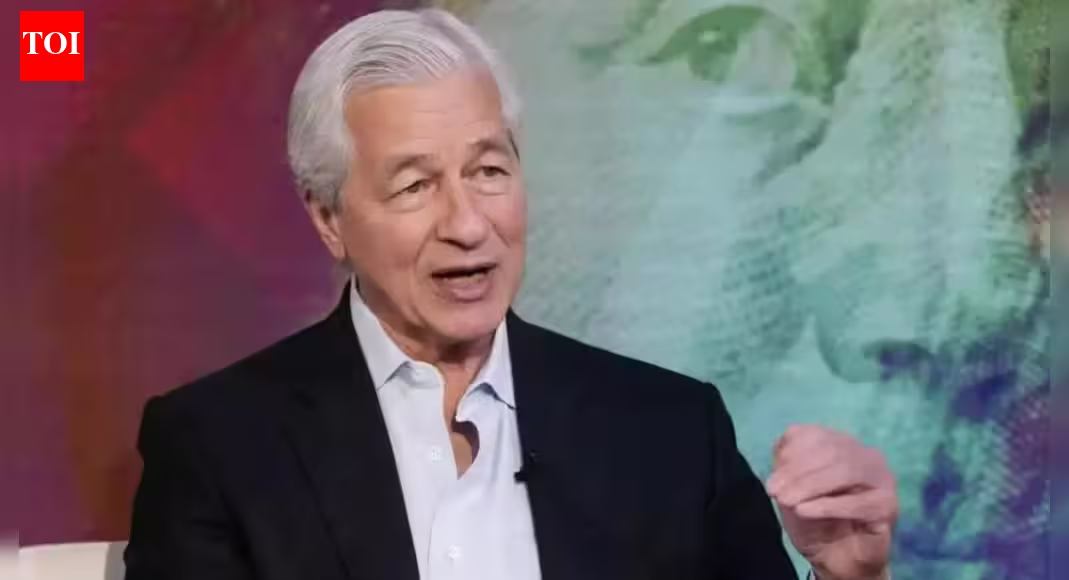
The Jamie Dimon San Francisco wealth tax conversation happened on the floor of an arena that carries his bank’s name, with the JPMorgan Chase chairman dressed in athleisure and openly frustrated by how American politics frames economic questions.
Speaking with San Francisco Standard editor-in-chief Kevin Delaney at Chase Center, Dimon made a case for something increasingly rare in public discourse: a middle position that asks business and government to fix problems together rather than blame each other for creating them.
Against What He Calls “Binary” Thinking
Dimon’s central complaint was about framing. He argued that reducing complex problems to two opposing camps produces radical proposals and poor outcomes.
His alternative is a centrist, business-friendly stance that still assigns corporations real responsibility for social conditions. He rejected the idea that big business caused America’s struggling schools or rising crime, but he was equally direct that companies can do substantial work to improve both.
On the underlying causes, he spread the blame widely. Whether you point at Republicans or Democrats, he said, the failures are in policy itself: education, criminal justice, wages, workforce training. His preferred response is for people with resources to volunteer rather than wait.
A Notable Change of Tune on San Francisco
Two years ago, Dimon told Fox News that San Francisco was in far worse condition than New York, a remark that produced visible discomfort at City Hall.
His assessment now is markedly warmer. He described a city on the rise and credited Mayor Daniel Lurie by name for progress on crime and street conditions.
The context was personal. Attendees at the bank’s flagship healthcare conference near Union Square had lodged hundreds of complaints about public safety and conditions on the street. Dimon’s line on why things improved was simple: problems do not get fixed while they are being denied.
His prescription for the city was equally compact. Less crime, better schools, more housing.
The K-Shaped Economy Problem
Dimon acknowledged the shape of the current recovery, in which some groups are thriving as never before while others slide backward.
The people on the lower path, he noted, tend to face:
- Higher exposure to crime
- Weaker schools
- Fewer paths to advancement
He treats this as a policy failure rather than an inevitable consequence of a strong economy, though he did not dispute that the divide is real and widening.
Housing: A Supply Argument
The tension in his position surfaces most clearly on housing. San Francisco rents have climbed alongside the influx of AI money, pricing out large numbers of residents.
Dimon conceded this is a difficult balance but insisted the answer lies in supply, not in restraining the industries generating growth.
His counterfactual was pointed. If those companies stumbled or collapsed, residents would not be priced out, but the city would also lose the tax base that supports them in the first place.
On AI and the Bubble Question
Dimon believes in the technology’s long-term trajectory while acknowledging the obvious near-term risk. He said investment figures will reverse at some point, noting that markets do not rise indefinitely and that they climb until they stop.
He drew a comparison to the dot-com collapse of the early 2000s. That crash destroyed companies and wiped out investors, yet it built the infrastructure the modern internet economy runs on.
On job displacement, he urged people not to hyperventilate.
His practical suggestion focused on community colleges. He wants local institutions offering certification programs that move displaced workers into fields with genuine demand, naming cybersecurity and the construction trades as examples.
He also proposed a different yardstick for high schools. The question that matters, he said, is whether graduates found jobs and whether those jobs paid well.
On regulation, he rejected the caricature that businesses reflexively oppose rules. The real question is what level is appropriate, and he said AI does require some form of proper oversight.
Why He Opposes the Wealth Tax
The California measure on November’s ballot drew his clearest opposition.
Dimon pointed to European precedent, citing attempts in France and Germany that he said drove capital out of those countries rather than raising sustainable revenue.
His governing principle for taxation is straightforward: policy should encourage competitive business, capital formation and growth.
The Presidential Question
Asked about his future, Dimon offered an unusually candid explanation for why he will not seek office.
He said he would love to be president. His family, however, has no interest in moving into the White House, and he genuinely prefers the job he already has.
Then came the sharpest observation of the interview. Other candidates, he suggested, do not have great jobs. They have known only politics, and if they lose an election they simply run for something else. He would have to surrender his position for what he called a quixotic run.
What He Actually Wants to Build
Dimon does have plans beyond JPMorgan, though he kept details thin.
He described interest in launching a media or educational organization dedicated to developing and promoting solutions for problems like education, homelessness and tax policy.
His description of the audience was characteristically blunt. Not partisan material, not Democratic or Republican positioning, but substance that a group of nerds would find worth knowing.
He closed on a note of concern rather than confidence, saying the country has lost some of its ability to govern itself well.
Author
-
Lucienne Albrecht is Luxe Chronicle’s wealth and lifestyle editor, celebrated for her elegant perspective on finance, legacy, and global luxury culture. With a flair for blending sophistication with insight, she brings a distinctly feminine voice to the world of high society and wealth.