ADNOC Gas Q2 results came in above the company’s own guidance range, with net income of $665 million for the second quarter of 2026, delivered despite operational disruptions and interruptions to product shipments during the period.
Alongside the earnings, the Abu Dhabi-listed processor took final investment decisions on the second and third phases of its Rich Gas Development project, awarding engineering, procurement and construction contracts worth a combined $8.2 billion.
Raising the Growth Target
The new commitments sit inside a broader expansion programme, and the company has revised its ambitions upward accordingly.
ADNOC Gas now expects EBITDA to increase by roughly 60 percent by 2030 relative to 2023 levels. The previous target had been growth exceeding 40 percent between 2023 and 2029.
Supporting that revised goal requires capital. The company said it expects to invest approximately $28 billion between 2026 and 2030.
Where the $8.2 Billion Is Going
The two new contracts split across different parts of the value chain.
China’s Wison Engineering received a $3.9 billion award for Phase 2, which adds a natural gas processing train at the Habshan complex.
Italy’s Tecnimont was awarded a $4.3 billion Phase 3 contract to construct a new natural gas liquids fractionation train at Ruwais. That facility increases the company’s ability to recover higher-value liquids for export.
Adding the $5 billion committed to Phase 1 in June 2025, total investment in the Rich Gas Development project now stands at $13.2 billion.
The Logic Behind the Buildout
The expansion is not speculative capacity. It is designed to handle rising associated gas volumes as parent company ADNOC increases upstream production capacity.
Associated gas comes up alongside oil production, which means processing capacity has to scale with upstream growth or the gas has nowhere to go. Additional volumes are also anticipated from projects including the Bab Gas Cap and Umm Shaif Gas Cap developments.
Several other major projects are running in parallel, including Ruwais LNG, the Maximizing Ethane Recovery and Monetization programme, and the Estidama gas pipeline expansion.
The Disruptions Behind the Quarter
Two separate issues weighed on second-quarter performance.
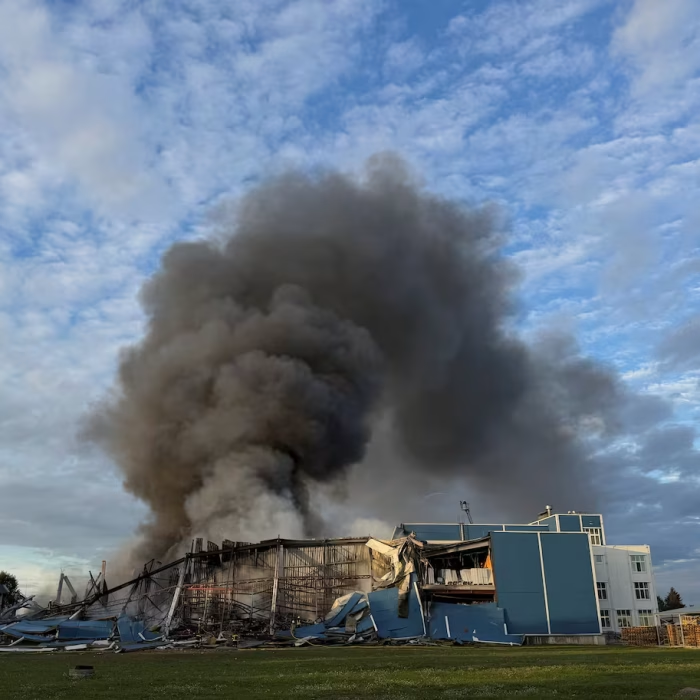
Security-related incidents at the Habshan complex on April 3 and April 8 affected operations there. The company said gas supply from Habshan has already recovered to 85 percent, running ahead of the year-end recovery target it announced in May.
Separately, disruption to maritime traffic through the Strait of Hormuz continued to restrict product liftings during the quarter. ADNOC Gas said inventory management and logistics measures helped limit the effect on customers.
Beating guidance while absorbing both is the more notable part of the result.
Guidance Going Forward
The company set third-quarter net income expectations at between $600 million and $800 million, a range that assumes maritime route disruptions persist.
Full-year 2026 net income is projected at between $3.5 billion and $4 billion, though that figure carries two conditions: maritime operations fully restored by the fourth quarter, and normalization of product pricing.
Those conditions are worth noting. Both depend on external circumstances outside the company’s control, which means the upper end of the range is contingent on a geopolitical situation resolving rather than on operational execution.
Returns to Shareholders
The board approved a quarterly dividend of $940 million, payable in September.
The company has committed to raising its annual dividend by 5 percent each year through 2030, a policy that sits alongside the $28 billion capital programme.
Balancing heavy capital expenditure with a rising dividend commitment is the central financial question for a business at this stage of expansion, and investors will watch how the two obligations coexist as project spending accelerates.
Where the Company Sits
ADNOC Gas processes and sells natural gas, natural gas liquids and related products.
It supplies roughly 60 percent of the UAE’s sales gas requirements domestically while serving customers across more than 20 countries.
That domestic share explains why the Habshan recovery timeline matters beyond the earnings statement. Disruption at a facility feeding a majority of a country’s gas needs is a national infrastructure issue as much as a corporate one.
I’m not a financial advisor, and this is a summary of the company’s reported results and stated guidance rather than a recommendation. Forward-looking figures depend on assumptions the company has disclosed, including the resolution of maritime disruption, and outcomes may differ.
Author
-
Lucienne Albrecht is Luxe Chronicle’s wealth and lifestyle editor, celebrated for her elegant perspective on finance, legacy, and global luxury culture. With a flair for blending sophistication with insight, she brings a distinctly feminine voice to the world of high society and wealth.