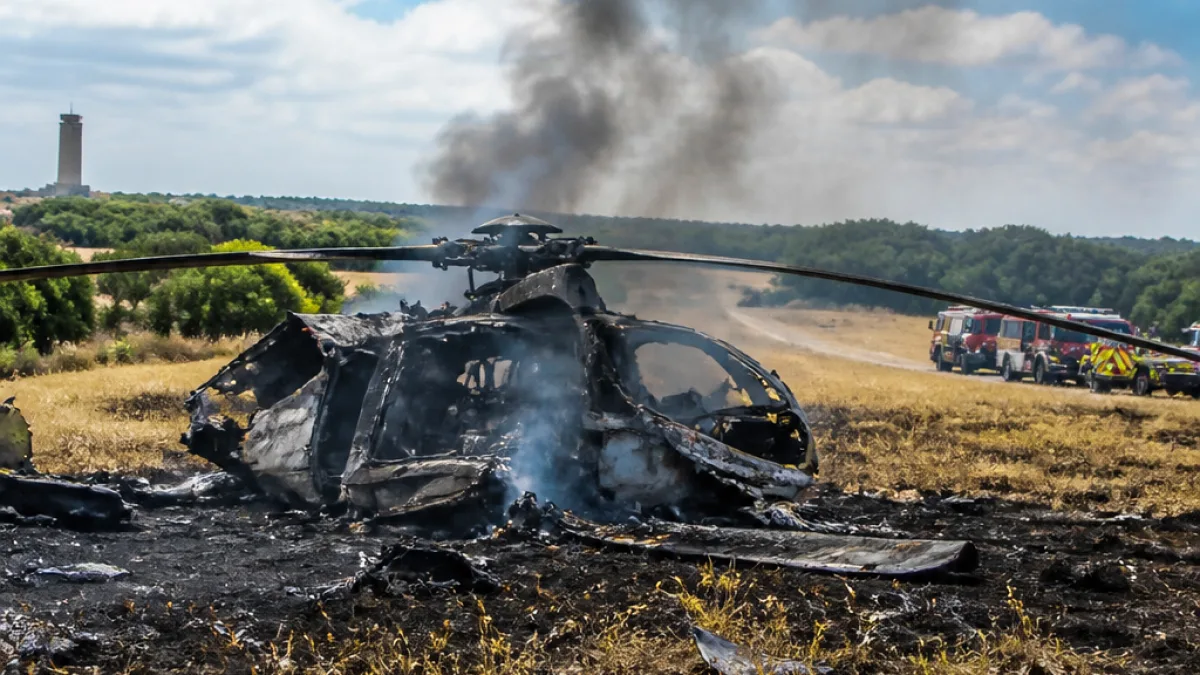
A military helicopter crash in central Texas has claimed the lives of two crew members, officials confirmed after emergency responders reached a burning wreck site in open farmland.
The aircraft was an AH-64 Apache attack helicopter operating out of Fort Hood, one of the largest US Army installations in the country. Both people aboard were pronounced dead at the scene.
How the Response Unfolded
The emergency call came in at roughly 1:33 p.m. local time, reporting downed wreckage in fields to the south of Salado, a small village in Bell County.
When deputies arrived, they encountered more than a crash site. A large fire had taken hold and was spreading rapidly. Cliff Coleman, a spokesman for the Bell County Sheriff’s Office, said the blaze was getting out of control very quickly.
Grass fires around crash sites are a serious complication in central Texas, particularly during dry stretches. Aviation fuel accelerates the burn, and open terrain gives flames room to run. Crews had to bring the fire under control before investigators could begin any meaningful work on the ground.
The Army’s Initial Response
The US Army confirmed that an investigation is underway alongside continuing emergency operations.
Brigadier General Ethan Diven, acting commanding general of the 1st Cavalry Division, said the immediate focus was on securing the site and supporting the first responders. He added that his thoughts were with the crew and their families while further information was awaited.
That sequencing is standard practice. Site security comes first, both to preserve evidence and to protect the public and responders from hazards including unburned fuel, ordnance, and structural debris.
Names of the two crew members had not been released at the time of the announcement. The military typically withholds identities until next of kin have been notified, a process that can take a day or more.
What the AH-64 Apache Does
The Apache is among the most recognizable aircraft in the US Army inventory.
According to the Army, it is a twin-engine attack helicopter with a four-blade rotor design, built for a wide range of combat roles. Those include armed reconnaissance, close combat support, mobile strike operations, and vertical maneuver missions.
Its crew configuration is fixed at two. The pilot sits in the rear cockpit, while the co-pilot gunner occupies the forward position. That layout explains why the loss of two service members corresponds to a full crew.
The aircraft has been in service for decades and has been progressively upgraded across multiple variants, remaining a core part of Army aviation.
Fort Hood’s Role
The installation near Killeen is one of the busiest Army posts in the United States and a major hub for armored and aviation units. The 1st Cavalry Division, headquartered there, maintains a substantial rotary-wing presence.
That means a high volume of flight activity across the surrounding region on any given week, including training sorties over rural areas of Bell County and neighboring counties. Salado lies a short distance from the installation’s operating areas.
What Investigators Will Examine
Military aviation accident investigations follow a structured process, and the findings usually take months rather than days.
Investigators will typically look at:
Maintenance records for the airframe, engines, and rotor systems, tracing recent inspections and any reported faults.
Flight data and cockpit recordings, where recoverable, to reconstruct the final minutes.
Weather conditions in the area at the time of flight, including wind, visibility, and turbulence.
Crew factors such as training currency, recent duty hours, and rest cycles.
Wreckage distribution across the site, which can indicate whether the aircraft broke up before impact or on contact with the ground.
Mission profile, meaning what the crew was doing and at what altitude when things went wrong.
Fire damage complicates several of these lines of inquiry, which is one reason the intensity of the blaze matters beyond the immediate response.
The Human Side
Behind the technical language of investigations are two families receiving the worst possible news, and a unit absorbing the loss of colleagues.
Aviation units tend to be tightly bonded. Crews train together intensively, and losses reverberate through squadrons and support staff alike. Chaplains, counselors, and casualty assistance officers are typically brought in immediately.
For residents of Salado, a quiet community more accustomed to hearing helicopters pass overhead than see them come down, the day brought something jarring and unwelcome.
The Broader Context
Military aviation carries inherent risk even outside combat. Training flights demand low-altitude maneuvering, night operations, and complex tactical profiles that push aircraft and crews.
The Army and other services have faced sustained scrutiny in recent years over rotary-wing accident rates, with attention focused on maintenance capacity, training hours, and operational tempo. Each new accident inevitably feeds into that larger conversation.
Whether this crash reflects a mechanical failure, an environmental factor, human error, or some combination will not be known until the formal report is completed.
What Happens Next
Investigators will continue working the site once it is fully secured and cooled. The Army will release the names of the crew members after family notifications.
A preliminary summary may emerge in the coming weeks, but the full accident report, including a determination of cause and any resulting safety recommendations, will take considerably longer.
For now, the confirmed facts remain narrow: an Apache from Fort Hood went down in fields near Salado shortly after midday, a serious fire followed, and two crew members lost their lives.
Author
-
Lucienne Albrecht is Luxe Chronicle’s wealth and lifestyle editor, celebrated for her elegant perspective on finance, legacy, and global luxury culture. With a flair for blending sophistication with insight, she brings a distinctly feminine voice to the world of high society and wealth.