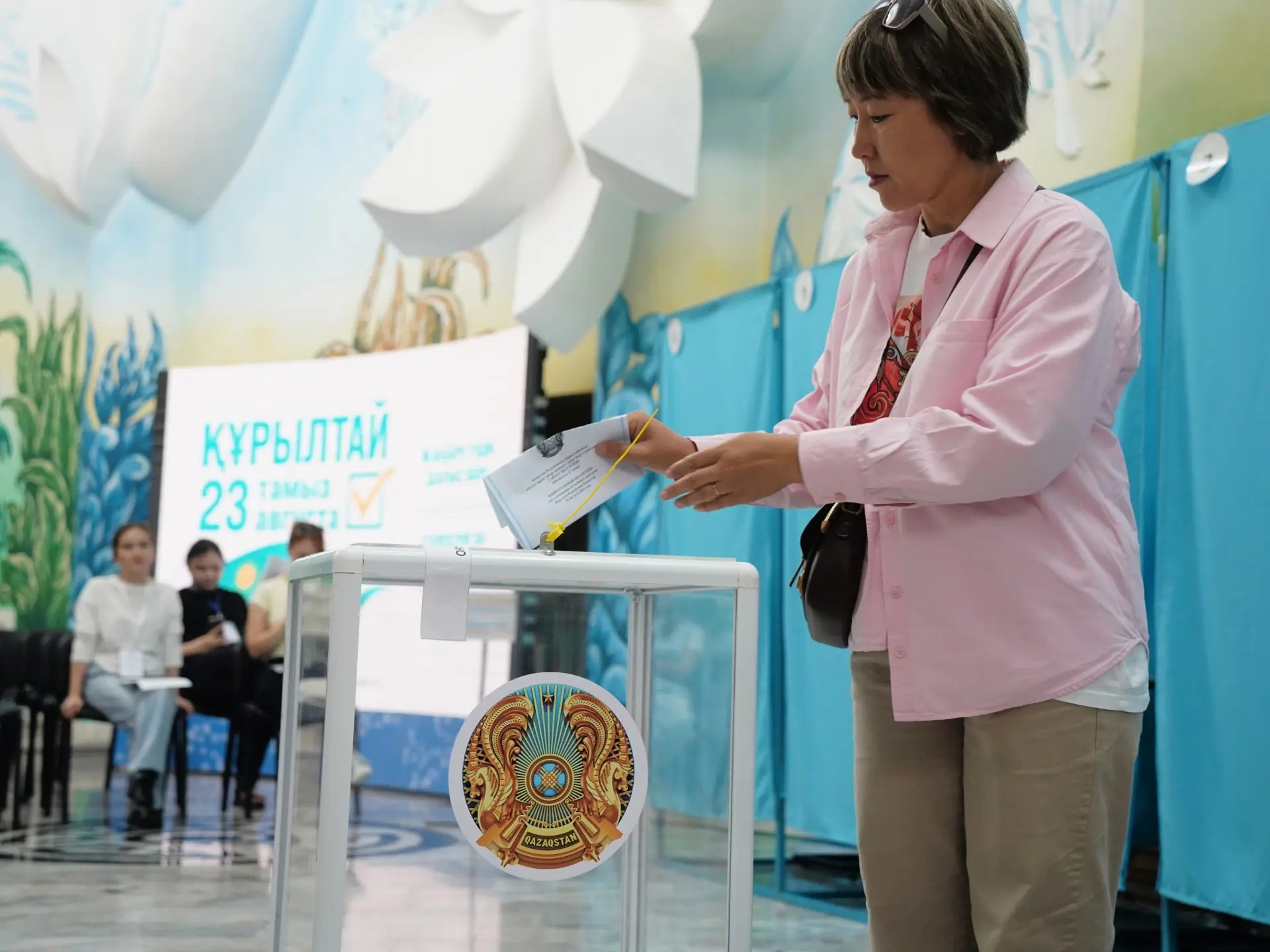
Kazakhstan Adilet party elections results are pointing toward a commanding new majority, with early exit polling showing the newly formed ruling party capturing more than 70% of the vote in Sunday’s parliamentary election.
The vote marked Kazakhstan’s first election held under its new constitution, which replaced the country’s former two-chamber parliament with a single legislative body known as the Kurultai.
A Dominant Showing for Adilet
Three separate exit polls placed Adilet’s support between 70.7% and 72.3%, projecting the party toward roughly 109 seats within the new 145-member Kurultai, a commanding majority by any measure.
Adilet was formally established in April, absorbing Amanat, the country’s largest political party, ahead of the election. Amanat itself had governed Kazakhstan for nearly three decades under various names, originally founded in 1999 as Nur Otan to support then-president Nursultan Nazarbayev’s electoral campaign.
Adilet emerged from that lineage as the country’s dominant political force, backing the new constitution and fielding the largest slate of candidates among all competing parties, 186 in total.
Party chair Aibek Dadebay thanked voters following the initial exit poll results, describing an extensive campaign that touched every region of the country. He said the party’s representatives met with thousands of people directly, gathering feedback that would inform the party’s future work, and emphasized that every opinion collected during the campaign mattered to the organization.
How the New Electoral System Works
Under the revised system, voters chose among seven registered political parties, a notable shift from the previous structure that also permitted independent candidates. All seats in the new Kurultai are now contested exclusively through party lists, meaning individual candidates without party backing were excluded from this election entirely.
Parties needed to clear a 5% threshold to secure seats in the new legislature.
Who Else Made the Cut
Exit polling from the Kazakhstan Institute of Public Development showed several smaller parties clearing that threshold. Auyl polled at 6.2%, Respublica at 5.2%, Ak Zhol at 5.1%, and the Nationwide Social Democratic Party at exactly 5%.
Projected seat totals based on those figures put Auyl at 12 seats, Respublica at 9, the Nationwide Social Democratic Party at 8, and Ak Zhol at 7.
Two parties fell short of representation. The People’s Party of Kazakhstan polled at 2.8%, while the Baitaq Green Party received just 0.9%, meaning neither is projected to hold seats in the new parliament.
A Closer Look at the Competing Parties
Each of the seven parties brought a distinct political identity to the race, collectively fielding 545 candidates.
Ak Zhol, founded in 2002, ran 63 candidates on a platform emphasizing political and economic reform, support for entrepreneurship and private business, and an expanded role for parliament.
Respublica, a considerably newer party established in January 2023, nominated 75 candidates and centered its platform on business development and economic growth.
The People’s Party of Kazakhstan fielded 72 candidates focused on social policy, worker protections and support for vulnerable populations.
Auyl, founded in 2000, nominated 69 candidates and occupies a distinct niche centered on agricultural policy.
The Baitaq Green Party, established in September 2022, ran 47 candidates on an environmental and green development platform.
The Nationwide Social Democratic Party, founded in 2006, nominated 33 candidates and had previously entered parliament for the first time in 2023.
Analyzing the Results
Indira Aubakirova, head of the Institute of Legislation and Legal Information, assessed the preliminary results as broadly predictable given Adilet’s extensive campaign presence across available platforms.
She expressed particular surprise at the weak showing from the People’s Party of Kazakhstan, attributing the roughly 3% result to generational shifts in the electorate. Younger voters entering political life, she suggested, no longer share the party’s traditional positions, while the party’s older support base has naturally declined in size over time.
Among the more competitive races, Aubakirova compared Ak Zhol’s longer institutional history, dating to 2002, against Respublica’s much shorter track record since its 2023 founding. Despite that gap in experience, she credited Respublica with positioning itself effectively and running a notably competent campaign.
A New Vice Presidency
Election day also brought significant political announcements from President Kassym-Jomart Tokayev, including confirmation that Kazakhstan will soon have its first vice president, a position introduced alongside the Kurultai under the new constitution.
When pressed by journalists at a polling station about the timing, Tokayev indicated an official announcement would follow within seven to ten days.
A New Advisory Body
Tokayev also announced plans to establish the Qazaqstan Khalyq Kenesi Secretariat, or Kazakhstan People’s Council, a body intended to build upon work previously carried out by the Assembly of the People of Kazakhstan.
He expressed confidence the new council would prove productive, tying its creation to an ambitious vision of nationwide construction. He described plans for major building projects across every regional center, district and city, including new polyclinics and children’s rehabilitation centers.
Specific to the capital, Tokayev mentioned upcoming projects including a new bridge, the Dombra Palace and a Water Resources Research Center, while emphasizing that improvement efforts would extend to cities nationwide.
Infrastructure Momentum Ahead of the Vote
Tokayev’s remarks arrived amid an active period of infrastructure development across the country. In the days immediately preceding the election, several notable projects opened.
An airport in Arkalyk reopened after more than 30 years, restoring regular air service to the city for the first time in decades. Pavlodar’s airport also underwent renovation.
In Kostanay, authorities conducted the technical launch of what officials describe as the country’s largest indoor water park, featuring seven pools with capacity for up to 500 visitors.
In the Almaty Region, a new multimodal logistics center opened, representing an investment of 28.1 billion tenge across more than 26.5 hectares. The facility can process up to 100,000 containers annually and includes rail infrastructure, a container terminal, warehousing and road logistics capacity.
Kazakhstan’s Broader Regional Ambitions
The parliamentary election takes place as Kazakhstan works to strengthen its position within Central Asia, an effort closely tied to its goals of expanding trade, attracting foreign investment and developing transport corridors connecting Asia and Europe, including the Middle Corridor route and various oil export pathways.
The Open Question of Tokayev’s Future
Among the most closely watched storylines on election day was Tokayev’s own political trajectory. Asked whether he intends to seek another presidential term, he declined to offer a firm answer, saying a more specific response would come later.
He confirmed that the Constitutional Court had issued a ruling establishing his legal right to seek reelection under current law, but stopped short of indicating whether or when he might exercise that option, calling it premature to speculate.
The question carries added significance because the new constitution altered the rules governing the presidency itself, opening a broader debate about the shape of Kazakhstan’s political future beyond this election cycle.
International Observation
The election drew significant international attention, with 777 observers monitoring the voting process. Among them was Caraman Angelica, chairperson of Moldova’s Central Election Commission, who highlighted the process’s modernization efforts.
She noted that polling stations incorporated digital features, including QR codes on voter invitations linking to detailed information on the Central Election Commission’s website. She also praised accessibility measures, noting that every polling station included a dedicated booth for voters with disabilities, equipped with tactile voting templates and audio instructions to help ensure independent and secret voting.
What Happens Next
Kazakhstan is presenting this election as a foundational moment in its transition to the new single-chamber legislative system. The newly elected Kurultai, comprising 145 deputies serving five-year terms, will now serve as the country’s central legislative body.
Final official results must be announced within seven days of voting, meaning confirmation is expected no later than the following Sunday.
Author