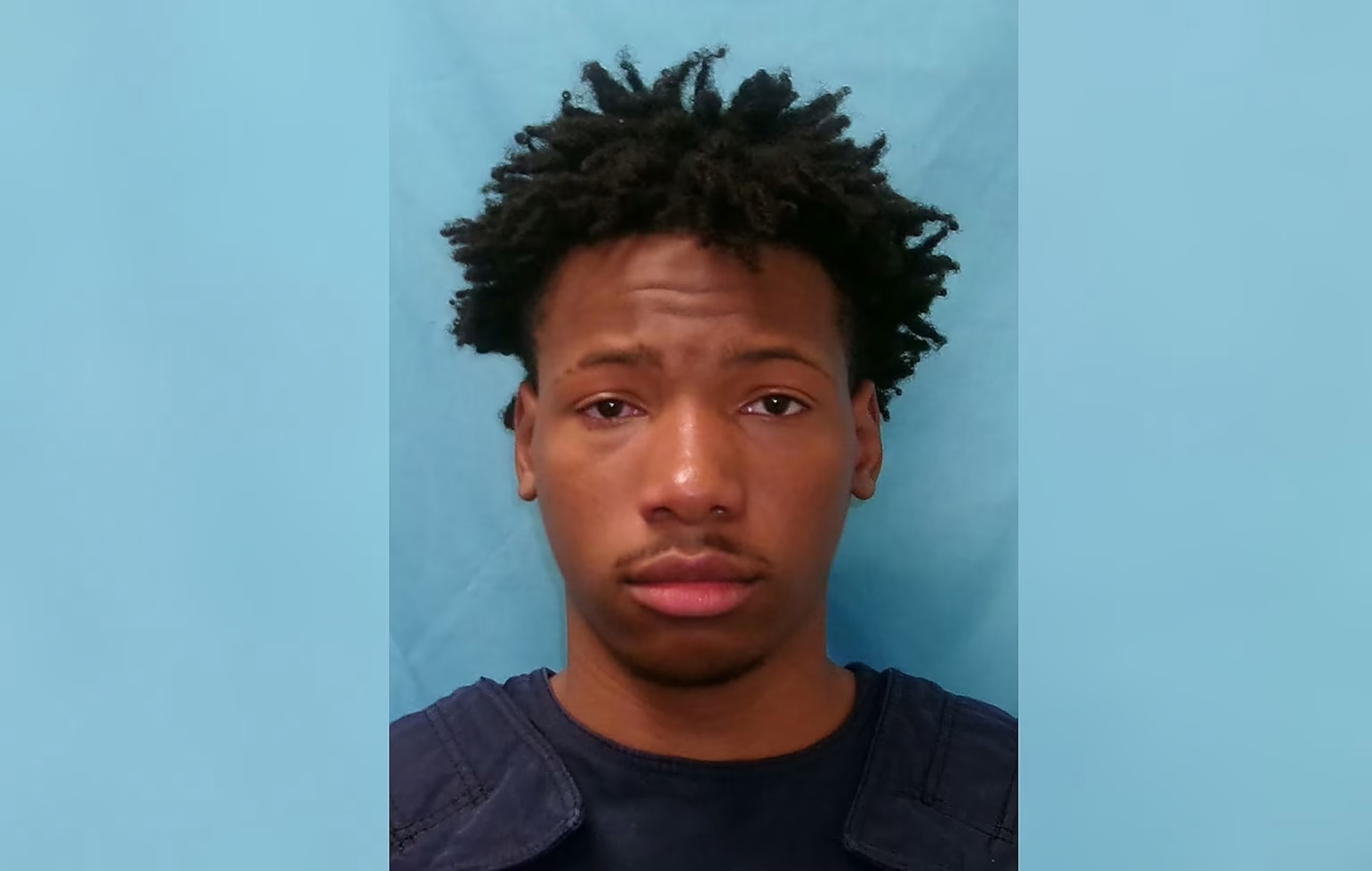
The Karmelo Anthony murder trial reached a pivotal moment on Friday when jurors finally laid eyes on the weapon at the center of the entire case — a small pocketknife that prosecutors say was used to fatally stab teenager Austin Metcalf. How the jury ultimately interprets that single piece of evidence may well determine the outcome of one of the most closely watched trials in the country.
The proceedings in McKinney brought the courtroom face to face with both the physical weapon and a series of emotionally charged accounts from young witnesses who watched the tragedy unfold.
A Knife on Display
Collin County Assistant District Attorney Bill Wirskye pulled on black gloves before presenting the knife to jurors. The weapon was a 3.5-inch black blade fitted with a textured silver handle — compact enough to rest in a palm and, notably, small enough to be legally carried on school grounds in Texas.
That legal detail looms large over the case. The central question facing the jury is whether Anthony, now 19, was justified in using the knife against the unarmed Metcalf, or whether the act crossed the line into murder.
What the Student Witnesses Saw
A string of student-athletes who witnessed the confrontation took the stand, and their testimony added vivid, unsettling detail to the events. Several recalled that Anthony had his hand inside a backpack moments before the altercation.
Crucially, they said they assumed he was bluffing and were stunned when he actually produced the knife. One 16-year-old student-athlete captured the disbelief plainly, testifying that no one brings a knife to a track meet. District Judge John Roach Jr. barred media outlets from identifying him or the other minors who testified.
The Origins of the Dispute
The case stems from a confrontation last year that has since drawn national attention, racially charged demonstrations, and a wave of online hostility. The trouble began when Metcalf and others told Anthony to leave their team’s tent during a rain-delayed high school track meet in Frisco.
The two sides offer sharply different interpretations of what happened next:
- The defense argues Anthony acted in self-defense, making a split-second choice when confronted by teenagers who were taller and larger than he was.
- The prosecution contends Anthony deliberately baited Metcalf into the altercation, using it as a pretext to deploy the knife.
A Difficult Day in Court
Before the witness testimony, jurors viewed body-worn camera footage from a responding officer, capturing the grim aftermath of the stabbing. The video showed paramedics working on Metcalf as he lay motionless at the base of the metal stands.
The footage proved so distressing that the judge called a prolonged break afterward, explaining that it had made one juror feel sick.
Reenacting the Fatal Moment
Testimony then moved closer to the heart of the confrontation beneath the Frisco Memorial High School tent. In a dramatic courtroom demonstration, defense attorney Toby Shook sat in a chair to let the 16-year-old witness physically reenact the stabbing.
Standing over Shook — who portrayed Anthony — the student placed a hand on Shook’s right shoulder. At that instant, Shook rose from the chair while acting out a stabbing motion toward the student’s upper chest.
The student explained that because Metcalf had moved forward to shove Anthony, he was leaning into Anthony at the moment of the stabbing and fell backward immediately afterward. Another student described how Metcalf tumbled down the bleachers, landing on his back, then briefly stood up and lifted his shirt to discover his chest covered in blood.
Differing Accounts, Same Conclusion
While each student recalled slightly different details about the lead-up to the stabbing, their ultimate judgments aligned. Their varied recollections included:
- Jalen Matthews, an 18-year-old recent graduate, described Anthony as “half in, half out” of the tent, noting the awning didn’t fully shield him from the rain. He characterized the interaction as tense, with both teens seeming more frustrated than angry, and said no one expected violence.
- A 17-year-old student testified that Anthony was positioned directly behind the tent rather than under it, and that several people told him to leave more than a dozen times. When defense attorney Shook asked what the problem was if Anthony wasn’t even under the tent, the student replied simply, “relative area.”
- The 16-year-old clarified that Metcalf used only one hand, not two, to shove Anthony in the seconds before the stabbing.
Despite their differences, each student was asked whether Anthony had provoked Metcalf. They uniformly identified Anthony as the aggressor and said they did not believe the stabbing was an act of self-defense.
The Officer’s Account
Eduardo Cortez, a school resource officer at Frisco ISD’s Staley Middle School, testified that he rushed to the stadium after hearing a radio call about a stabbing. He located Anthony and placed him in handcuffs.
Under the prosecution’s questioning, Cortez said Anthony made no attempt to flee. The defense seized on the teen’s cooperative demeanor during cross-examination. Lead defense attorney Mike Howard pointed out that Anthony could have refused to give his name or supplied a false one, and Cortez agreed the teenager had been cooperative throughout.
The Legal Nuance Around the Weapon
Wirskye presented a replica of the knife to the jury while questioning Frisco police officer Jacob Shalz, who had secured the scene and collected evidence. During cross-examination, Howard drew out an important legal distinction, asking whether the officer understood that a knife under 5.5 inches might violate school policy without being a crime. Shalz confirmed that was correct.
Texas law does not prohibit every knife from school campuses or school-sponsored events. Criminal charges apply only to what the law defines as “location-restricted knives” — those with blades longer than 5.5 inches.
Why the Weapon Matters Beyond Legality
Eric Ruben, a Southern Methodist University law professor who studies weapons regulations and self-defense law, offered context on why the knife’s legality is only part of the equation. He explained that whether a weapon is lawful is often a separate question from whether its use was justified.
In self-defense cases, Ruben noted, the mere presence of a weapon can raise pointed questions about why the defendant was carrying it and whether they were seeking a confrontation. He said it speaks to reasonableness and state of mind — factors that become critically important when a jury must decide whether the defendant’s perception of a threat was reasonable and whether their response was both necessary and proportionate.
What Comes Next
With conflicting testimony, emotional evidence, and a tangle of legal nuance now before them, the jurors face the weighty task of determining intent and justification. The trial is set to resume at 9 a.m. Saturday, as both sides continue building toward a verdict in a case that has captivated and divided observers far beyond the courtroom.
Author