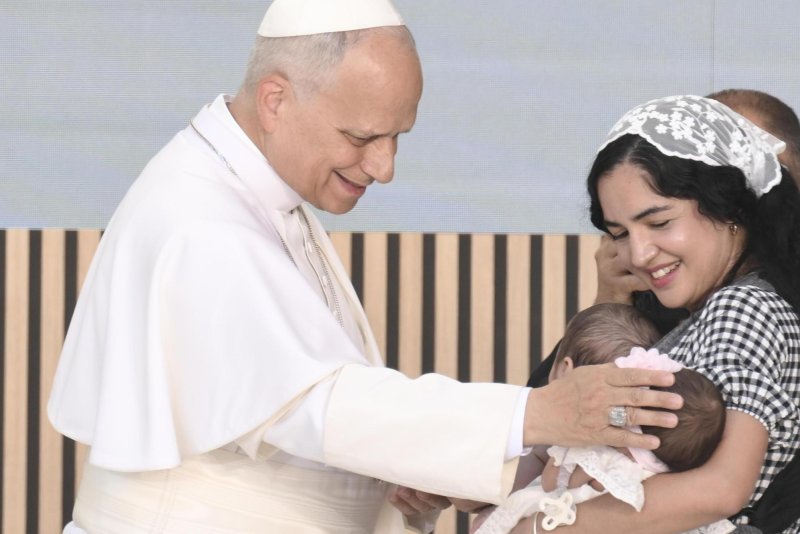
The Pope Leo Spain visit has arrived at a moment of striking political tension, marking the first papal trip to the country in 15 years and landing in the middle of a dramatic realignment between the Catholic Church and politics. As Pope Leo XIV touched down in Spain on Saturday, he stepped into a landscape where conservatives — once the church’s staunchest allies — have increasingly turned against it, while the left embraces the faith more warmly than ever.
At the heart of this shift lies one explosive issue: the church’s vocal advocacy for migrants and asylum seekers.
A Historic Reversal in Spanish Politics
To understand the controversy, it helps to look at how dramatically the relationship between the church and Spanish politics has flipped.
During the era of Franco, the fascist dictator known as El Generalísimo, the Spanish Catholic Church backed National Catholicism — a fusion of faith and right-wing politics that spread across Europe and the United States. When the left returned to power in 1982, bishops marched in anti-government protests, opposing the lifting of an abortion ban and the legalization of same-sex marriage.
That alignment has now reversed. The shift initiated by Pope Francis — away from moral judgment and toward tolerance, including sympathy for migrants — created a new dynamic. Today, it’s conservatives who criticize the church, while leftists appear more willing than ever to embrace it.
A Papacy Built on Unity and Polarization
This realignment poses a real challenge for Leo, who has made easing political polarization a central goal of his papacy.
The first U.S.-born pope is expected to address polarization directly in a highly anticipated speech to Spain’s gridlocked parliament on Monday — a message some are framing as a keynote address to the entire Western world. Throughout the seven-day visit, Leo plans to acknowledge different parts of the church, holding a prayer vigil with young people and joining a traditional street procession long cherished by Spanish traditionalists.
But his unifying goals may prove difficult to achieve in a country now serving as a microcosm of the broader Western struggle over migration and other divisive issues.
Migration: The Centerpiece of the Visit
The defining issue of Leo’s trip is the church’s role as both a lifeline and a political advocate for undocumented migrants and asylum seekers.
The timing is especially charged. European governments have been adopting tougher migration rules in response to growing public exhaustion, making the church’s pro-migrant stance all the more contentious.
Leo’s itinerary underscores how central this theme is:
- A Thursday visit to Spain’s Canary Islands, a major landing point for migrants arriving by sea from the African coast and a hub for Latin American migrants
- A floral offering to the sea honoring those who drowned attempting to reach Europe
- A planned gathering with 700 migrants during his time on the islands
The waters around the Canary Islands have become a graveyard for those who lost their lives seeking a new start in Europe. The visit also sets the stage for Leo’s landmark July 4 trip to the Italian island of Lampedusa, another powerful symbol in Europe’s migration debate — cementing migrant welfare as a hallmark of his papacy, much as it was for Francis.
Competing With Bad Bunny
In a moment of levity, Leo acknowledged that he wouldn’t be the only major draw in Madrid.
Upon landing, he noted he’d be competing for attention with Bad Bunny, the world’s most-streamed artist, who was performing in the Spanish capital on Saturday night. With characteristic humor, Leo predicted that if young people had to choose between seeing the music star and seeing the pope, many would pick Bad Bunny — but he added that some would still come to see him, and that itself said something.
He also pointed to a deeper trend, observing that growing numbers of young people are searching for spiritual meaning. They sense an emptiness, he suggested, and a lack of purpose that draws them toward the church.
The Left Embraces the Pope
In a twist of history, Spain’s political left is now celebrating a faith it once accused of complicity in the abuses of the Franco regime.
Spanish Prime Minister Pedro Sánchez, of the center-left Socialist Party, flew to Rome ahead of the visit to meet with Leo and has begun quoting the new pontiff, including his recent warnings about artificial intelligence.
Deputy Prime Minister Yolanda Díaz described how the left’s alignment with the church has deepened. She noted that the alignment with Pope Francis was immediate, pointing to his defense of Spain’s labor reform — support echoed by the Episcopal Conference in a way that would have been unthinkable two decades ago. With Leo XIV, she said, that alignment has only grown stronger.
Why Conservatives Are Furious
The flip side of the left’s embrace is a mounting conservative backlash, and migration sits at its core.
Tensions sharpened after the Spanish Catholic Church became the most powerful backer of Sánchez’s January plan to legalize hundreds of thousands of undocumented migrants. Bishops voiced support, Catholic volunteers were mobilized, and churches even posted sign-up lists to gather names backing legalization.
Conservatives have bristled at other church positions too, including its opposition to:
- Efforts to prioritize Spanish citizens for government benefits
- A measure aimed at restricting Muslim worship
Santiago Abascal, leader of the far-right Vox party, has accused the church of staying silent on the Socialist government’s liberal policies, including one of the world’s most inclusive transgender rights laws. Echoing criticism made by U.S. Vice President JD Vance against American bishops, Abascal has suggested the church’s pro-migrant stance is driven by financial gain, given the grants and payments it receives for migrant work. In a pointed April message aimed at the bishop of the Canary Islands, he urged those who profit from illegal immigration to leave their palaces and witness the consequences for Spanish health care, security, wages, and taxes.
The Valley of Cuelgamuros Dispute
Conservative anger is also tied to a controversial site steeped in Spain’s painful history.
A deal between the church and the center-left government would transform the Valley of Cuelgamuros, a Civil War memorial near a major papal basilica northwest of Madrid where Franco was once buried before his remains were exhumed in 2019. The plan aims to make the site more respectful to the victims of his regime.
Critics see the agreement as evidence of a church too willing to bend to a scandal-plagued Socialist government. Former center-right lawmaker Marcos de Quinto went so far as to call on Spaniards to stop contributing to a church he portrayed as increasingly political, accusing its leaders of cowardly supporting a corrupt government.
A Church That Defies Simple Labels
Despite the heated rhetoric, the reality of the Spanish church is more complex than either side suggests.
The Catholic Church avoids political labels, and in Spain it is led by a mix of senior clerics spanning the ideological spectrum — conservatives, liberals, and others. As a whole, it is not as outwardly progressive as its counterpart in Germany, where some senior figures have been reprimanded by the Vatican for backing same-sex blessing ceremonies.
Still, several senior Spanish positions have recently been filled by bishops elevated by Francis who share his priorities. In a nation that birthed deeply conservative Catholic movements like Opus Dei, the church’s wholehearted embrace of migrant rights has unsettled traditional quarters.
Archbishop Luis Argüello, head of the Spanish bishops’ conference, captured the nuance, noting that while the church may appear aligned with the left on migration, it diverges sharply on issues like abortion, euthanasia, and the right to life.
How Leo Differs From Francis
A closer look at Leo’s statements reveals a more nuanced approach to migration than his predecessor.
Leo frequently prefaces his defense of migrants by affirming that countries have the right to control their borders, and he calls for investment in impoverished nations to reduce the pressures driving migration. At the same time, he emphasizes the Christian duty to welcome the stranger and to safeguard migrant rights — even describing the Trump administration’s immigration crackdown as “inhuman.”
That balance reflects his broader effort to bridge divides rather than deepen them.
Voices From the Front Lines
On the ground in the Canary Islands, bishops have directly challenged far-right framing of migration as an invasion.
Bishop José Mazuelos Pérez, who heads a diocese providing shelter, food, and medical care to arriving migrants, argued that Spain cannot keep treating migrants as invaders. Describing those who arrive after days crowded at sea without food, he insisted the only humane response is to welcome and help them rather than turn them away.
Not everyone agrees. Vox politician Alberto Rodríguez Almeida said the church had adopted an immigration vision he doesn’t share, voicing particular opposition to welcoming those who don’t share Spain’s language and religion. He maintained that Vox wasn’t seeking confrontation with the church, but said the party responds when bishops insult its voters or leaders.
A Transatlantic Pattern
The Spanish drama mirrors a larger conflict playing out across the Atlantic.
As President Donald Trump feuds with Leo and prominent American cardinals clash with the MAGA movement, Spain’s arch-conservatives are waging their own battle against a church they once considered a natural ally. As Mazuelos Pérez put it, the far right in Spain wants to copy the far right in the United States — going to war with the bishops over migration.
Why This Matters
The Pope Leo Spain visit is far more than a ceremonial trip. It places the pope at the center of a defining struggle over migration, faith, and political identity in the Western world.
Leo’s challenge is immense. He hopes to ease polarization, yet his church’s stance on migrants has itself become a lightning rod. With hard-line critics accusing the church of drifting leftward and the political left embracing it more enthusiastically than ever, Spain has become a vivid microcosm of the tensions dividing much of the West.
What Comes Next
As the visit unfolds, attention will focus on Leo’s parliamentary address and how he navigates the competing pressures surrounding him. His ability to speak to both traditionalists and reformers — while holding firm on migrant advocacy — will test the unifying vision at the heart of his papacy.
For now, the Pope Leo Spain visit stands as a powerful snapshot of a church caught between old alliances and new ones, in a country where the politics of faith and migration have rarely felt more charged.
Author